
Brief Summary
This video provides a foundational understanding of electrical circuits, covering series circuits, parallel circuits, and combinations of both. It explains how voltage and current behave in each type of circuit, offering formulas and rules to calculate voltage and current values.
- Series circuits have one path for electricity, current remains constant, and voltage is distributed across resistors.
- Parallel circuits offer multiple paths, voltage is the same across each path, and current divides among the paths.
- Combined circuits require applying principles of both series and parallel circuits to analyze voltage and current.
Intro
The lesson will cover series circuits, parallel circuits, and circuits combining both. The goal is to understand how to determine current and voltage values in these circuits.
Series Circuits
In a series circuit, electricity flows from the positive terminal of the battery, through devices like ammeters and resistors, and back to the negative terminal, following only one path. The battery supplies voltage to the charges, which then use this voltage to move through the resistors. The sum of the voltage drops across each resistor equals the voltage supplied by the battery.
Voltage in Series Circuits
The voltage supplied by the battery is equal to the sum of the voltages across all components in series, plus any parallel branches. In a series circuit, the current remains constant throughout the circuit. For example, if the total current is 5 amps, each ammeter in the series circuit will also read 5 amps.
Summary of Series Circuits
In series circuits, the voltage of the battery (V) is the sum of all voltages in series (V1 + V2 + V3), and the current remains constant throughout the circuit (A1 = A2 = A3 = A4 = A5). The key takeaways for series circuits are that current remains constant and the battery voltage equals the sum of voltages in series.
Parallel Circuits
In a parallel circuit, the current splits into multiple paths. The voltage across each parallel path is the same. However, if a parallel branch contains multiple resistors in series, the total voltage of that branch is the sum of the voltages across each resistor in that branch.
Voltage and Resistors in Parallel Circuits
In a parallel circuit, the voltage of each pathway is the same. If one pathway has multiple resistors, the total voltage of that pathway is the sum of the voltages across each resistor. This total voltage is the same for all parallel pathways.
Examples of Voltage in Parallel Circuits
If there are two resistors in series in one branch with voltages of 2 volts and 7 volts, the total voltage for that branch is 9 volts. Therefore, any parallel branch must also have a total voltage of 9 volts. If a parallel branch has one resistor, that resistor must have a voltage of 9 volts.
Current and Voltages in Parallel Circuits
In a parallel circuit, the voltage across each parallel path is the same (V1 = V2 = V3). A voltmeter measuring across the entire parallel section will also read the same voltage (V4). Ammeters in the main circuit (A1 and A4) are in series and will have the same current reading.
Current Division in Parallel Circuits
The current in parallel branches does not have to be the same, but the sum of the currents in each parallel branch equals the total current in the main circuit. For example, if the total current is 5 amps, and one branch has 2 amps, the other branch must have 3 amps.
Parallel Circuit Example
Given a parallel circuit with a total current of 5 amps, if one branch has a current of 2 amps and a 4-volt resistor, and another branch has a 1-volt resistor, the current in the second branch is 3 amps. The voltage across the second resistor in the second branch must be 3 volts to match the 4-volt potential of the parallel branch.
Rules for Parallel Circuits
The sum of parallel currents (A2 + A3) is equal to the current in the main circuit (A1). Also, A1 and A4 are the same because they are in series. The battery voltage is equal to any one of the parallel branches' voltage, not the sum of all parallel voltages.
Battery Voltage in Parallel Circuits
The battery voltage is equal to the sum of all voltages in series plus one of the parallel branches. You only choose one of the parallel branches, not all of them.
Applying Rules to Parallel Circuits
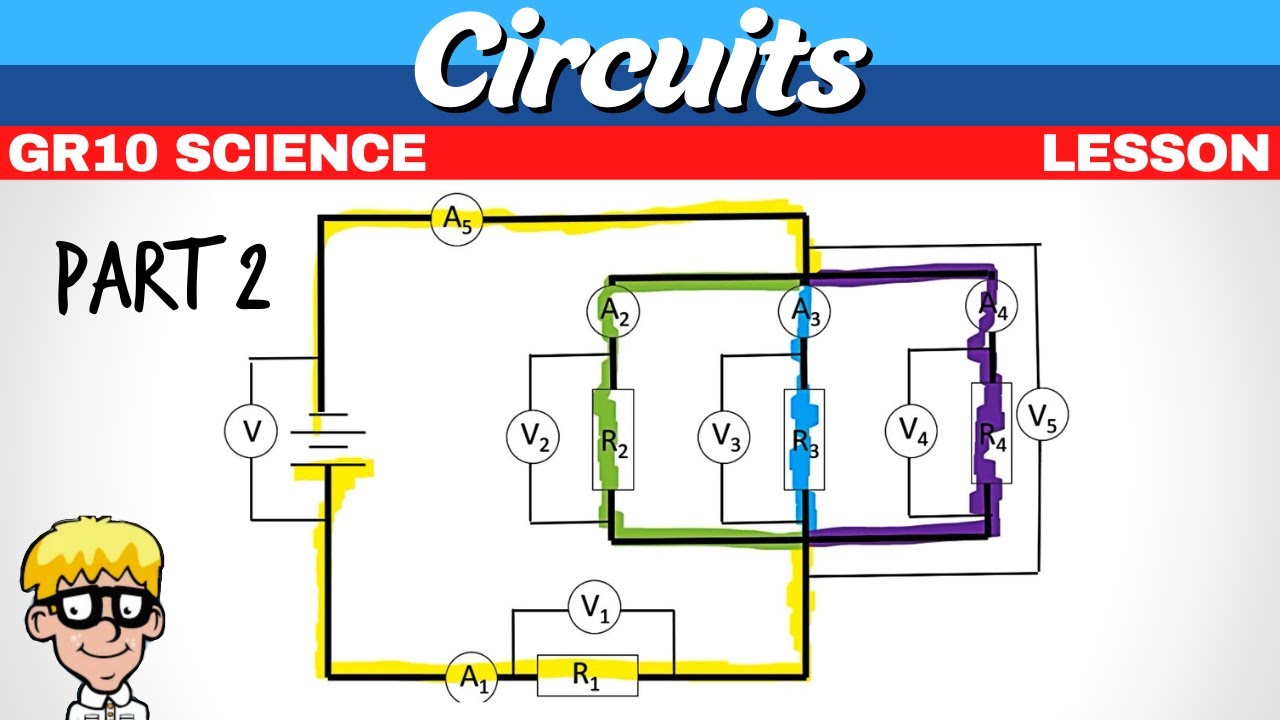
In parallel, the voltage of each pathway is the same. If there are 12 amps of current (A1), 4 amps go one way, and 6 amps go another way, then 2 amps go the remaining way. The sum of currents in parallel is equal to the current in the main circuit (A1 = A2 + A3 + A4).
Combined Circuits
In a combined circuit, electricity flows through series and parallel components. In series, current remains constant (A1 = A5). In parallel, the voltage of each pathway is the same (V2 = V3 = V4 = V5). The sum of currents in parallel is equal to the current in the main circuit (A1 = A2 + A3 + A4). The battery voltage is the sum of all voltages in series plus one of the parallel voltages.

