
Brief Summary
This video provides a review of arithmetic and geometric sequences, covering recursive definitions, common differences and ratios, and formulas for finding the nth term of each type of sequence. It includes examples and practice problems to reinforce understanding.
- Arithmetic sequences involve adding a constant difference to each term.
- Geometric sequences involve multiplying each term by a constant ratio.
- Formulas are provided for calculating the nth term of both arithmetic and geometric sequences.
Arithmetic Sequences: Recursive Definition and Common Difference
An arithmetic sequence is defined recursively by its first term, F(1), and the rule that each subsequent term is the sum of the previous term and a constant number, known as the common difference (D). This can be expressed as F(n) = F(n-1) + D. The common difference can be found by subtracting any two consecutive terms in the sequence. For example, in the sequence 3, 8, 13, 18, 23, the common difference is 5, as 8 - 3 = 5, 13 - 8 = 5, and so on.
Generating Terms in Arithmetic Sequences
To generate the next three terms of an arithmetic sequence, one must identify the common difference and apply it to the last known term. For instance, given the sequence defined by F(n) = F(n-1) + 6 with F(1) = 2, the next three terms are found by repeatedly adding 6: F(2) = 8, F(3) = 14, and F(4) = 20. Similarly, with subscripts, if each term is calculated by taking the previous term and adding 1/2, starting with A1 = 3/2, the subsequent terms are A2 = 2, A3 = 2.5, and A4 = 3. The common difference can be positive or negative, determining whether the sequence increases or decreases.
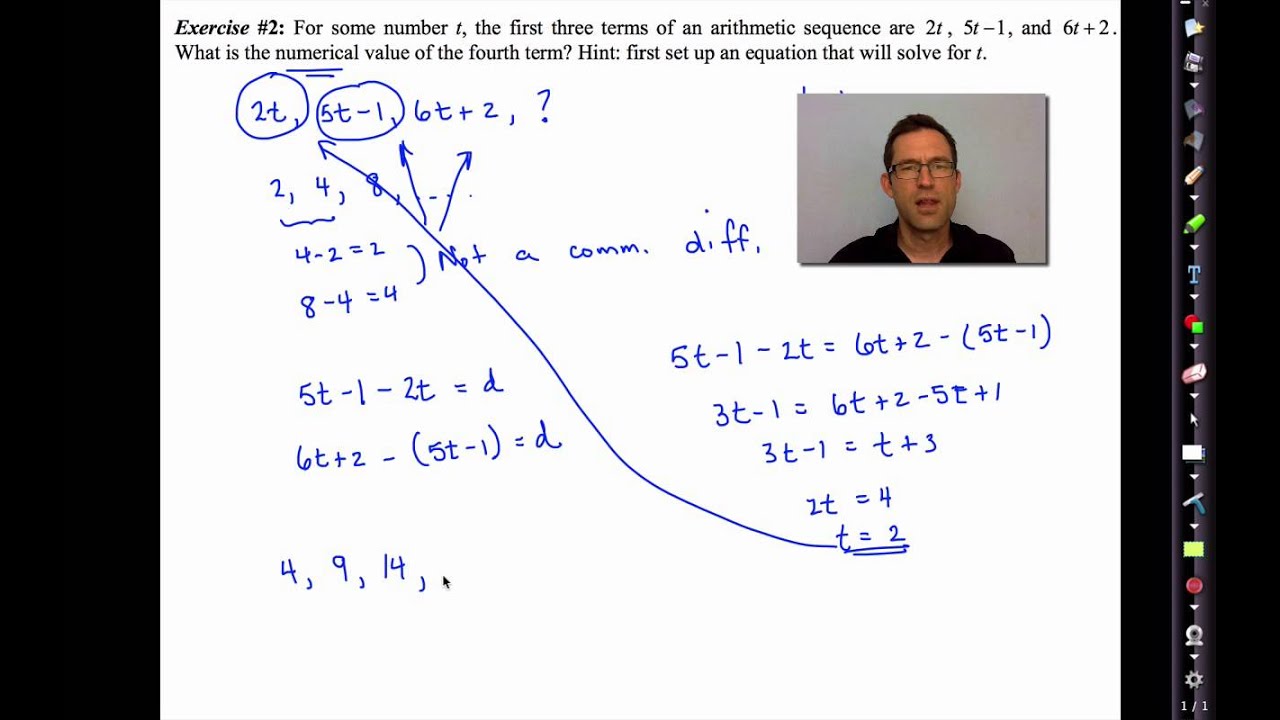
Finding Terms in Arithmetic Sequences with Algebraic Expressions
Given that 2T, 5T-1, and 6T+2 form an arithmetic sequence, the goal is to find the numerical value of the fourth term. To solve this, the common difference between consecutive terms must be equal. Therefore, (5T-1) - 2T = (6T+2) - (5T-1). Simplifying and solving for T yields T = 4. Substituting T = 2 into the expressions gives the first three terms as 4, 9, and 14. Since the common difference is 5, the fourth term is 19.
Determining the nth Term of an Arithmetic Sequence
Given the recursive definition A(n) = A(n-1) + 3 and A(1) = 5, the values of A2, A3, and A4 are determined by repeatedly adding 3 to the previous term, resulting in A2 = 8, A3 = 11, and A4 = 14. To produce A4, the number 3 was added three times to the initial value of 5. To find the value of A50, the number 3 must be added 49 times to the initial value. Therefore, A50 = 5 + 49 * 3 = 152. The general formula for the nth term of an arithmetic sequence is A(n) = A(1) + (n-1) * D, where A(1) is the first term, n is the term number, and D is the common difference.
Applying the Arithmetic Sequence Formula
Given that A1 = 6 and A4 = 18 are members of an arithmetic sequence, the objective is to determine the value of A20. To find the common difference (D), recognize that from the first term to the fourth term, the common difference is added three times. Thus, 3D = A4 - A1, which means 3D = 18 - 6 = 12, so D = 4. Using the formula A(n) = A1 + (n-1) * D, A20 = 6 + (20-1) * 4 = 6 + 19 * 4 = 82.
Geometric Sequences: Recursive Definition and Common Ratio
A geometric sequence is defined recursively by its first term and a common ratio (R), where each term is the product of the previous term and R. The formula is F(n) = F(n-1) * R. The common ratio can be found by dividing any term by its preceding term. For example, in the sequence 2, 6, 18, 54, the common ratio is 3, as 6/2 = 3, 18/6 = 3, and 54/18 = 3.
Generating Terms in Geometric Sequences
To generate the next three terms of a geometric sequence, multiply the last term by the common ratio. Given the sequence defined by A1 = 4 and a common ratio of 2, the next three terms are A2 = 4 * 2 = 8, A3 = 8 * 2 = 16, and A4 = 16 * 2 = 32. If the common ratio is less than one, the terms decrease. For example, with a common ratio of 1/3 and F(1) = 9, the next terms are F(2) = 3, F(3) = 1, and F(4) = 1/3. With square roots, if each term is produced by multiplying the previous term by √2 and T1 = 3√2, the subsequent terms are T2 = 6, T3 = 6√2, and T4 = 12.
Determining the nth Term of a Geometric Sequence
Given A1 = 2 and A(n) = A(n-1) * 3, the value of A4 can be found by repeatedly multiplying by 3: A2 = 2 * 3 = 6, A3 = 6 * 3 = 18, and A4 = 18 * 3 = 54. To find A4, the initial term 2 was multiplied by 3 three times. Therefore, A10 = 2 * 3^9 = 39,366. The general formula for the nth term of a geometric sequence is A(n) = A(1) * R^(n-1), where A(1) is the first term, R is the common ratio, and n is the term number.
Summary of Arithmetic and Geometric Sequences
Arithmetic sequences are defined by a common difference, where subtracting any two consecutive terms yields the same number. Geometric sequences are defined by a common ratio, where multiplying by the same number produces each term. The formulas for finding the nth term in both types of sequences are essential for future lessons.

