
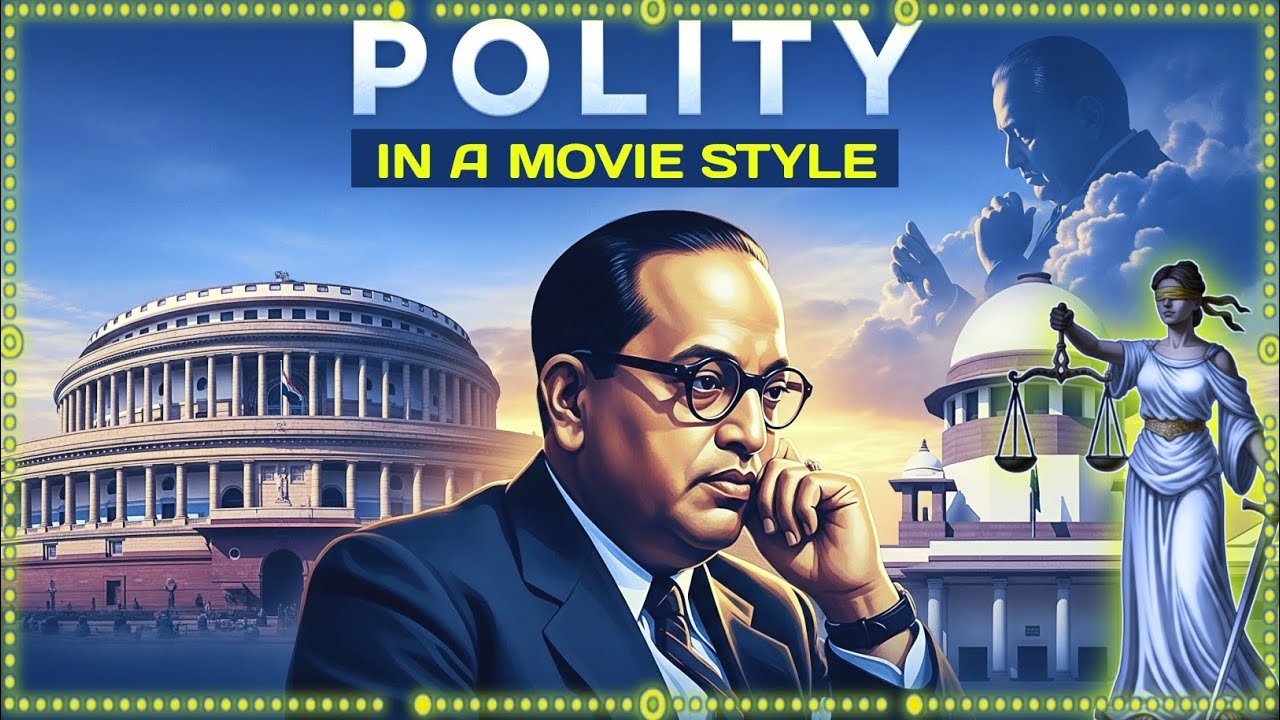
Brief Summary
This comprehensive overview of the Indian Constitution covers its historical origins, key features, and various components. It explains the making of the Constitution, its structure, fundamental rights, directive principles, fundamental duties, and the roles of various constitutional and non-constitutional bodies.
- The Constitution's journey from its inception to its adoption.
- Key features such as fundamental rights, directive principles, and emergency provisions.
- The roles and functions of constitutional bodies like the Election Commission, Finance Commission, and CAG, as well as non-constitutional bodies like the CBI and NITI Aayog.
Making + Committee + Preamble
The Indian Constitution's origins can be traced to the 1928 Nehru Report, with M.N. Roy proposing the idea of a Constituent Assembly in 1934, which the Congress adopted as an official demand in 1935. The British accepted this in principle through the 1940 August Offer, and the assembly was formed under the 1946 Cabinet Mission Plan. The first meeting occurred on December 9, 1946, with Dr. Sachchidanand Sinha as the temporary chairman, followed by Dr. Rajendra Prasad as the permanent chairman on December 11, 1946. H.C. Mukherjee became the vice-chairman, and B.N. Rau served as the constitutional advisor. Initially, there were 389 members, which reduced to 299 after partition. The constitution-making process took 2 years, 11 months, and 18 days, involving 11 sessions and 165 days of meetings, with 141 days spent discussing the draft constitution alone, costing approximately ₹64 lakhs. Adopted on November 26, 1949, celebrated as Constitution Day, it was implemented on January 26, 1950, to honor the 1930 decision to celebrate complete independence on that day. Various committees, including the Drafting Committee led by Dr. Ambedkar, played crucial roles, with Jawaharlal Nehru heading the Union Constitution Committee and the Union Power Committee, and Sardar Patel leading the Provincial Constitution Committee and the Advisory Committee on Fundamental Rights and Minorities. The original handwritten constitution, penned by Prem Behari Narain Raizada in italic style, was decorated by artists from Shantiniketan, including Nandlal Bose, and exists in both English and Hindi. The constitution includes Union, State, and Concurrent Lists, delineating the powers of the central and state governments.
Part 1 & 2
Part 1 of the Indian Constitution defines India as a "Union of States," emphasizing its integrity by preventing states from seceding due to the absence of any agreement. Articles 2 and 3 grant Parliament the power to admit new states and alter existing state boundaries, areas, and names, without requiring state consent, showcasing the flexibility of India's federal structure. Article 4 clarifies that changes under Articles 2 and 3 do not require constitutional amendments, allowing simple majority legislation. Part 2 addresses citizenship, particularly concerning the complexities arising from the partition. Article 5 defines citizenship at the commencement of the Constitution on January 26, 1950, granting it to individuals domiciled in India who were born there, had parents born there, or had resided there for at least five years before the Constitution's commencement. Article 6 addresses the citizenship of those who migrated from Pakistan, setting July 19, 1948, as the key date for the permit system. Those who migrated before this date were granted citizenship if they had been ordinarily residing in India, while those who migrated after had to register after six months of residency. Article 7 denies citizenship to those who migrated to Pakistan after March 1, 1947, unless they returned with a resettlement permit, in which case Article 6 could apply. Article 8 pertains to persons of Indian origin residing abroad, allowing them to register as Indian citizens through Indian diplomatic representatives. Article 9 emphasizes single citizenship, terminating Indian citizenship for those voluntarily acquiring another country's citizenship. Articles 10 and 11 empower Parliament to regulate citizenship, leading to the enactment of the Citizenship Act of 1955, which has been amended over time.
Part 3
Part 3 of the Indian Constitution, spanning Articles 12 to 35, enshrines fundamental rights, considered the backbone of Indian democracy, applicable to citizens and, to some extent, all persons residing in India. Article 32 guarantees the right to constitutional remedies, allowing direct access to the Supreme Court for enforcement. Article 12 defines the "State" as including the central government, Parliament, state governments, legislatures, and local authorities, as well as entities under government control. Article 13 acts as a safeguard, declaring any law inconsistent with fundamental rights as void to the extent of the inconsistency. Articles 14 to 18 cover the right to equality, with Article 14 ensuring equality before the law and equal protection of the laws. Article 15 prohibits discrimination on grounds of religion, race, caste, sex, or place of birth, with exceptions for women, children, and socially and educationally backward classes. Article 16 guarantees equality of opportunity in public employment, including provisions for reservation. Article 17 abolishes untouchability, declaring it an offense, while Article 18 abolishes titles, except military and academic distinctions. Articles 19 to 22 address the right to freedom, with Article 19 outlining six fundamental freedoms, subject to reasonable restrictions. Article 20 protects against double jeopardy and self-incrimination, while Article 21 guarantees the right to life and personal liberty, interpreted broadly to include the right to privacy and a clean environment. Article 22 provides safeguards against arbitrary arrest and detention. Articles 23 and 24 prohibit exploitation, with Article 23 banning human trafficking and forced labor, and Article 24 prohibiting child labor for children under 14 in hazardous occupations. Articles 25 to 28 guarantee freedom of religion, with Article 25 ensuring freedom of conscience and the right to practice and propagate religion, subject to public order, morality, and health. Article 26 allows religious denominations to manage their own affairs, while Article 27 prohibits compulsory taxation for the promotion of any particular religion, and Article 28 protects freedom from attending religious instruction in certain educational institutions. Articles 29 and 30 protect cultural and educational rights, particularly for minorities, allowing them to conserve their language, script, and culture, and to establish and administer educational institutions of their choice. Article 32, the right to constitutional remedies, empowers citizens to approach the Supreme Court for the enforcement of fundamental rights, with the Court issuing writs like habeas corpus, mandamus, prohibition, certiorari, and quo warranto. The right to property under Article 31 was removed as a fundamental right by the 44th Amendment in 1978 and is now a legal right under Article 300A. Articles 33, 34, and 35 grant Parliament the power to modify fundamental rights for armed forces, impose restrictions during martial law, and enact laws to give effect to certain fundamental rights.
Part 4 + Cases
Part 4 of the Indian Constitution, covering Articles 36 to 51, outlines the Directive Principles of State Policy (DPSP), which serve as moral guidelines for the government to establish social and economic democracy. Article 36 adopts the same definition of "State" as in Part 3, while Article 37 states that these principles are not enforceable by any court but are fundamental in the governance of the country, imposing a moral and administrative responsibility on the state to apply them when making laws. Article 38 directs the state to promote the welfare of the people and minimize inequalities in income, status, facilities, and opportunities. Article 39 outlines specific policies, such as ensuring adequate means of livelihood for all citizens, equitable distribution of resources, prevention of wealth concentration, equal pay for equal work, and protection of workers' health and childhood. Article 39A, added by the 42nd Amendment, promotes equal justice and free legal aid for the poor. Article 40 organizes village panchayats as units of self-government, while Article 41 secures the right to work, education, and public assistance in cases of unemployment, old age, sickness, and disablement. Article 42 provides for just and humane conditions of work and maternity relief. Article 43 ensures a living wage, decent standard of living, and opportunities for leisure for workers, promoting cottage industries. Article 43A, also added by the 42nd Amendment, ensures worker participation in the management of industries. Article 44 calls for a uniform civil code for all citizens. Article 45 focuses on early childhood care and education for children under six, following the 86th Amendment, which made education a fundamental right under Article 21A. Article 46 promotes the educational and economic interests of Scheduled Castes, Scheduled Tribes, and other weaker sections, protecting them from social injustice and exploitation. Article 47 raises the level of nutrition and the standard of living, improving public health, and prohibiting intoxicating drinks and drugs injurious to health. Article 48 organizes agriculture and animal husbandry on modern and scientific lines, prohibiting the slaughter of cows and other milch cattle. Article 48A, added by the 42nd Amendment, protects and improves the environment, safeguarding forests and wildlife. Article 49 protects monuments, places, and objects of national importance. Article 50 separates the judiciary from the executive, and Article 51 promotes international peace and security, maintaining just and honorable relations between nations, respecting international law and treaty obligations, and settling disputes through arbitration. The relationship between fundamental rights and DPSPs has been shaped by landmark Supreme Court cases. In the Champakam Dorairajan case (1951), the Court held that DPSPs are subordinate to fundamental rights. The Golaknath case (1967) initially restricted Parliament's power to amend fundamental rights. The Kesavananda Bharati case (1973) overturned this, allowing amendments but not altering the basic structure of the Constitution. The Minerva Mills case (1980) reinforced the balance between fundamental rights and DPSPs, stating that harmony between them is essential to the Constitution's basic structure.
Part 4A
Part IVA of the Indian Constitution, specifically Article 51A, outlines the fundamental duties of citizens, added in 1976 through the 42nd Amendment. These duties aim to instill discipline and commitment towards the nation. The first duty, 51A(a), requires citizens to abide by the Constitution, respect its ideals and institutions, the national flag, and the national anthem, emphasizing adherence to the rule of law and constitutional processes. The second duty, 51A(b), calls for cherishing and following the noble ideals that inspired the national struggle for freedom, such as democracy, equality, and fraternity. The third duty, 51A(c), mandates upholding and protecting the sovereignty, unity, and integrity of India. The fourth duty, 51A(d), requires defending the country and rendering national service when called upon, promoting active citizenship and contributing to the nation's progress. The fifth duty, 51A(e), promotes harmony and the spirit of common brotherhood amongst all the people of India, transcending religious, linguistic, regional, or sectional diversities, and renouncing practices derogatory to the dignity of women, highlighting social reform as a collective responsibility. The sixth duty, 51A(f), values and preserves the rich heritage of the composite culture, emphasizing the preservation of diversity and communal harmony. The seventh duty, 51A(g), protects and improves the natural environment, including forests, lakes, rivers, and wildlife, and to have compassion for living creatures, assigning a moral basis to the relationship between humans and nature. The eighth duty, 51A(h), develops the scientific temper, humanism, and the spirit of inquiry and reform, encouraging logical thinking, questioning, and evidence-based opinions. The ninth duty, 51A(i), safeguards public property and abjures violence, requiring citizens to protect government assets and reject violence. The tenth duty, 51A(j), strives towards excellence in all spheres of individual and collective activity so that the nation constantly rises to higher levels of endeavor and achievement, promoting continuous improvement and development. The eleventh duty, 51A(k), added by the 86th Amendment in 2002, requires parents or guardians to provide opportunities for education to their children between the ages of 6 and 14 years, reinforcing the right to education and emphasizing the family's role in children's education.
Part 5
Part V of the Indian Constitution, spanning Articles 52 to 123, outlines the structure of the federal government, including the executive and the Parliament. Article 52 establishes the office of the President of India, while Article 53 vests the executive power of the Union in the President. Articles 54 and 55 detail the election process of the President, including who votes and how the election is conducted. Article 56 specifies the President's term of office as five years, and Article 57 allows for reelection. Article 58 outlines the qualifications for the office, such as being a citizen of India and being at least 35 years old. Article 59 specifies the conditions of the office, such as not being a Member of Parliament or a state legislator. Article 60 contains the form of oath or affirmation, and Article 61 describes the procedure for impeachment. Article 62 ensures timely elections to fill vacancies in the office. Articles 70 to 73 are also related to the President, with Article 70 addressing contingencies not covered elsewhere, Article 71 dealing with election-related disputes, Article 72 granting the President the power to grant pardons, reprieves, respites, or remissions of punishment, and Article 73 defining the extent of the Union's executive power. Article 63 establishes the office of the Vice-President of India, and Article 64 designates the Vice-President as the ex-officio Chairman of the Rajya Sabha. Article 65 describes when the Vice-President acts as President, while Articles 66, 67, 68, and 69 cover the election process, term of office (five years), removal process, timing of elections to fill vacancies, and the form of oath, respectively. Article 74 establishes a Council of Ministers headed by the Prime Minister to aid and advise the President, who shall act in accordance with such advice. Article 75 deals with appointments, stating that the Prime Minister is appointed by the President, and other ministers are appointed by the President on the Prime Minister's advice. It also covers the term of office, responsibilities, oath, and the collective responsibility of the Council of Ministers to the Lok Sabha. Article 76 establishes the office of the Attorney General for India, appointed by the President, as the legal advisor to the government. Article 77 deals with the conduct of government business, stating that all executive actions are taken in the name of the President, and Article 78 outlines the Prime Minister's duties to communicate information to the President. Article 79 establishes the Parliament of the Union, consisting of the President and two Houses: the Rajya Sabha and the Lok Sabha. Article 80 describes the composition of the Rajya Sabha, including representatives of states and nominated members, while Article 81 describes the composition of the Lok Sabha, with members directly elected by the people. Article 82 provides for the readjustment of seats after each census, and Article 83 specifies the duration of the Houses, with the Rajya Sabha being a permanent body and the Lok Sabha having a term of five years. Article 84 outlines the qualifications for membership, including citizenship and age (30 for Rajya Sabha, 25 for Lok Sabha). Article 85 empowers the President to summon, prorogue, and dissolve the Lok Sabha. Articles 86 and 87 deal with the President's address and messages to the Houses, and Article 88 grants ministers and the Attorney General the right to speak in the Houses, even if they are not members. Articles 89 to 92 cover the Chairman, Deputy Chairman of the Rajya Sabha, and Articles 93 to 96 cover the Speaker and Deputy Speaker of the Lok Sabha, including their roles, vacancies, removal, and powers. Article 97 deals with the salaries and allowances of the presiding officers, and Article 98 provides for a separate secretariat for each House. Article 99 covers the oath or affirmation by members, and Article 100 deals with voting and quorum, requiring a quorum of one-tenth of the total members for a sitting to proceed. Article 101 describes how seats become vacant, including resignation and absence, while Article 102 outlines the grounds for disqualification, such as holding an office of profit, bankruptcy, and defection. Article 103 states that the President decides on questions of disqualification in consultation with the Election Commission, and Article 104 provides penalties for unqualified persons sitting or voting in the House. Article 105 outlines the powers, privileges, and immunities of Parliament and its members, including freedom of speech, and Article 106 deals with their salaries and allowances. Article 107 describes the procedure for the introduction and passing of ordinary bills, requiring passage by both Houses, and Article 108 provides for a joint sitting in case of disagreement, presided over by the Speaker of the Lok Sabha. Article 109 outlines the special procedure for money bills, which can only be introduced in the Lok Sabha, and the Rajya Sabha can only delay them by 14 days. Article 110 defines a money bill, and the Speaker of the Lok Sabha makes the final decision on whether a bill is a money bill. Article 111 deals with the President's assent to bills, allowing the President to give assent, withhold assent, or return the bill for reconsideration, except for money bills. Article 112 deals with the annual financial statement or budget, which the President causes to be laid before Parliament each year. Article 113 describes the procedure for estimates in the Lok Sabha, and Article 114 deals with appropriation bills, without which the government cannot withdraw money from the Consolidated Fund. Article 115 provides for supplementary, additional, or excess grants, and Article 116 deals with votes on account, votes of credit, and exceptional grants. Article 117 deals with financial bills, which are different from money bills but also involve financial matters. Articles 118 to 123 cover various procedural matters, with Article 118 empowering the Houses to make rules, Article 119 dealing with the procedure in financial business, Article 120 determining the language to be used in Parliament (Hindi or English), Article 121 restricting discussion on the conduct of judges, except during impeachment, Article 122 preventing courts from inquiring into the proceedings of Parliament, and Article 123 granting the President the power to promulgate ordinances during recess of Parliament, which have the force of law but are temporary and must be approved by Parliament within six weeks of reassembly.
Part 6
Part VI of the Indian Constitution, spanning Articles 152 to 213, focuses on the states. Article 152 defines the term "State" for this part. Article 153 states that there shall be a Governor for each state, and Article 154 vests the executive power of the state in the Governor. Article 155 specifies that the President appoints the Governor, and Article 156 states that the Governor holds office during the pleasure of the President, with a term of five years. Article 157 outlines the qualifications for appointment as Governor, including being a citizen of India and being at least 35 years old. Article 158 specifies the conditions of the Governor's office, and Article 159 deals with the oath or affirmation. Article 161 grants the Governor the power to grant pardons, reprieves, respites, or remissions of punishment. Article 163 states that there shall be a Council of Ministers with the Chief Minister at the head to aid and advise the Governor, who shall act in accordance with such advice. Article 164 deals with the appointment of the Chief Minister and other ministers, with the Governor appointing the Chief Minister and other ministers on the Chief Minister's advice. It also specifies that the ministers are collectively responsible to the Legislative Assembly. Article 167 outlines the duties of the Chief Minister to communicate information to the Governor. Article 165 establishes the office of the Advocate General for the state, appointed by the Governor, as the legal advisor to the state government. Article 166 states that all executive actions of the state government are expressed to be taken in the name of the Governor. Article 168 states that there shall be a Legislature for each state, consisting of the Governor and one or two Houses (Legislative Council and Legislative Assembly). Article 169 describes the procedure for the abolition or creation of Legislative Councils, requiring a resolution passed by the Legislative Assembly with a special majority. Article 170 deals with the composition of the Legislative Assemblies, with members directly elected by the people, and Article 171 deals with the composition of the Legislative Councils, with members elected through various means, including indirect elections by teachers, graduates, and local bodies, and nominations by the Governor. Article 172 specifies the duration of the Legislative Assemblies as five years, while the Legislative Council is a permanent body. Article 173 outlines the qualifications for membership, including age (25 for Legislative Assembly, 30 for Legislative Council). Article 174 empowers the Governor to summon, prorogue, and dissolve the Legislative Assembly. Articles 175 and 176 deal with the Governor's right to address and send messages to the Houses, and Article 177 grants ministers and the Advocate General the right to take part in the proceedings of the Houses. Articles 178 and 182 deal with the Speaker and Deputy Speaker of the Legislative Assembly and the Chairman and Deputy Chairman of the Legislative Council, respectively, who preside over the proceedings. Article 188 requires members to take an oath, and Article 189 deals with voting and quorum. Articles 190 and 191 deal with the vacation of seats and disqualifications for membership. Article 194 outlines the powers, privileges, and immunities of the members and the Houses. Article 196 describes the procedure for the passing of bills, requiring passage by both Houses and assent by the Governor. Article 199 defines a money bill, and Article 198 describes the special procedure for money bills, which can only be introduced in the Legislative Assembly, and the Legislative Council can only delay them by 14 days. Article 200 deals with the Governor's assent to bills, allowing the Governor to give assent, withhold assent, or return the bill for reconsideration, except for money bills. Article 201 allows the Governor to reserve certain bills for the consideration of the President. Article 202 deals with the annual financial statement or budget, and Article 204 requires an appropriation bill to withdraw money from the Consolidated Fund. Article 208 empowers the Houses to make rules of procedure, Article 210 deals with the language to be used in the Legislature, and Article 212 prevents courts from inquiring into the proceedings of the Legislature. Article 213 grants the Governor the power to promulgate ordinances during recess of the Legislature, which have the force of law but are temporary and must be approved by the Legislature within six weeks of reassembly.
Supreme Court + CAG + High Courts + Subordinate Courts
The Indian Constitution outlines the structure and powers of the judiciary and the Comptroller and Auditor General (CAG). Article 124 deals with the establishment and constitution of the Supreme Court, including the appointment of judges, their number, and service conditions. Article 125 deals with the salaries of judges, and Article 126 provides for the appointment of an acting Chief Justice if the Chief Justice is unavailable. Article 127 provides for the appointment of ad hoc judges, and Article 128 allows retired judges to be called upon to sit and act as judges. Article 129 declares the Supreme Court to be a court of record. Article 131 outlines the original jurisdiction of the Supreme Court, dealing with disputes between the Union and states or between states. Articles 132, 133, and 134 deal with the appellate jurisdiction of the Supreme Court in constitutional, civil, and criminal matters, respectively. Article 136 grants the Supreme Court special leave to appeal from any judgment, decree, determination, sentence, or order in any cause or matter passed by any court or tribunal in India. Article 137 grants the Supreme Court the power to review its own judgments, and Article 143 allows the President to consult the Supreme Court. Article 142 grants the Supreme Court the power to pass any decree or order necessary for doing complete justice in any cause or matter pending before it, and such decree or order shall be enforceable throughout the territory of India. Articles 145, 146, and 149A deal with the power to make rules, staff, and transfer of cases, respectively. Articles 148 to 151 deal with the Comptroller and Auditor General of India (CAG), with Article 148 dealing with the appointment, oath, and conditions of service. Article 149 outlines the duties and powers of the CAG, including auditing the accounts of the Union and state governments. Article 150 deals with the form of accounts, and Article 151 states that the reports of the CAG relating to the accounts of the Union and states shall be submitted to the President or Governor, respectively, who shall cause them to be laid before the Parliament or Legislature. Article 214 states that there shall be a High Court for each state, and Article 231 allows Parliament to establish a common High Court for two or more states or for a state and a Union territory. Article 215 declares the High Court to be a court of record. Article 216 deals with the constitution of the High Court, including the appointment of judges. Article 217 deals with the appointment and conditions of office of a judge of a High Court, including their age (62 years). Article 219 deals with the oath or affirmation, and Article 220 restricts the practice of law by permanent judges. Article 221 deals with the salaries of judges, and Article 222 deals with the transfer of judges from one High Court to another. Articles 223 and 224 deal with the appointment of an acting Chief Justice and additional judges, respectively, and Article 224A allows for the appointment of retired judges. Article 226 grants the High Court the power to issue writs for the enforcement of fundamental rights and for any other purpose. Article 227 grants the High Court the power of superintendence over all courts and tribunals within its jurisdiction. Article 228 deals with the transfer of certain cases to the High Court, particularly those involving a substantial question of law as to the interpretation of the Constitution. Articles 229 and 230 deal with staff and extension of jurisdiction to Union territories, respectively, and Article 231 deals with common High Courts. Articles 233 to 237 deal with subordinate courts.
Part 9 & 9A
Part IX of the Indian Constitution, covering Articles 243 to 243O, deals with Panchayats. Article 243A discusses the Gram Sabha, which includes all registered voters in the village. Articles 243B and 243C deal with the constitution and composition of Panchayats at the village, intermediate, and district levels. Article 243D provides for reservation of seats for Scheduled Castes, Scheduled Tribes, and women, with at least one-third of the seats reserved for women. Article 243E specifies a fixed term of five years for Panchayats. Article 243G outlines the powers, authority, and responsibilities of Panchayats, often linked to the Eleventh Schedule, which includes subjects like agriculture, irrigation, and rural development. Article 243H empowers Panchayats to levy certain taxes and fees, and Article 243I establishes a State Finance Commission to recommend the distribution of taxes between the state and the Panchayats. Article 243J provides for the audit of accounts, and Article 243K establishes a State Election Commission to conduct elections. Article 243O restricts interference by courts in electoral matters. Part IXA, covering Articles 243P to 243ZG, deals with Municipalities. Article 243Q specifies three types of Municipalities: Nagar Panchayats for areas transitioning from rural to urban, Municipal Councils for smaller urban areas, and Municipal Corporations for larger cities. Article 243R deals with the composition of Municipalities, and Article 243S discusses Ward Committees in cities with a population of 300,000 or more. Article 243T provides for reservation of seats for Scheduled Castes, Scheduled Tribes, and women. Article 243U specifies a term of five years, and Article 243W outlines the powers, authority, and responsibilities of Municipalities, often linked to the Twelfth Schedule, which includes subjects like urban planning, roads, and water supply. Article 243X empowers Municipalities to levy taxes, and Article 243Y establishes a State Finance Commission to recommend the distribution of taxes between the state and the Municipalities. Article 243Z provides for the audit of accounts, and Article 243ZA establishes a State Election Commission to conduct elections. Article 243ZG restricts interference by courts in electoral matters. Articles 243ZD and 243ZE discuss planning committees, with Article 243ZD establishing a District Planning Committee to draft development plans for the entire district, and Article 243ZE establishing a Metropolitan Planning Committee for larger metropolitan areas.
Emergency + Amendments + Acts
The Indian Constitution includes provisions for three types of emergencies. Article 352 deals with the National Emergency, which can be declared in case of war, external aggression, or armed rebellion, leading to the suspension of fundamental rights under Article 19. Article 356 deals with the President's Rule, imposed when the constitutional machinery in a state fails, resulting in the suspension or dissolution of the state's legislative assembly. Article 360 deals with the Financial Emergency, declared when the financial stability of the country is threatened, allowing for the reduction of salaries of government officials and judges, though it has never been imposed. The Constitution has been amended multiple times. The First Amendment in 1951 imposed restrictions on freedom of speech and added the Ninth Schedule to protect land reform laws. The 42nd Amendment in 1976, known as the "Mini Constitution," prioritized Directive Principles, added Fundamental Duties, and attempted to reduce the power of the judiciary. The 44th Amendment in 1978 reversed many provisions of the 42nd Amendment, strengthened citizens' rights, removed the right to property from the list of Fundamental Rights, and tightened the conditions for imposing a National Emergency. The 61st Amendment in 1989 reduced the voting age from 21 to 18 years. The 86th Amendment in 2002 made education a Fundamental Right for children aged 6-14 years. The 93rd Amendment in 2005 provided for reservation for OBCs in private educational institutions. The 103rd Amendment in 2019 introduced a 10% reservation for Economically Weaker Sections (EWS). The 106th Amendment in 2023 provided for one-third reservation for women in the Lok Sabha and state legislative assemblies, to be implemented after delimitation. The 101st Amendment in 2016 introduced the Goods and Services Tax (GST). The 102nd Amendment in 2018 granted constitutional status to the National Commission for Backward Classes (NCBC). The 105th Amendment in 2021 restored the power of states to identify and specify Backward Classes. The 104th Amendment in 2020 ended the nomination of Anglo-Indian members to the Lok Sabha and state legislative assemblies. The 100th Amendment related to the India-Bangladesh Land Boundary Agreement. Several pre-independence laws have shaped the Indian Constitution. The Regulating Act of 1773 marked the first control of the British Parliament over the East India Company's affairs. The Pitt's India Act of 1784 separated the Company's political and commercial functions. The Charter Acts gradually reduced the Company's monopoly, with the Act of 1833 making it an administrative body and establishing the Governor-General of India. The Act of 1853 introduced open competition for civil services. The Government of India Act of 1858 ended Company rule and transferred governance to the British Crown, establishing the office of the Secretary of State for India. The Indian Councils Act of 1861 allowed for the nomination of some Indians to legislative councils, and the Act of 1892 granted more rights for budget discussions. The Morley-Minto Reforms of 1909 introduced separate electorates for Muslims. The Montagu-Chelmsford Reforms of 1919 introduced dyarchy in provinces and a bicameral legislature at the center. The Government of India Act of 1935 provided provincial autonomy, a division of powers into federal, provincial, and concurrent lists, and the establishment of the Reserve Bank of India. The Indian Independence Act of 1947 ended British rule, partitioned India and Pakistan, and granted India the power to frame its own constitution.
Constitutional & Non-Constitutional Bodies
India's governance machinery includes both constitutional and non-constitutional bodies. Constitutional bodies derive their power directly from the Constitution, which outlines their formation, powers, functions, and limitations, providing them with autonomy and making them difficult to alter without a constitutional amendment. Non-constitutional bodies, on the other hand, are created either by an Act of Parliament (statutory bodies) or by an executive resolution of the government. Statutory bodies are considered legally stronger than those created by executive order. Examples of constitutional bodies include the Election Commission of India (Article 324), responsible for conducting free and fair elections for Parliament, state legislatures, and the offices of President and Vice-President. The Finance Commission (Article 280) recommends the distribution of tax revenue between the Union and states, crucial for fiscal federalism. The Union Public Service Commission (UPSC) and State Public Service Commissions (SPSCs) (Article 315) conduct recruitment for civil services based on merit, ensuring an impartial administration. The Comptroller and Auditor General (CAG) of India (Article 148) audits government expenditures at both the central and state levels, ensuring financial accountability. The Attorney General for India (Article 76) and the Advocate General for states (Article 165) provide legal advice to the government and represent them in court. Commissions for specific groups, such as the National Commission for Scheduled Castes (Article 338), the National Commission for Scheduled Tribes (Article 338A), and the National Commission for Backward Classes (Article 338B), protect the rights of these communities. A Special Officer for Linguistic Minorities is provided under Article 350B. The Goods and Services Tax (GST) Council (Article 279A) is a unique body with representatives from both

