
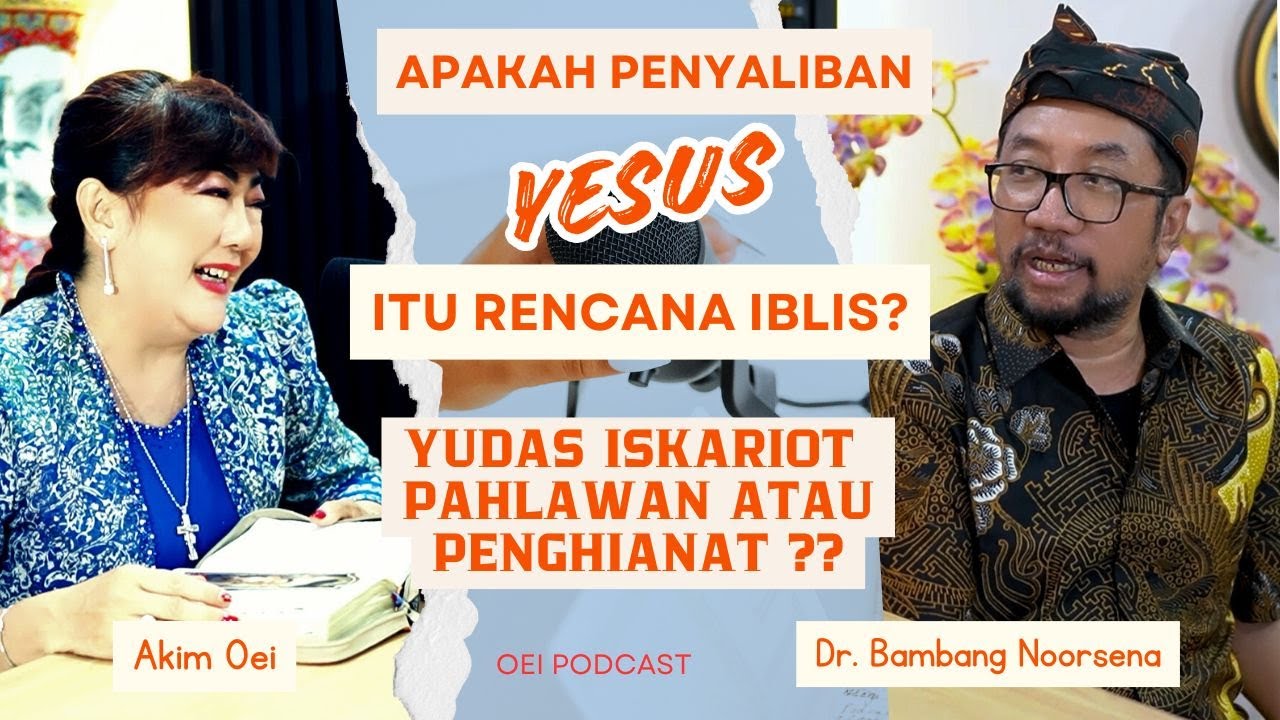
Brief Summary
This podcast episode explores the complexities surrounding Judas Iscariot's role in Jesus' crucifixion, the nature of God's sovereignty, and the meaning of the cross. It challenges common understandings of sacrifice, redemption, and the interplay between divine will and human free will.
- Judas's motivation was personal gain, not divine purpose.
- God's sovereignty means He cannot be bound by external laws or obligations.
- The cross represents God's love and grace, not a forced sacrifice.
- Evil exists due to free will, but God ultimately controls and can use it for good.
- The crucifixion was prophesied and part of God's plan for salvation, but also aligned with the Devil's destructive intentions.
Introduction
The podcast episode begins by introducing the central question of whether Judas Iscariot should be considered a hero or a traitor, given his role in the crucifixion of Jesus. The host introduces Dr. Bambang Nursena, who will provide insights into this complex theological issue. The discussion aims to explore the motivations behind Judas's actions and the broader implications of the crucifixion.
Judas: Hero or Traitor?
The discussion starts with the question of whether Judas Iscariot should be considered a hero because his betrayal led to Jesus' crucifixion, which Christians believe redeemed humanity. Dr. Nursena argues that Judas's motivation was not to facilitate salvation but to gain 30 pieces of silver. He emphasizes that actions are judged by intention, not just by their results. To illustrate this point, he references the story of Joseph from Genesis 50:20, where Joseph's brothers intended evil by selling him into slavery, but God used it for good to save many lives. The key takeaway is that people are judged by their intentions, while God can use the outcomes for good.
The Cross as Redemption
The conversation shifts to the understanding of the cross as redemption and the common notion that God the Father had to sacrifice Jesus for humanity's sins. Dr. Nursena clarifies that the idea of God being obligated to sacrifice Jesus is incorrect because no one can oblige God. The cross is instead the greatest act of grace and love, not a forced ritual. God's sovereignty means He is not bound by natural law; He created it. Even the devil's actions are subject to God's permission, as illustrated in the story of Job. God allows evil due to free will, creating a battleground between good and evil, but ultimately, everything remains under God's control.
The Cross as a Substitute Ransom
The discussion addresses whether the cross of Christ serves as a substitute for humanity's ransom, suggesting that sin has separated humans from God. Dr. Nursena explains that the concept of a substitute redemption is a metaphor, not a literal debt paid to the devil. He references 1 Corinthians 6:20, noting that being "bought with a price" is a figure of speech, not a civil transaction where something is lost. The cross is the pinnacle of God's love, but the idea of God being limited by His justice, creating a conflict within Him, is inaccurate. The theory of atonement as a substitute should not be taken literally.
The Devil's Plan
The conversation explores whether Jesus' crucifixion was part of the devil's plan, noting that Judas was possessed by the devil before betraying Jesus. Dr. Nursena cautions against oversimplification and references John 13:27, where the devil possessed Judas. However, he contrasts this with Matthew 16:21-23, where Peter, in trying to prevent Jesus from going to Jerusalem to suffer, was also rebuked as a "stumbling block," suggesting he was influenced by the devil as well. The devil's goal is to oppose God, but God's plan is ultimately sovereign. The devil is not all-powerful or all-wise; he is often confused and his plans are ultimately used by God for good.
Prophecies of the Crucifixion
The discussion turns to whether the crucifixion of Jesus was prophesied in the Old Testament, suggesting it was God's plan. Dr. Nursena points to Psalm 22:16-17, which describes the piercing of hands and feet, and Genesis 3:15, which speaks of the offspring of a woman crushing the serpent's head while being bruised on the heel. He explains that Jesus, while on the cross, referenced Genesis 3:15, recognizing that he was fulfilling this prophecy. Additionally, Galatians 4:4 speaks of Jesus being born of a woman, fulfilling the prophesied role of crushing the serpent's head through his sacrifice.
God's Plan vs. The Devil's Plan
The final question addresses whether the crucifixion was solely God's plan or the devil's plan. Dr. Nursena clarifies that it is not a simple conclusion. The devil's plan was to kill Jesus and thwart God's work, but God's plan was for salvation. He references 1 Chronicles 21:1 and 2 Samuel 24:1, which attribute David's census to both Satan and God, illustrating that the same event can be seen from different perspectives. Ultimately, God is sovereign, and everything, including Satan's actions, is under His control and permission. Actions are judged by motivation, not just results, and God can turn evil intentions into good outcomes.

