
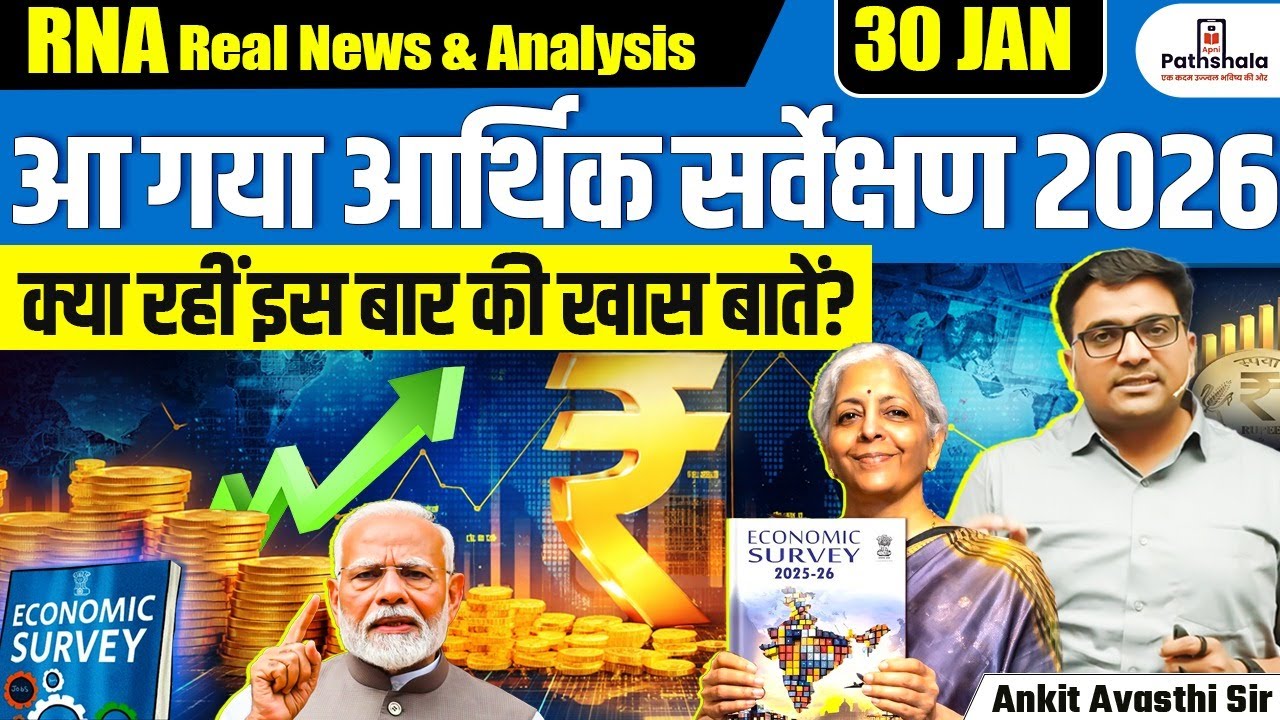
Brief Summary
This video provides an overview of the Economic Survey, a document that reviews the past year's economy and presents it to the country. It explains the survey's importance in a democracy for accountability, its creation by the Finance Ministry, and its presentation by the Chief Economic Advisor. The video also touches on key economic terminologies like GDP, inflation, and deficit, and highlights the government's key indicators and challenges outlined in the Economic Survey 2025-26.
- The Economic Survey is a crucial document for understanding the Indian economy's performance and future trajectory.
- Key economic terms like GDP, inflation, and deficits are essential for interpreting the survey's data.
- The government highlights positive growth trends but also acknowledges challenges like obesity and mental health.
Introduction to the Economic Survey
The Economic Survey is a comprehensive review of the country's economy from the past year, presented to the public. It is a crucial document for those seeking official data on India's economy, particularly useful for competitive exams like the UPSC. The survey serves as a valid reference for understanding the economic progress and challenges the country faces. In a democracy, the government is accountable to its citizens, and the Economic Survey is a key tool for providing this accountability by detailing how public funds have been utilized and the resulting economic outcomes.
The Purpose and Significance of the Economic Survey
The Economic Survey serves as an account of the government's economic activities and achievements over the past year. It details the progress made in various sectors and provides forecasts for the future. This document is essential for understanding the government's financial performance and its impact on the country's economy. The survey provides insights into the government's expenditures, the resulting progress, and future economic projections.
Creation and Presentation of the Economic Survey
The Finance Ministry, led by Nirmala Sitharaman, is responsible for preparing the Economic Survey. Within the ministry, the Economic Affairs Department and its Economic Division compile the survey annually. The Chief Economic Advisor (CEA), currently Dr. V Anantha Nageswaran, presents the survey. The Economic Survey offers suggestions to the government, which can then be implemented in the budget. The Economic Survey serves as a guide, offering insights and recommendations that can shape future economic policies.
Key Economic Terminologies
Understanding certain economic terms is crucial for interpreting the Economic Survey. GDP, or Gross Domestic Product, measures the total value of goods and services produced within a country's borders in a year. It is measured in real and nominal terms, with real GDP calculated using a base year (currently 2011-12) to account for inflation. Inflation, or the rate at which prices increase, is another key indicator. A moderate level of inflation (2-6%) is considered healthy for the economy. Deficit refers to when expenditures exceed income. There are different types of deficits, including revenue deficit (recurring expenses exceeding income) and effective revenue deficit (revenue deficit minus capital asset development).
Key Indicators from the Economic Survey 2025-26
The Economic Survey 2025-26 presents several key indicators, including a real GDP growth of 7.4%, an average CPI inflation of 1.7%, banking sector growth of 2.2%, and foreign exchange reserves of $701.4 billion. The survey forecasts a GDP growth of 6.8% to 7.2% for the financial year 2026-27. Additionally, it highlights that 56.2 crore people over the age of 15 were employed. The Reserve Bank of India (RBI) projects a 7.3% growth, positioning India as one of the fastest-growing economies globally.
Inflation, Employment, and Agriculture
The Economic Survey projects that inflation will remain within the RBI's target range of 4% (+/- 2%). The RBI anticipates inflation rates of 3.9% and 4% for the first two quarters of fiscal year 27. India has demonstrated significant success in controlling inflation. The survey also indicates that 56.2 crore people were employed, with 8.7 lakh new jobs created between the first and second quarters. The government projects an agricultural growth of 3.1%, supported by record grain production in 2024-25.
Fiscal Deficit and Infrastructure Development
The government aims to maintain the fiscal deficit at 4.4% of GDP, a reduction from the previous 4.8%. The Economic Survey highlights significant infrastructure development, including a 60% increase in the national highway network since 2014 and a tenfold increase in operational high-speed corridors. The railway network has also expanded. GST collections have risen to ₹22.1 lakh crore, indicating economic activity and increased tax revenue. Foreign exchange reserves have increased to $701 billion, up from $668 billion, and exports reached $825.3 billion in 2025.
Challenges and Concerns
The Economic Survey identifies several challenges, including rising obesity, the need for technology-driven initiatives, and mental health issues. To combat obesity, the survey suggests reducing oil consumption by 10% and promoting healthy lifestyle campaigns. It also addresses the growing concern of digital addiction and the need for mental health programs. The Chief Economic Advisor has expressed concerns about the increasing prevalence of "freebies" (subsidies), which consume a significant portion of the budget. Data indicates that 24% of women and 23% of men in India aged 15-49 are overweight, raising concerns about public health.

