
Brief Summary
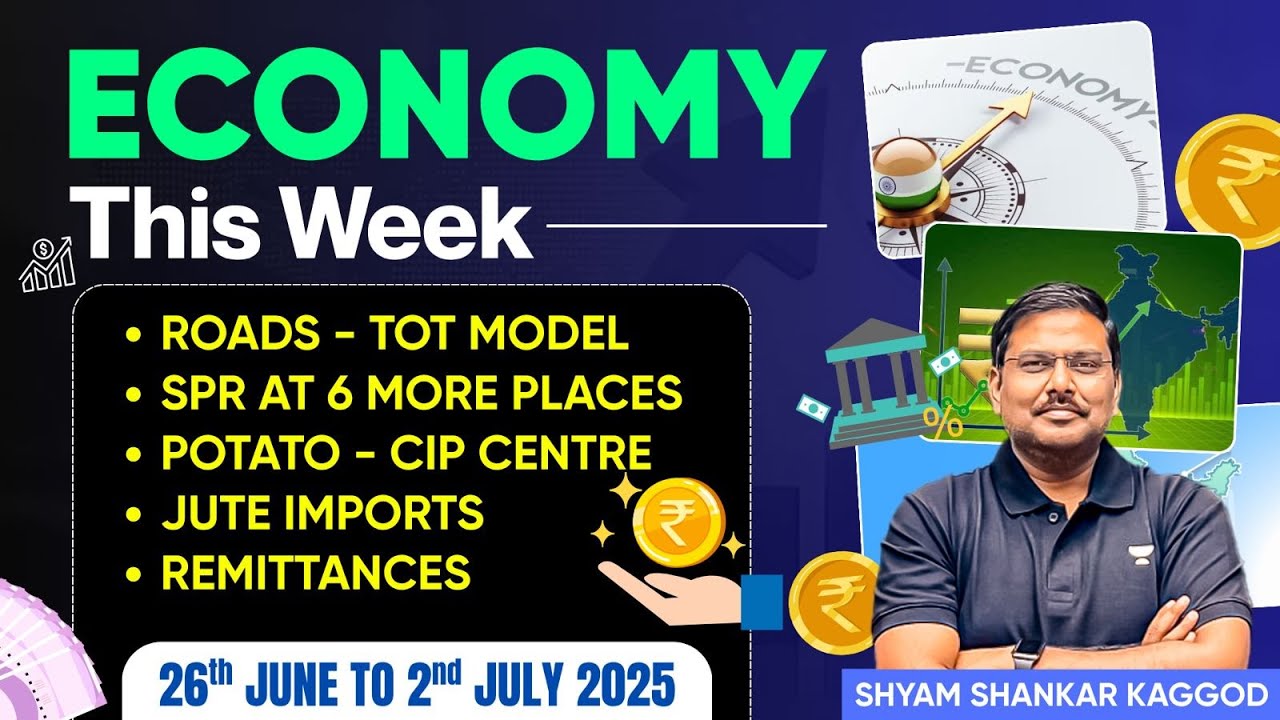
This session covers important economy-related articles from June 26th to July 2nd, 2025, focusing on key announcements and analyses relevant to the Indian economy and civil services aspirants. The discussion includes the discontinuation of the Toll Operate Transfer (TOT) model, strategic crude oil reserves, developments in potato production, restrictions on jute imports from Bangladesh, and trends in inward remittances to India. Additionally, it provides practice questions and assignments for UPSC preparation.
- Discontinuation of the Toll Operate Transfer (TOT) model
- Strategic crude oil reserves
- Developments in potato production
- Restrictions on jute imports from Bangladesh
- Trends in inward remittances to India
Introduction and Announcements
The session begins with a welcome to Unacademy and an overview of the topics to be covered, which include analyzing economy-related articles from various newspapers. It is specified that the articles discussed are from June 26th to July 2nd, 2025. Important announcements are made, including the availability of PPT PDFs and notes on a Telegram channel, the QR code for which is provided. Additionally, the Unacademy UPSC summit on July 5th and 6th, 2025, is announced, featuring experts and educators conducting sessions to address doubts and strategies for subjects like Indian economy and polity.
Discontinuation of Toll Operate Transfer (TOT) Model
The Union Minister for Road Transportation and Highways, Dr. Nitan Gkari, announced the discontinuation of the Toll Operate Transfer (TOT) model. This decision is related to the national monetization pipeline (NMP), where the government uses existing assets to generate revenue without selling them. Under the TOT model, private sector operators collect tolls for a specified period, paying a concession fee to the government. The minister stated that the private sector benefits more than the government under this model. Additionally, concerns were raised about foreign investment flowing into these companies. The government will now shift to the infrastructure investment trust model.
Infrastructure Investment Trust (InvIT) Model
The government will reduce reliance on the TOT model and shift to the infrastructure investment trust (InvIT) model. This model is similar to mutual funds, where investors pool money, and the company invests in infrastructure assets like roadways, generating revenue and paying returns to unit holders. The National Highways Authority of India has floated a private infrastructure investment trust and is considering a public infrastructure investment trust to allow retail investors to participate. Additionally, the toll securitization model is used, where companies issue instruments like bonds, collecting money upfront with the assurance of repaying investors from future toll collections.
Strategic Crude Stocks at Six New Locations
India is about 85% import-dependent on crude oil, making it vulnerable to market price variations. To mitigate this, the government has developed strategic petroleum reserves (SPRs), maintained by Indian Strategic Petroleum Reserves Limited (ISPL). Currently, 5.3 million metric tons of crude are stored at Padur, Mangalore, and Vishaka Patnham. Oil marketing companies also store crude, providing a total strategic reserve sufficient for about 77 days of requirement. To meet the international standard of 90 days, the government plans to set up strategic crude stocks at six new locations. Engineers India Limited has been tasked with conducting a survey to identify suitable locations near ports and refining capacities. These reserves are used to stabilize market prices during supply volatility or high prices.
International Potato Center and Potato Production
Potato is the third-highest produced agricultural commodity in India, but there are issues with productivity. The potential productivity is 50 tons per hectare, but the actual production is around 25 tons per hectare due to the lack of quality seeds. To address this, a South Asia regional center of the International Potato Center (CIP) will be set up in Agra, similar to the one in China that helped it become the largest potato producer. This center will provide access to better quality germ plasm, improving productivity and promoting export potential. The International Rice Research Institute (IRRI), headquartered in the Philippines, already has a center in Varanasi.
Restrictions on Jute Imports from Bangladesh
India has imposed curbs on jute imports from Bangladesh through sea and land ports, allowing it only through the Mumbai port. Both India and Bangladesh are part of SAFTA, where Bangladesh is treated as a least developing country (LDC), exempting many imports from customs duties. However, the government of Bangladesh provides subsidies for jute products, leading to cheaper imports into India. Despite anti-dumping duties, imports from Bangladesh continue to thrive, affecting Indian farmers and companies. The DGTR has announced these restrictions to address the issue.
Inward Remittances to India
India has received over $135 billion worth of remittances, the highest in the world. The amount of remittances has more than doubled in the last decade. While remittances are typically associated with crude oil prices due to Indian migrants in the Middle East, the linkage has weakened as skilled migrants find high-paying jobs in western countries. Remittances account for about 10% of the total amount received under the current account and are higher than the inflow of foreign direct investment.
Assignments: India Energy Stack and Digital India Initiative
Two assignments are given for practice. The first is based on India's energy stack, discussing the need for it and the measures taken to promote it, based on recommendations from a committee headed by Mr. Nandan Nilikani. The second assignment focuses on the 10-year anniversary of the Digital India initiative, elaborating on how it has helped India's digital transformation by bridging the digital divide and promoting inclusive innovation.

