
Brief Summary
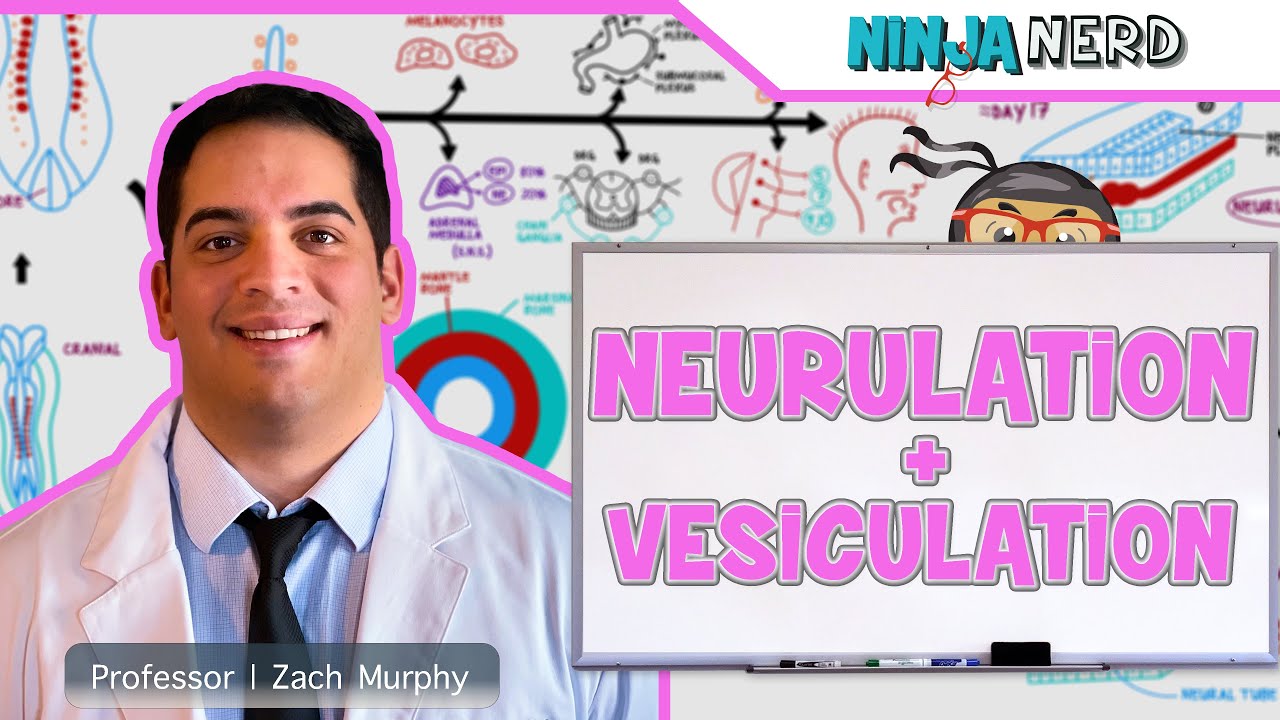
This video by Ninja Nerd explains the development of the nervous system from the trilemma Nordisk stage. It covers neurulation, the formation of the neural tube, vesiculation where the neural tube differentiates into the brain and spinal cord, and the migration and differentiation of neural crest cells into various structures.
- Neurulation involves the formation of the neural plate, neural folds, and neural groove, ultimately leading to the neural tube.
- Vesiculation is the process where the neural tube differentiates into primary and secondary vesicles, which further develop into the brain, brainstem, cerebellum, and spinal cord.
- Neural crest cells migrate and differentiate into melanocytes, adrenal medulla cells, enteric nervous system components, dorsal root ganglia, sympathetic ganglia, meninges, and head and neck structures.
Lab
The video begins by continuing from the gastrulation process and the development of the notochord, focusing on the complete development of the nervous system. The process starts around day 15 to day 17, where the notochord releases growth factors, stimulating ectodermal cells to proliferate. This proliferation leads to the thickening of the ectoderm, forming the neural plate.
Neurulation
The neural plate begins to involute, with the central part pulling down and the edges rolling towards each other. This forms the neural folds and the neural groove. Some ectodermal cells differentiate into neural crest cells, which are located around the edges of the neural folds. The neural plate forms around day 17, while the neural folds, neural groove, and neural crest cells appear around day 18. The neural folds fuse, and the neural groove involutes to form the neural tube beneath the ectoderm, with neural crest cells positioned above. The cranial portion and caudal portion of the neural tube are also highlighted. Around day 21, the neural tube is completely formed, but the anterior and posterior neuropores remain open. Folate is essential for the closure of these neuropores, aiding in DNA synthesis and replication. A lack of folate can lead to defects such as anencephaly (if the anterior neuropore doesn't close) or spina bifida (if the posterior neuropore doesn't close). The anterior neuropore closes around day 24, and the posterior neuropore closes around day 26. After the closure of the neuropores, the neural tube develops into the central nervous system. This entire process, from ectodermal proliferation to neural tube formation, is called neurulation.
Vesiculation
The neural tube undergoes vesiculation, where the cranial end forms three primary vesicles: the prosencephalon, mesencephalon, and rhombencephalon. These primary vesicles further develop into secondary vesicles. The prosencephalon splits into the telencephalon and diencephalon. The mesencephalon remains the same, becoming the midbrain. The rhombencephalon divides into the metencephalon and myelencephalon. The telencephalon becomes the cerebrum, including the frontal, parietal, occipital, temporal lobes, and insula. The diencephalon forms the thalamus, subthalamus, hypothalamus, epithalamus, and mammillary bodies. The metencephalon develops into the pons and cerebellum, while the myelencephalon becomes the medulla oblongata. The remaining part of the neural tube becomes the spinal cord. This entire process of brain and spinal cord development from the neural tube is called vesiculation.
Neural Crest Cell Migration
Neural crest cells migrate and differentiate into various structures throughout the body. They become melanocytes in the skin, adrenal medulla cells that secrete epinephrine and norepinephrine, and components of the enteric nervous system, such as the submucosal (Meissner's) plexus and myenteric (Auerbach's) plexus. Neural crest cells also form the dorsal root ganglia, sympathetic chain ganglia, prevertebral ganglia, Pia mater, arachnoid mater (together forming the leptomeninges), and contribute to the formation of muscles, bones, and nerves in the head and neck, including cranial nerves V, VII, IX, and X.
Comment, Like, SUBSCRIBE!
The video concludes by summarizing the covered information, emphasizing the development of the neural tube and neural crest cells. The next video in the embryology series will cover the implantation of the cytotrophoblast and syncytiotrophoblast and the formation of the placenta.

