
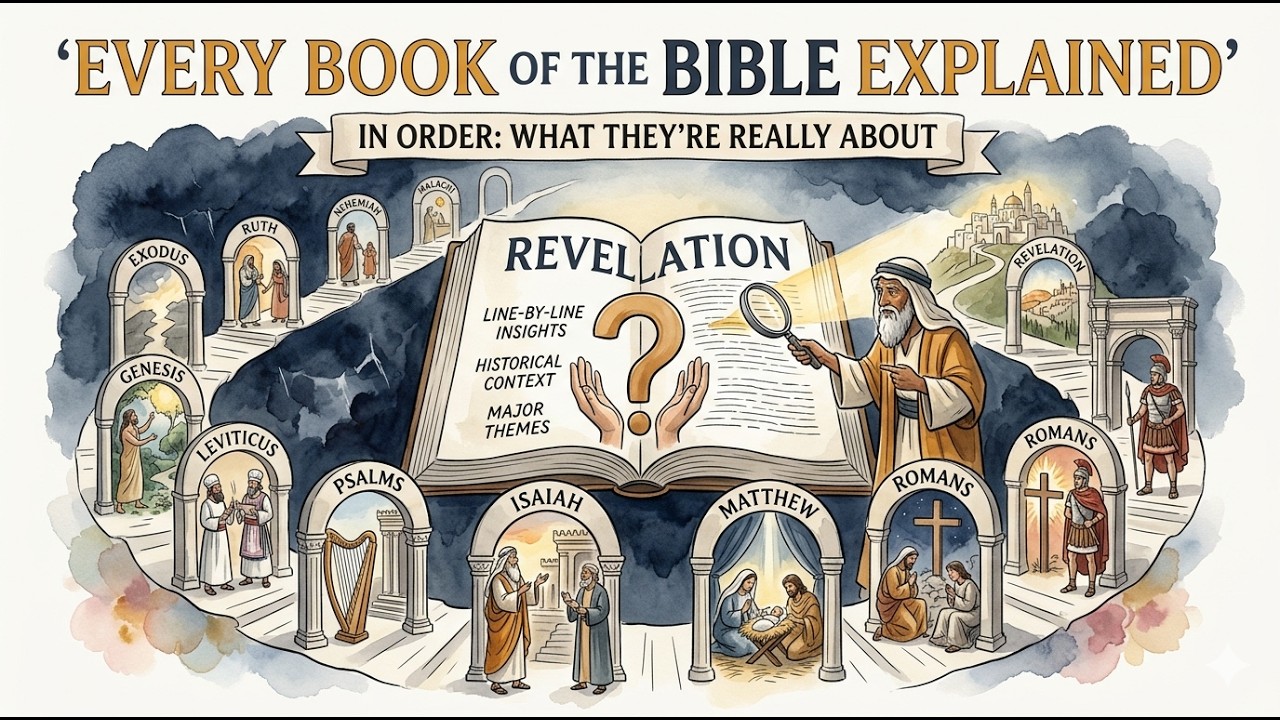
Brief Summary
This video provides an overview of the entire Bible, from Genesis to Revelation, emphasizing its unified narrative despite being written by multiple authors over centuries. It highlights key themes, stories, and the overarching question of God's relationship with humanity. The video aims to make the Bible more accessible by presenting each book's unique contribution to the whole, encouraging viewers to see it as a cohesive story rather than a collection of disparate texts.
- The Bible is a library of 66 books written over 1500 years by 40 authors in 3 languages.
- The Old Testament is about God making and keeping promises.
- The New Testament is four accounts of the life, death and resurrection of Jesus of Nazareth.
- Despite its complexity, the Bible tells a single, unified story of God's relationship with humanity.
Introduction
The Bible is the most printed, translated, and studied document in history, shaping law, literature, and philosophy. However, many people find it daunting due to its size and complexity, feeling lost without guidance. The Bible is not a single book but a library of 66 separate documents written over 1500 years by about 40 different authors in Hebrew, Aramaic, and Greek, across three continents. Despite this, a single story emerges, addressing the question of whether God and humanity can share the same space, from Genesis to Revelation.
The Old Testament
The word "testament" comes from the Latin "testamentum," translating the Hebrew word for "covenant," a binding agreement. The Old Testament is a record of God making promises to a specific people, their repeated breaking of those promises, and God's continued faithfulness.
Genesis
Genesis, meaning "beginning" in Greek, or "Bereshit" in Hebrew, explores whether God and humanity can share the same space. It opens with creation and the placement of humans in a garden, which is then broken by distrust, leading to exile. This story diagnoses the problem the rest of the Bible seeks to treat. Genesis concludes with a broken family and God's continued promises, exemplified by Joseph forgiving his brothers.
Exodus
Exodus, meaning "departure" in Greek, or "Shemot" (names) in Hebrew, recounts the descendants of Jacob enslaved in Egypt for 400 years. Moses, raised in Pharaoh's palace, is called by God to free his people. After 10 plagues, the Israelites escape through the Red Sea and receive the law at Mount Sinai. The law provides a framework for the freed slaves to live in relationship with a holy God. Exodus ends with the construction of the tabernacle, symbolizing God's presence among them.
Leviticus
Leviticus is a manual for unholy people to approach a holy God without being destroyed. Named after the priestly tribe of Levi, it details sacrifices, clean and unclean foods, and Yom Kippur, the day of atonement. The central theme is "be holy, for I am holy," emphasizing proximity to God requires holiness, not perfection.
Numbers
Numbers, or "Bamidbar" (in the wilderness) in Hebrew, describes Israel's journey after receiving the law and tabernacle. Despite God's promises, the people distrust Him, leading to a 40-year wandering in the wilderness. This book illustrates the consequences of choosing slavery over freedom in their hearts.
Deuteronomy
Deuteronomy, meaning "second law" in Greek, features Moses's three speeches to the new generation before they enter the promised land. Moses retells the law, recounts their history, and presents them with a choice between life and death, urging them to choose life. The book ends with Moses's death and the nation poised to enter the promised land.
Joshua
Joshua is the story of the conquest of Canaan. Joshua, Moses' successor, leads Israel across the Jordan River, conquers the land, and divides it among the tribes. The book concludes with Joshua's farewell speech, urging the people to serve the Lord.
Judges
Judges is the darkest book in the historical section, depicting a repeating cycle of Israel abandoning God, falling into oppression, crying out for help, and God raising a judge to deliver them. The judges become increasingly flawed, and the book ends with the statement, "Everyone did what was right in their own eyes," illustrating chaos disguised as freedom.
Ruth
Ruth is a story set during the time of the judges, offering a window of light. Ruth, a Moabite woman, follows her widowed Israelite mother-in-law Naomi back to Bethlehem. Her declaration of loyalty is a beautiful statement. Ruth ends up in the genealogy of King David and Jesus, showing a foreign widow becoming an ancestor of the Messiah.
1 and 2 Samuel
1 and 2 Samuel cover the birth of the Israelite monarchy. The people demand a king, and God warns them of the cost. Saul, the first king, fails due to insecurity. David, the second king, is called a man after God's own heart, despite his sins of adultery and murder.
1 and 2 Kings
1 and 2 Kings trace the monarchy from Solomon's reign to the nation's collapse. Solomon builds the temple but turns to other gods. The kingdom splits, with the northern tribes falling to Assyria in 722 BC and the southern kingdom falling to Babylon in 586 BC. The temple is burned, and the people are exiled.
1 and 2 Chronicles
1 and 2 Chronicles cover the same period as Samuel and Kings but focus on the Davidic line and the temple, written for those returning from exile to remember their identity.
Ezra and Nehemiah
Ezra and Nehemiah describe the return from exile. After 70 years in Babylon, the Persian king Cyrus allows the Jewish exiles to return home. Ezra leads a group to rebuild the temple, and Nehemiah leads another to rebuild the city walls, focusing on reconstructing both buildings and identity.
Esther
Esther is set in the Persian court and never mentions God's name, yet His influence is evident. A Jewish girl becomes queen under a hidden identity and risks her life to save her people from extermination, turning a day of destruction into a day of deliverance.
Job
Job explores why the righteous suffer. Job, described as blameless, loses everything. His friends try to explain his suffering but are wrong. God speaks from a whirlwind, answering with a question about Job's presence at the earth's creation, refusing to cheapen suffering with easy answers.
Psalms
Psalms is the hymn book of ancient Israel, containing 150 poems, songs, and prayers expressing a full range of human emotions. It teaches that it is acceptable to tell God exactly how you feel.
Proverbs
Proverbs offers practical wisdom for everyday life, based on the idea that the fear (reverence) of the Lord is the beginning of wisdom, reorganizing one's priorities.
Ecclesiastes
Ecclesiastes explores the temporary nature of everything under the sun. The teacher concludes that finding ultimate meaning in temporary things leads to disappointment. The book pivots to fearing God and keeping His commandments, finding meaning beyond the temporary.
Song of Solomon
Song of Solomon is a passionate love poem celebrating human romantic love and portraying the relationship between God and His people.
Isaiah
Isaiah is the longest prophetic book, describing a suffering servant who will be pierced for our transgressions and by whose stripes we are healed. Early Christians called it the fifth gospel.
Jeremiah
Jeremiah preaches for 40 years, warning of the Babylonian threat. He promises a new covenant where God will write His law on their hearts, working from the inside out.
Lamentations
Lamentations consists of five poems of grief written after Jerusalem falls. Amidst the darkness, it declares that the steadfast love of the Lord never ceases and His mercies are new every morning.
Ezekiel
Ezekiel, writing to exiles, sees strange visions and promises that God will give His people a new heart, removing the heart of stone and giving a heart of flesh.
Daniel
Daniel is set in Babylon, where Daniel rises to high levels in the empire while maintaining his identity. The book contains both biography and apocalyptic visions of successive world empires followed by an indestructible kingdom. Daniel sees a son of man coming with the clouds of heaven, given dominion and glory.
The Minor Prophets
The 12 minor prophets (Hosea, Joel, Amos, Obadiah, Jonah, Micah, Nahum, Habakkuk, Zephaniah, Haggai, Zechariah, and Malachi) span four centuries, each urging the people to turn back to God.
Hosea
Hosea is called to marry an unfaithful woman, making his marriage a living picture of God's relationship with Israel.
Joel
Joel sees a locust plague as a preview of the day of the Lord and promises that God will pour out His spirit on all flesh.
Amos
Amos preaches economic justice, condemning the wealthy for oppressing the poor and emphasizing that God desires justice over worship when neighbors are hungry.
Obadiah
Obadiah is the shortest book in the Old Testament, directed at Edom for rejoicing when Jerusalem fell, warning that pride goes before destruction.
Jonah
Jonah runs from his assignment but eventually preaches repentance to Nineveh. The city repents, and Jonah is angry that God showed mercy to his enemies.
Micah
Micah summarizes God's requirements: to do justice, love kindness, and walk humbly with God. It also names Bethlehem as the birthplace of the coming ruler.
Nahum
Nahum announces the fall of Nineveh, signifying that judgment eventually arrives when grace is exhausted.
Habakkuk
Habakkuk argues with God about the prosperity of the wicked but ends with a radical statement of faith, rejoicing in the Lord even if there is no fruit on the vine.
Zephaniah
Zephaniah announces judgment but closes with an image of God rejoicing over His people with gladness and quieting them with His love.
Haggai
Haggai urges returned exiles to prioritize rebuilding the temple over their own houses.
Zechariah
Zechariah is the most Messianic of the minor prophets, foreseeing a king entering Jerusalem on a donkey, a betrayal for 30 pieces of silver, and the one who was pierced.
Malachi
Malachi is the last voice in the Old Testament, promising the prophet Elijah before the day of the Lord.
The New Testament
After 400 years of silence, a voice emerges in the wilderness.
The Gospels
The Gospels (Matthew, Mark, Luke, and John) are four accounts of the life, death, and resurrection of Jesus of Nazareth, each written for different audiences with different questions in mind.
Matthew
Matthew writes for a Jewish audience, emphasizing how Jesus fulfills the Old Testament prophecies. He structures Jesus's teachings into five major discourses, mirroring the five books of Moses.
Mark
Mark is the shortest and fastest-paced gospel, opening with Jesus already in motion and focusing on His actions and miracles.
Luke
Luke, written by a physician, is the most literary gospel and pays particular attention to marginalized people, such as women, the poor, and outsiders.
John
John is unique, opening with "In the beginning was the Word," echoing Genesis and presenting Jesus as the point the whole story was building towards.
Acts
Acts is Luke's sequel, describing the birth of the church at Pentecost and the spread of the gospel from Jerusalem to the ends of the earth. The church is built significantly by its former enemy, Paul.
The Letters
The bulk of the New Testament consists of letters written by apostles to specific churches and individuals, addressing specific problems.
Romans
Romans is the most comprehensive statement of the gospel in Paul's letters, arguing that everyone is guilty and the cure is grace through faith, freeing believers from sin's dominion.
1 Corinthians
1 Corinthians addresses a church torn apart by pride, immorality, and arguments about spiritual gifts. Paul includes his famous passage on love as a corrective.
2 Corinthians
2 Corinthians is Paul's most personal letter, defending himself against attacks by sharing his weaknesses and a thorn in his flesh that God refused to remove, stating, "My grace is sufficient for you."
Galatians
Galatians is Paul's angriest letter, condemning the addition of religious performance to grace, asserting that the gospel is complete and does not need to be earned.
Ephesians
Ephesians emphasizes that God had a plan before the foundation of the world and that believers are His workmanship created for good works. It also includes the famous armor of God.
Philippians
Philippians, written from prison, emphasizes joy, describing a peace that surpasses all understanding despite facing possible execution.
Colossians
Colossians asserts the absolute supremacy of Jesus Christ, stating that all things were created by Him and hold together in Him.
1 and 2 Thessalonians
1 and 2 Thessalonians address a church confused about the second coming, assuring them that the dead in Christ will rise first and urging those who quit their jobs to wait for the end to get back to work.
1 and 2 Timothy and Titus
1 and 2 Timothy and Titus are letters to young pastors, offering practical and honest encouragement for leading churches with real problems.
Philemon
Philemon is a plea on behalf of a runaway slave, Onesimus, asking his master to receive him back as a brother, with Paul offering to pay any debt Onesimus owes.
Hebrews
Hebrews argues that Jesus is better than the angels, Moses, the Levitical priesthood, and the old sacrificial system, as they were all shadows pointing toward Him.
James
James emphasizes that faith without works is dead, asserting that genuine faith produces action.
1 and 2 Peter
1 and 2 Peter are written to suffering churches, reminding them that they are a chosen people and warning against false teachers.
1, 2, and 3 John
1, 2, and 3 John emphasize that God is love and that whoever abides in love abides in God.
Jude
Jude warns against false teachers and closes with a beautiful benediction, praising God's ability to keep believers from stumbling.
Revelation
Revelation, meaning "unveiling," is a vision given to John, encouraging persecuted churches to hold on, as the one on the throne has not moved. The center of Revelation is a throne with a lamb looking as though it had been slain, symbolizing that the one who suffered reigns. The book ends with a new heaven and a new earth, restoring God and humanity to the same space.

