
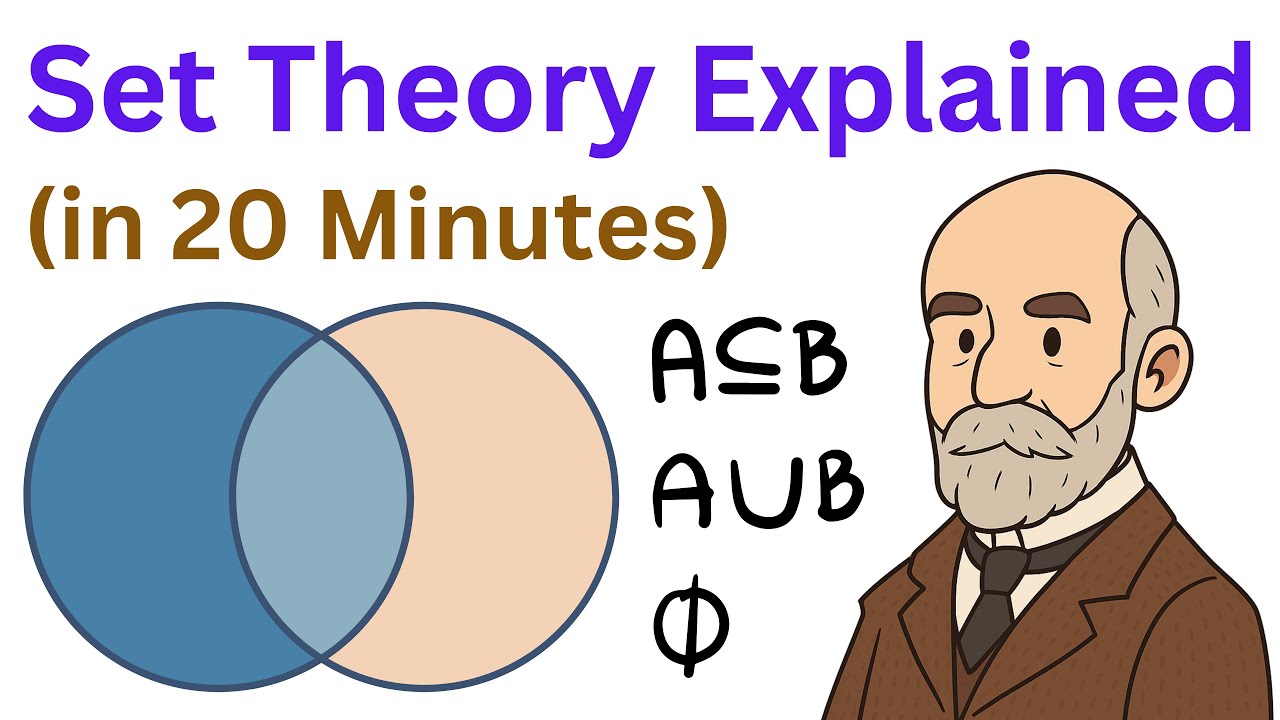
Brief Summary
The video provides a comprehensive introduction to set theory, detailing the fundamental concepts of sets, their types, and operations. Key points include:
- Definition and representation of sets.
- Types of sets (finite, infinite, subsets, etc.).
- Set operations like union, intersection, difference, and complement.
- Use of Venn diagrams for visualizing and solving problems related to sets.
Introduction to Sets
A set is a collection of distinct objects or elements perceived as a single entity. These elements must be unique, meaning that no element appears more than once, and the order of elements does not matter. For instance, the set of colors (red, yellow, green) is the same as (green, red, yellow). A well-defined set allows clear determination of whether an object belongs to it, such as the set of months in a year.
Types of Sets and Representation
Sets can be represented in roster form, listing elements within curly brackets, or in set builder form, which describes a property that elements must satisfy. For example, the set of vowels can be written as {a, e, i, o, u} in roster form or as {x | x is a vowel} in set builder form. There are finite sets containing limited elements and infinite sets where counting never ends. Two sets are equal if they contain the same elements, while they are equivalent if they have the same number of elements.
Special Sets and Subsets
Special sets include the singleton set (one element) and the empty set (no elements). A set A is a subset of set B if every element in A is also in B. An empty set is a subset of every set, while a proper subset must have at least one element not present in the larger set. For example, {1, 2} is a proper subset of {1, 2, 3}.
Power Set and Supersets
The power set encompasses all subsets of a given set, including the empty set and the set itself. If A is {1, 2}, its power set includes {}, {1}, {2}, and {1, 2}. A superset contains all the elements of another set; for example, if A = {1, 2} and B = {1, 2, 3}, then B is a superset of A. The universal set represents the complete set from which other sets are derived.
Operations on Sets
Set operations allow for combinations and comparisons. The union of two sets includes all elements from both sets, while the intersection contains only the elements common to both. The difference represents elements in one set but not the other, and the complement includes elements from the universal set that are not in the given set.
Laws of Set Algebra
Set algebra follows specific rules when performing operations. The commutative law states that the order of union or intersection does not matter. The associative law implies that grouping does not affect the outcomes of these operations. The distributive law connects intersections and unions, while De Morgan's identities relate their complements.
Venn Diagrams for Set Operations
Venn diagrams visually depict sets and their relationships, where circles represent sets and their intersections signify shared elements. They can illustrate union, intersection, and complement, making complex relationships among sets easier to understand.
Disjoint Sets and Cardinality
Disjoint sets have no elements in common, meaning their intersection is empty. Cardinality refers to the number of elements in a set. For finite sets, it is a whole number, while infinite sets have infinite cardinality.
Future Topics in Set Theory
The speaker indicates plans to explore more advanced concepts in set theory in future videos, including functions, mappings, and complex ideas like countable and uncountable sets, as well as paradoxes.

