
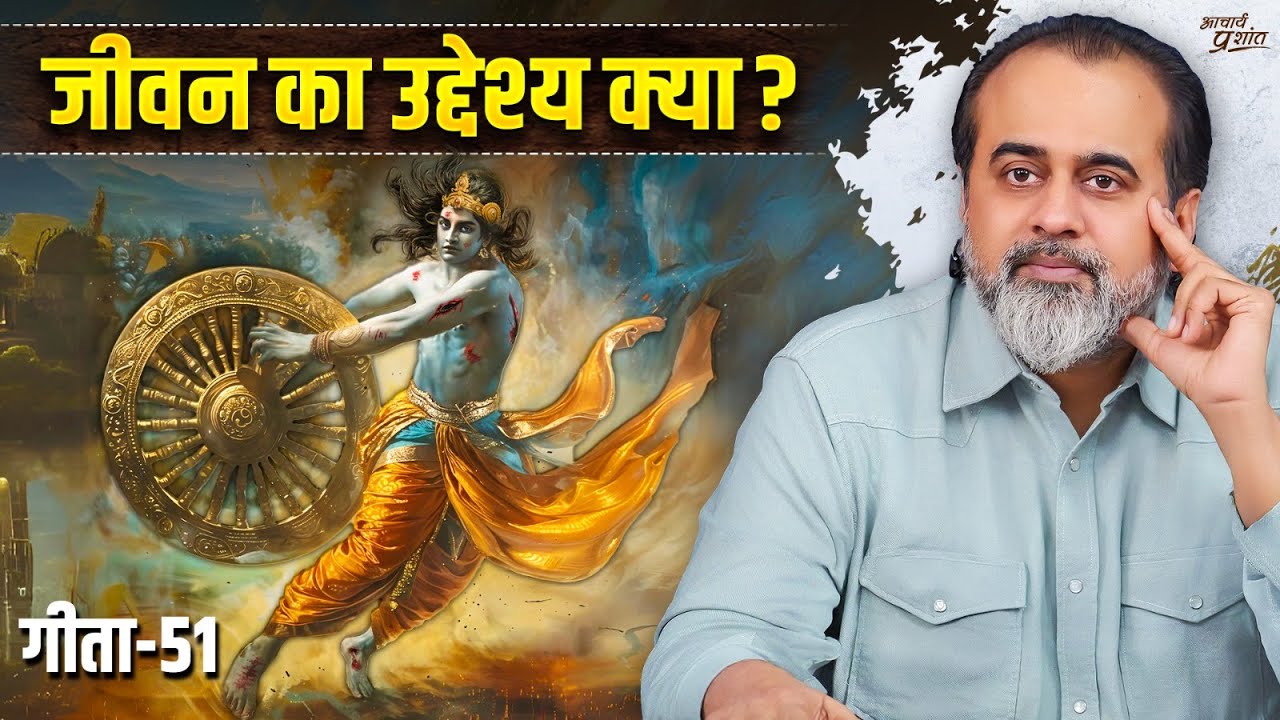
Brief Summary
This video explores the purpose of life and the human condition through the lens of the Bhagavad Gita. It discusses the inherent duality within humans—the conflict between the physical body (nature) and consciousness (spirit). The video addresses the central problem of suffering and the path to liberation (moksha) by understanding and transcending this duality.
- The purpose of life is to understand and address suffering through conscious awareness.
- Humans are a combination of nature (physical body) and spirit (consciousness), often in conflict.
- Liberation is achieved by understanding and transcending the duality of nature and spirit, not by suppressing either.
Intro
The video begins by posing fundamental questions about human existence: Why are we here? What is the purpose of life? It emphasizes that these questions are central to understanding the human condition and the pursuit of spirituality. The speaker references the Bhagavad Gita as a definitive source of wisdom on these matters, suggesting that it offers profound insights into the nature of existence and the path to liberation.
जीवन का उद्देश्य क्या?
This section addresses the common question, "What is the purpose of life?" The speaker notes that there are many opinions on this topic, especially in the realm of religion, where discussions often remain theoretical. The Bhagavad Gita, however, provides a definitive answer, offering clarity and eliminating the need for further debate. The discussion highlights the importance of understanding our true nature and purpose, as illuminated by spiritual texts.
मनुष्य: मिट्टी भी, प्रकाश भी
Here, the speaker explains that humans are composed of both matter and consciousness. From a higher, "paramarthic" perspective, matter and consciousness are one, but from a practical, "vyavaharic" perspective, they are distinct. The body is made of earth, just like any other material object, but humans also possess consciousness, which differentiates them. This consciousness is what allows humans to experience suffering and seek meaning in life.
अध्यात्म की पहली सीढ़ी क्या?
This section explores the role of consciousness in determining the quality of life. While we cannot change our physical attributes or genetic predispositions, we can influence our consciousness. The speaker emphasizes that suffering is experienced by consciousness, not by the physical body. The desire to understand the purpose of life arises from this suffering, making the pursuit of spiritual understanding a journey for the conscious self.
देह: एक बेमेल गठबंधन
The speaker describes the body as an incompatible union of nature (prakriti) and spirit (swabhava). These two aspects are fundamentally different, yet they are bound together in the body. This binding is the root of suffering. The only way to separate them completely is through death. The body is a "maya," an illusion where two conflicting entities are forced to coexist.
प्रेम या आकर्षण: क्या चुनोगे?
This section contrasts the nature of the physical body and consciousness. The body seeks rules and limitations, while consciousness seeks freedom and liberation. Laws of matter govern the physical world, but consciousness transcends these laws. The body is value-neutral, whereas consciousness assigns value, particularly to liberation. The body is driven by attraction, which is predictable, while consciousness is driven by love, which is not bound by rules.
सबसे बड़ा सवाल: जीना है या नहीं?
The speaker discusses existential themes, referencing playwrights like Beckett and Ionesco, who capture the sense of being trapped in the human condition. These works highlight the dilemma of whether to continue living in a state of suffering. The speaker contrasts this with the Vedantic perspective, which offers a path to liberation through understanding and awareness.
इसी जन्म में मुक्ति कैसे?
Drawing from the Bhagavad Gita, this section explains how to achieve liberation in this lifetime. It emphasizes the importance of enduring natural urges (kama and krodha) with patience and understanding. Liberation is achieved by consciously enduring the body's impulses, not by suppressing them. This involves understanding the nature of the body and its limitations, and responding with awareness and equanimity.
अपने स्वभाव में अडिग कैसे रहें?
The speaker advises maintaining steadfastness in one's true nature (swabhava). While we cannot control the body's actions, we can control our response to them. This involves understanding the body's impulses without being dominated by them. By remaining grounded in our consciousness, we can transform the nature of our experiences, even negative ones, into something beautiful.
आनंदित रहने का सूत्र
This section defines "anandit" (joyful) as being united with oneself and one's true nature. It means knowing both joy and sorrow without being uprooted by either. Joy is possible even in the presence of sorrow. The speaker emphasizes that true joy is revealed in the depths of sorrow, and that it involves remaining steadfast in one's true nature, regardless of external circumstances.
Testimonial
A testimonial from a listener who has been following the speaker for three years and attending Gita sessions for a year and a half. She shares that the speaker simplifies complex concepts and makes them accessible. She feels that she is becoming aware of her potential and is able to see that she can be more than what she currently is.

