
Brief Summary
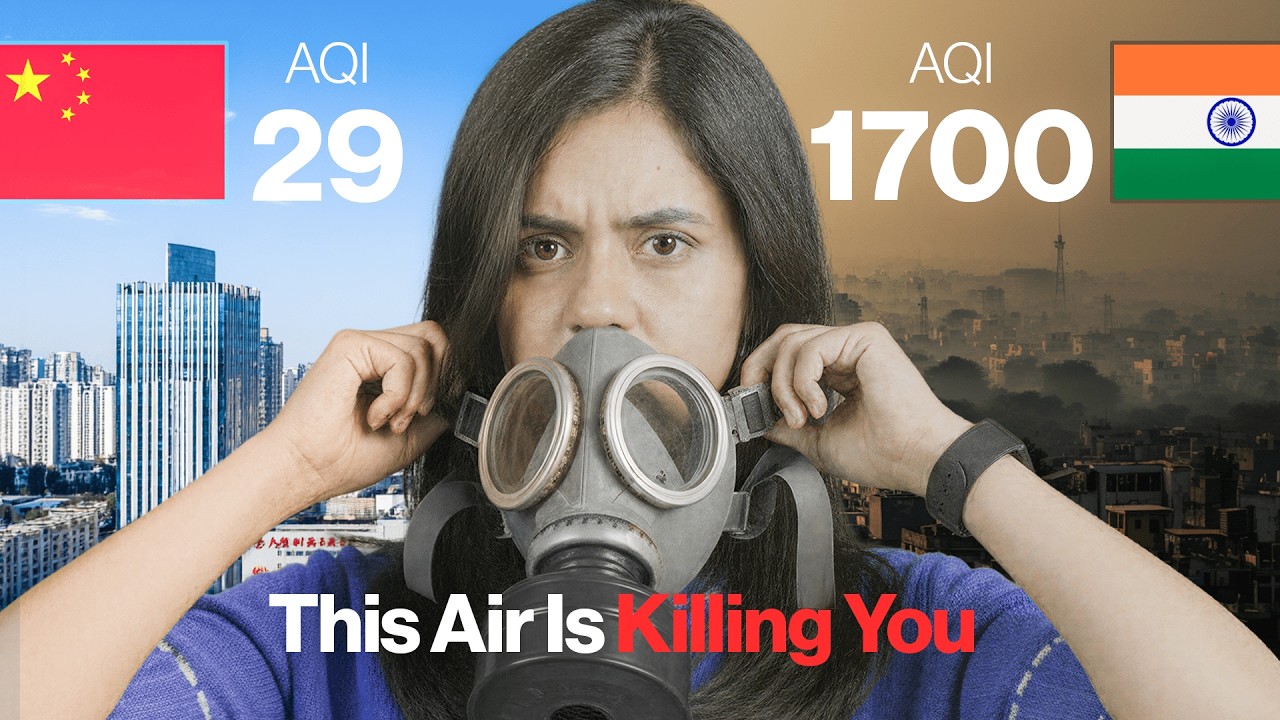
The video discusses the severe air pollution crisis in Delhi, India, comparing it to Beijing's successful efforts to combat similar pollution levels. It highlights the geographical factors contributing to Delhi's pollution, identifies key sources, and criticizes the Indian government's ineffective strategies. The video also touches on the social inequality of air pollution exposure and emphasizes the power of public accountability, drawing parallels with successful environmental campaigns worldwide. The video concludes with a call to action, urging viewers to consider what choices need to be made to prioritize public health over political convenience.
- Delhi's air pollution is critically high, causing significant health issues and reduced life expectancy.
- Beijing successfully combatted similar pollution problems through decisive action and strategic planning.
- Ineffective governance, lack of accountability, and social inequality exacerbate Delhi's pollution crisis.
- Public awareness, transparency, and community action are crucial for driving environmental change.
Introduction: Delhi's Air Pollution Crisis
In 2024, Delhi faces a severe air pollution crisis, with 94 out of the 100 most polluted cities globally being in India. Specifically, 15% of all deaths in Delhi are linked to air pollution, and the city's Air Quality Index (AQI) reached a staggering 795, even peaking at 1,700 in some areas. This level of pollution is causing children's lungs to resemble those of 40-year-old smokers, reducing their life expectancy by 8 to 10 years. The situation raises concerns about whether the crisis is unsolvable, especially when compared to Beijing's successful pollution control measures.
Geographical and Environmental Factors
Delhi's geographical location, situated in a bowl-like region surrounded by the Himalayas and Aravalli hills, traps pollutants. Microscopic particles like PM2.5, along with PM10, nitrogen oxide, sulfur dioxide, ozone, and carbon monoxide, get trapped, creating a toxic environment. The winter season exacerbates the problem due to temperature inversion, where warm air acts as a lid, preventing pollutants from dispersing. Seasonal winds from Punjab and Haryana, carrying smoke from crop fires and dust, further worsen the air quality.
Sources of Pollution in Delhi
Delhi's pollution is compounded by several factors, including a high number of registered vehicles (1.2 crore), construction activities generating tons of waste daily, and stubble burning in neighboring states. Farmers in Punjab and Haryana burn approximately 35 million tons of paddy straw due to a short window between harvests, contributing up to 40% of Delhi's PM2.5 on peak burning days. These factors combine to make Delhi an unlivable city, contrasting sharply with its historical cultural significance.
Beijing's Success Story
Beijing faced similar geographical challenges, including mountains, temperature inversions, agricultural burning, and seasonal wind patterns, with PM2.5 levels peaking at 755 micrograms per cubic meter in 2013. However, by 2024, Beijing achieved its cleanest year ever by implementing a five-action plan. This plan included shutting down polluting factories, subsidizing the replacement of coal heaters with electric or gas heaters, expanding public transportation, strategically tackling agricultural burning, and ruthlessly monitoring and enforcing regulations.
Video Editing School Announcement
The video transitions to an announcement about a video editing school that was started 2.5 years ago. The school aims to train individuals in video editing and content creation, which are becoming increasingly viable career options. The school has trained 3,500 students and is offering a free masterclass to help more people enter the industry, where there is a high demand for editors, video producers, and motion designers.
Inconsistencies and Inaction in India
In India, there is a lack of consensus on the primary sources of pollution, with different studies providing conflicting data. This confusion is exploited, with various industries deflecting blame. Despite Supreme Court orders and the implementation of Graded Response Action Plan (GRAP) measures, the cycle of pollution continues each year. The government's solutions, such as subsidized happy seeders for stubble management, fall short due to inadequate supply.
Government Funding and Priorities
The National Clean Air Program, launched in 2019 with a budget of 19,711 crores, has only utilized 57% of its funds as of 2024. Of the money spent, a significant portion went to temporary dust control measures, while minimal amounts were allocated to addressing biomass burning, vehicular pollution, and industrial pollution. This inefficient allocation contrasts with Beijing's proactive approach, where the government declared a "war against pollution" and tied local officials' promotions to air quality improvements.
Social Inequality and Call to Action
The video highlights the social inequality in exposure to pollution, with wealthier individuals able to afford air purifiers and other protective measures, while the poor have no choice but to breathe unfiltered air. The commodification of clean air exacerbates this disparity. The video concludes with a call to action, urging viewers to share their thoughts and insights on the crisis and emphasizing the power of public accountability. Drawing parallels with successful environmental campaigns, the video underscores that solutions exist and that prioritizing public health over political convenience is essential.

