
Brief Summary
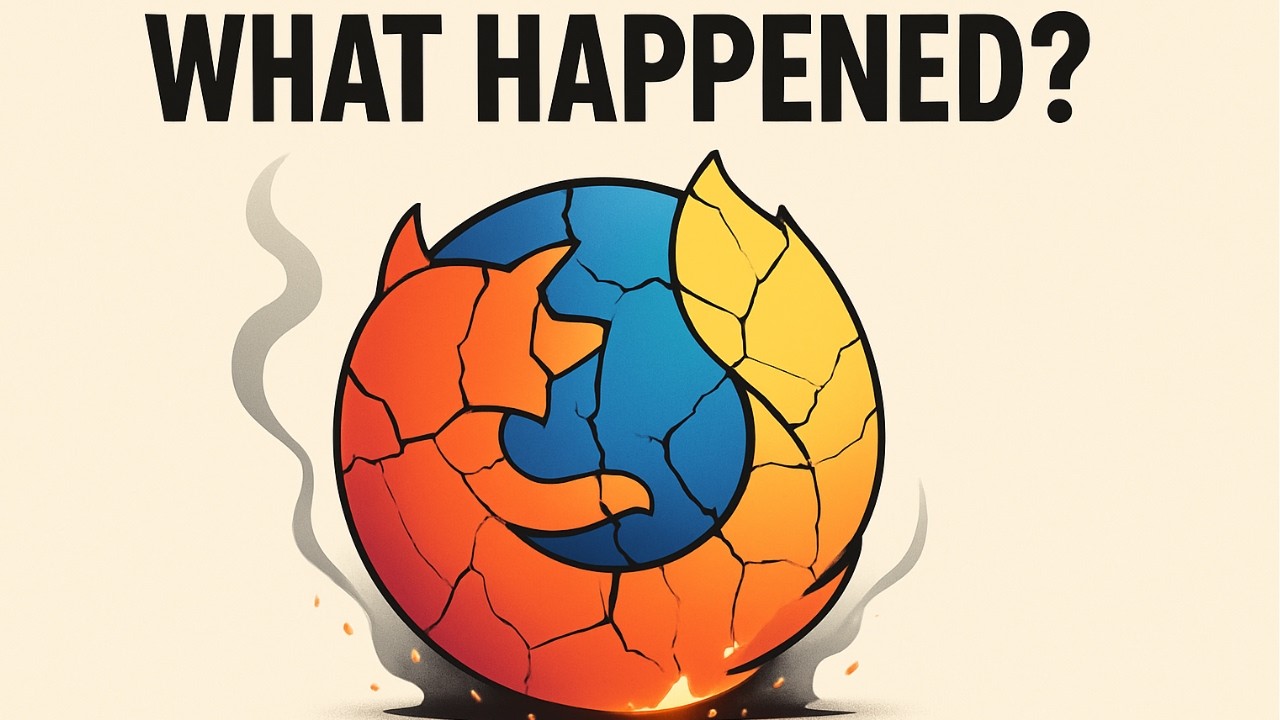
This video tells the story of Mozilla Firefox, a browser that once challenged Microsoft's dominance but now struggles to survive. Key points include:
- Firefox rose to prominence through volunteer efforts and innovative extensions, breaking Microsoft's browser monopoly.
- Financial dependence on Google, its main competitor, created a conflict of interest and strategic paralysis.
- A major engine rewrite, while improving performance, alienated loyal users by breaking compatibility with legacy extensions.
- The browser wars shifted to distribution, where Google's control over Android and Chrome gave it an insurmountable advantage.
- Mozilla's failure to diversify revenue and control distribution led to its decline, highlighting the importance of a sustainable business model for mission-driven companies.
Ch 1: A Privacy Hero That Lives Off Big Tech
Mozilla Firefox is presented as a champion of user privacy, contrasting with Google's data-centric approach. However, Mozilla's survival depends heavily on Google, creating a paradoxical situation. Firefox once dominated the browser market through community passion and innovative extensions, but now it struggles with a small market share while relying on Google, whose Chrome browser threatens the open web that Firefox aims to defend.
Ch 2: From Phoenix to the People’s Browser
In 2002, Microsoft controlled 95% of the browser market, but a group of volunteer programmers created Phoenix, which later became Mozilla Firefox, to challenge them. Firefox was built by developers who disliked Internet Explorer's issues. It was not a Silicon Valley startup but a project by passionate volunteers working on donated server space. The timing was perfect as Internet Explorer hadn't been updated in 3 years and was slow, unstable, and offered no customization. Firefox 1.0 launched on November 9, 2004, and quickly gained 60 million downloads within 9 months through word of mouth.
Ch 3: The High-Water Mark
Firefox's revolutionary feature was its extensions, allowing users to customize their browsing experience with tabbed browsing, pop-up blocking, and a clean interface. The extension ecosystem became Firefox's secret weapon, with developers creating add-ons like ad blockers, password managers, and developer tools. Firefox users actively recruited others, and by 2009, Firefox had 32% of the desktop browser market, breaking Microsoft's monopoly in just 5 years. However, this grassroots momentum created financial problems that passion alone couldn't solve, as maintaining a modern browser required resources beyond volunteer capacity.
Ch 4: The Money Pipeline
Mozilla needed infrastructure that grassroots passion couldn't provide, including server costs and security teams. The foundation accepted a default search partnership with Google for hundreds of millions annually. This deal provided Firefox with funding to compete with established players, while Google gained search traffic from Firefox users. However, Google was simultaneously building Chrome, launching it just as Firefox's dominance peaked, creating a conflict of interest that Mozilla seemingly didn't address.
Ch 5: The Engine Rewrite That Broke Everything
Mozilla's financial dependence on Google created a contradiction, as the privacy-focused browser received 81% of its $593 million annual revenue from Google, a company that monetizes surveillance. This dependence created strategic paralysis, preventing Mozilla from aggressively criticizing Google's privacy practices or making Firefox's privacy features too effective. Google has leverage in contract renewals, leading to reduced payments as Firefox's traffic value diminishes. By 2017, Firefox had performance issues compared to Chrome, leading to Project Quantum, a complete engine rewrite for speed improvements.
Ch 6: When Platforms Stack the Deck
Quantum improved Firefox's speed but required breaking legacy extensions, alienating users. The new web extensions API removed deep access for security, causing thousands of extensions to stop working. Developers had to rebuild extensions with limited functionality or abandon Firefox, leading to user backlash. The vibrant extension ecosystem that differentiated Firefox was gutted. While Quantum improved benchmarks, it shattered trust with loyal community members, who switched to Chrome or other browsers.
Ch 7: Crisis, Cuts, and Survival
The browser wars shifted to distribution, with Google turning Chrome into an ecosystem play. Chrome came pre-installed on Android phones and Chromebooks, and Google promoted Chrome on Gmail, YouTube, and search results. The Chromium engine became the industry standard, with Microsoft Edge and other browsers adopting it. Web developers optimized for Chromium-based browsers, making Firefox's Gecko engine an afterthought. Original equipment manufacturers received incentives to set Chrome as the default browser, making it difficult for users to discover Firefox.
Ch 8: The Lesson: Mission Needs a Business
On January 13, 2022, a bug in Firefox's HTTP/3 update caused a global outage for 6 hours, revealing Mozilla's centralized architecture. This incident raised questions about Firefox's reliability against Google's resources. Mozilla laid off 250 employees in 2020 and had further cuts in 2021. By 2023, Firefox had only 2.8% global browser usage and 0.5% on mobile. Diversification into subscription services generated less than $50 million annually, not enough to replace Google payments. The browser wars are over, and Mozilla hasn't surrendered. The lesson is that mission-driven companies need to diversify revenue, control distribution, and build defensive advantages that reinforce their principles.

