
Brief Summary
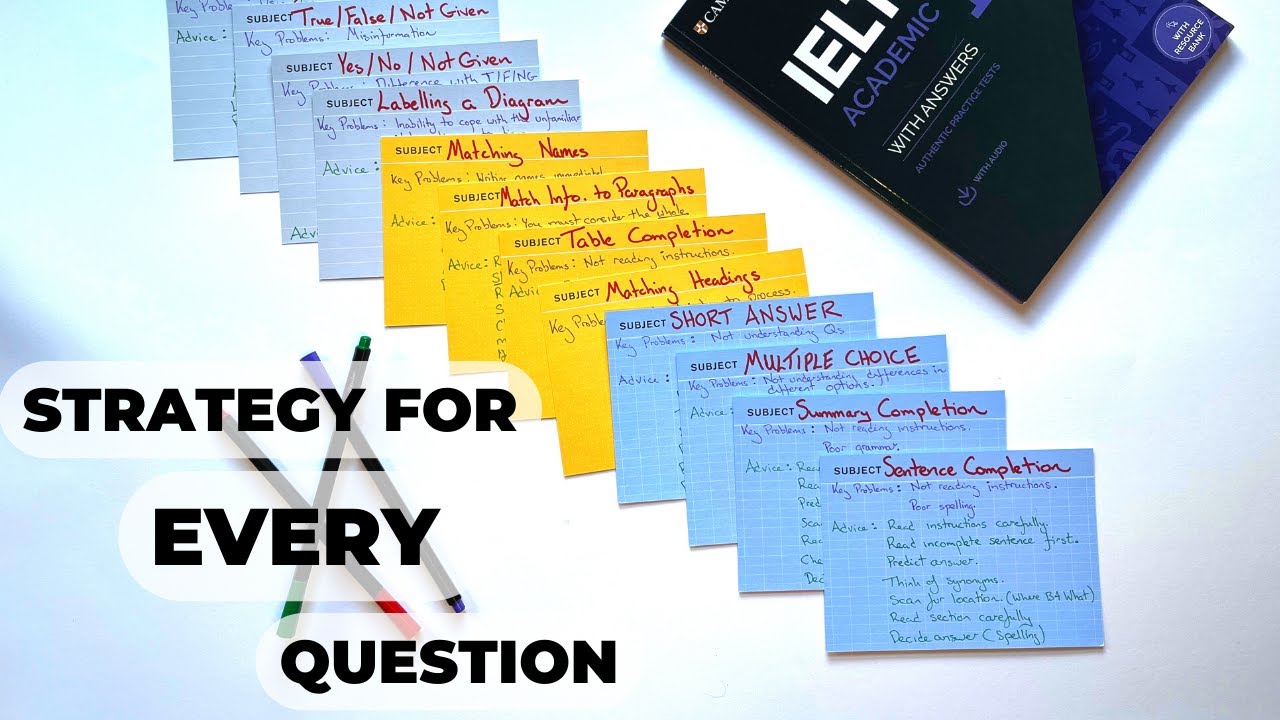
This video provides a comprehensive guide to the 12 main types of questions in the IELTS reading test. It outlines common problems students face with each question type and offers step-by-step strategies to solve them. The key is understanding the instructions, predicting answers, scanning for the correct location in the text, and being aware of synonyms.
- Understanding question types is crucial for efficient test-taking.
- Strategic approaches can significantly improve your score.
- Identifying and addressing personal weaknesses is key to achieving a high band score.
Introduction
The video introduces the 12 main types of IELTS reading questions, aiming to simplify the test for students. It promises to show what the questions look like, address common problems, and provide strategies to achieve high scores. The speaker emphasizes the importance of understanding question types and having effective strategies to quickly find the correct answers.
Sentence Completion
Sentence completion questions require filling in missing words in sentences using words from the text. Key problems include not reading instructions carefully, especially regarding the number of words allowed, and poor spelling. The advice includes reading instructions carefully, reading the incomplete sentence first, predicting the answer, scanning for the location of the answer using the "where before what" principle, and being careful with spelling.
Summary Completion
Summary completion involves completing a summary with words from the text, adhering to specific word limits. Common issues are not reading instructions, poor spelling, and grammar mistakes. The recommended strategy involves reading instructions carefully, reading the summary first, predicting the type of word needed (noun, verb, adjective), scanning for the location, checking if the answer makes sense grammatically, and then deciding on the correct answer.
Multiple Choice
Multiple-choice questions present a question with three or four options, requiring the selection of the correct answer. A key problem is not understanding the differences between the options. The strategy involves reading the questions and options carefully, skimming the text to understand the general meaning, focusing on the differences between the options, locating the relevant section of the text, reading that section carefully, and if confused, identifying which options are definitely wrong to narrow down the choices.
Short Answer
Short answer questions require answering direct questions based on the text. The main problem is not fully understanding the questions. The advice includes reading and understanding the questions first, underlining keywords within the questions, thinking of synonyms for those keywords to help scan for the location of the answer, reading the relevant section carefully, rereading the question, and then deciding on the answer.
Labelling a Diagram
Labeling a diagram questions involve completing parts of a diagram using information from the text. A key problem is feeling unable to cope with unfamiliar topics. The strategy involves reading instructions carefully, looking at the diagram to understand it, highlighting keywords, predicting the answers, scanning to find the location in the text, reading in detail, and being careful with spelling.
True/False/Not Given
True/False/Not Given questions require determining if statements are true, false, or not given based on the text. Problems include misinformation, not understanding what "not given" means, failure to understand the whole sentence, and focusing too much on keywords. The strategy involves reading the whole statement first, thinking of synonyms, matching the statement with the correct part of the text, reading the text section carefully, and determining if the meaning matches, contradicts, or is not mentioned in the text.
Yes/No/Not Given
Yes/No/Not Given questions are similar to True/False/Not Given but focus on the writer's opinion rather than facts. The main difference is determining whether the question statements agree or contradict the views of the writer, or if there is no information to judge the writer's opinion. The advice is to approach it the same way as True/False/Not Given, but focus on the writer's opinion, not on facts.
Matching Sentences
Matching sentences questions, also known as matching sentence endings, require matching the beginning of a sentence with the correct ending from a list. A key problem is using logic or grammar instead of relying on the text. The strategy involves reading the first part of the sentences, predicting the endings before checking, reading the endings, matching the obvious ones, eliminating wrong endings, matching potential endings, locating the relevant part of the text, reading it carefully, and choosing the correct answer.
Matching Names
Matching names questions involve matching names of people with statements related to their work or findings. A key problem is writing names immediately without considering the text in detail. The strategy involves scanning for the names in the text and underlining them, focusing on names mentioned only once first, reading their research in detail, matching with the question statements, and deleting the matched statement to make it easier to differentiate between the remaining statements.
Matching Information
Matching information questions require matching information to the appropriate paragraph in the text. A key problem is the need to consider the whole text. The advice is to do this question last, after familiarizing yourself with the text through other questions, reading the questions first and thinking of synonyms, skimming the text, rereading the questions and thinking about location, underlining the location if found, checking the question statement again, and moving to a different paragraph quickly if the answer is not found.
Table Completion
Table completion or flowchart completion questions involve filling in missing information in a table or flowchart. A key problem is not reading instructions carefully, especially regarding word limits. The advice includes reading the instructions carefully, scanning the text to locate the correct paragraph, reading that section carefully, and transferring the words exactly as they are to the gap, checking spelling.
Matching Headings
Matching headings questions involve matching headings to the correct paragraphs. A key problem is processing a lot of information. The strategy involves doing this question first, reading each paragraph with the intention of writing your own heading, then looking at the headings provided, focusing on understanding the difference of meaning between the different headings, and matching any obvious ones. For the remaining paragraphs, read them carefully and choose the correct option based on the text and the difference of meaning between the headings.
Bonus Lesson
The video concludes by emphasizing that understanding question types and strategies is just the first step. The most powerful method for improving your reading is understanding your own personal weaknesses and then improving those weaknesses.

