
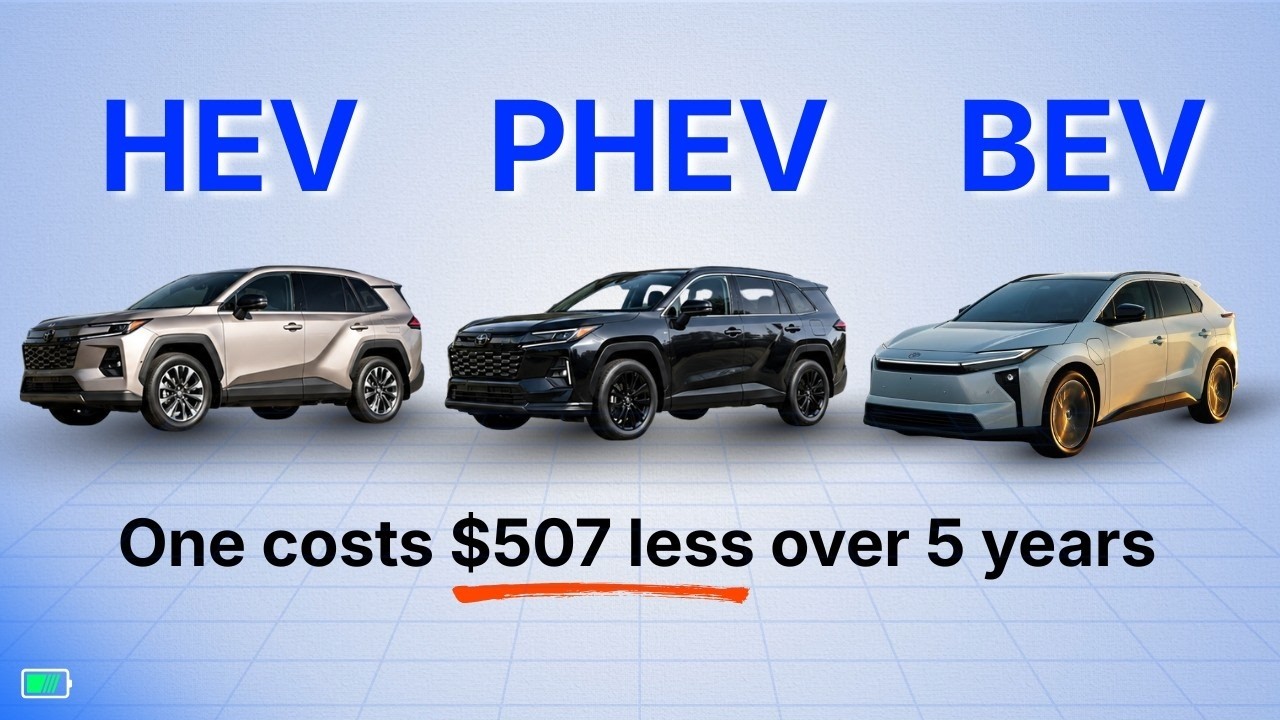
Brief Summary
This video analyzes the true cost of ownership of three 2026 RAV4 powertrains: hybrid, plug-in hybrid, and fully electric (bZ). The analysis considers purchase price, fuel and energy costs, insurance, maintenance, and depreciation over five years, providing a detailed comparison to help potential buyers understand the financial implications of each option.
- The analysis compares three RAV4 models: hybrid, plug-in hybrid (PHEV), and fully electric (bZ).
- Key factors include purchase price, energy costs, insurance, maintenance, and depreciation.
- The PHEV emerges as the most cost-effective option after five years, with the hybrid following closely.
Metrics
The analysis is grounded in specific metrics such as on-road purchase price after taxes and rebates, fuel costs, insurance over five years, maintenance for 100,000 km, and net depreciation when selling the vehicle. The parameters set for this analysis pertain to Ontario, with factors like annual mileage and electricity and gas prices established for accurate calculations. A free calculator for customizing these metrics based on location is provided to cater to individual needs.
Parameters
The parameters specified for the analysis focus on Ontario, Canada, involving an annual driving distance of 20,000 km. It assumes ownership lasts for five years and includes considerations for homeowners with overnight charging options. The price of gasoline used for computations is fixed at $1.55 per liter based on a five-year average for accurate fuel and energy cost analysis.
Meet the Three RAV4s
The vehicles being compared are all-wheel-drive models equipped to match features across the RAV4 lineup. The RAV4 Hybrid XLE has 236 horsepower and a purchase price of approximately $50,000 after fees and taxes. The RAV4 plug-in hybrid SE offers 324 horsepower at about $56,000 after incentives. Meanwhile, the bZ4XLE, which has a higher starting price of over $63,000, produces 338 horsepower. Each model's final cost after applicable incentives showcases the pricing variations within the RAV4 family.
Purchase Price
The initial purchase prices for the RAV4 models are as follows: hybrid at $50,000, plug-in hybrid at $56,000 (after a $2,500 federal incentive), and the fully electric model at about $53,000 (after a $10,000 total incentive). Cost calculations include various fees such as dealer costs and taxes that significantly impact the final purchase price for each vehicle. It's noted that the incentives available are subject to change, emphasizing the need for current information.
Fuel & Energy Costs
The hybrid consumes 5.7 L per 100 km, leading to projected fuel costs of $8,835 over five years. The bZ4X, utilizing energy at 17.3 kWh per 100 km, results in energy costs of approximately $2,443, while the plug-in hybrid costs around $4,000 in combined fuel and energy expenses when accounting for a balance of 75% electric driving. For plug-in options, an additional installation fee of $1,750 for a home charger is included in the overall calculations, affecting the total energy costs.
Insurance
Insurance quotes were gathered for the three vehicles, revealing the plug-in hybrid to be the costliest option due to its complex drivetrains with both gas and electric power systems. It costs $259 more per year than the hybrid and $96 more than the fully electric model. This disparity highlights the varying insurance impacts among these powertrains and their implications for long-term ownership.
Maintenance
Maintenance costs align with expectations, with the hybrid requiring more frequent oil changes and servicing. The plug-in hybrid, using its gas engine less frequently, has reduced maintenance needs compared to the hybrid. The bZ4X stands out with minimal maintenance requirements, needing only tire rotations and periodic checks, leading it to rank favorably for overall maintenance expenses during ownership.
Depreciation
Depreciation calculations are based on the original MSRP and expected residual percentages after five years. The hybrid is estimated to retain 70% of its value, while the plug-in hybrid holds at 68%. The bZ’s depreciation is projected at 45%, which reflects its potential challenges in resale value compared to traditional vehicles due to past performance issues with earlier models.
The Verdict
After five years and 100,000 km, the plug-in hybrid is found to be the most cost-effective option, surpassing the hybrid by $507, primarily influenced by the cost of the home charger. Despite being a close competition, choosing between the hybrid and plug-in hybrid depends on individual driver profiles. The bZ maintains a position above the hybrid but does not outperform the plug-in model in cost-effectiveness.
Different Scenarios
Specific buyer profiles demonstrate how the hybrid can be the superior financial choice in certain scenarios: lack of home charging access, short vehicle ownership periods under three years, and low annual mileage of 10,000 km. Each scenario indicates that the plug-in's economic advantages rely on effective electric charging usage and longer ownership durations.
The Surprise
A surprise element reveals that Toyota has eliminated gas-only RAV4 models for 2026, ensuring all vehicles come with some form of electrification. A quick look at the 2025 gas-only RAV4 reveals its high fuel costs and depreciation rates. The amount spent on fuel for the gas model over five years is projected at $12,400. This model ranks as the highest in ownership costs, demonstrating improved value in the hybrid and electric options.

