
Brief Summary
In this video, Armando Hasudungan explains the Adaptive immune response, focusing on the roles of T helper and T killer cells, as well as the function of plasma cells. He also introduces inflammatory mediators that contribute to the immune response and discusses both innate and adaptive immunity. The video concludes with a preview of future topics, including mucosal immunity and hypersensitivity reactions.
- The Adaptive immune response involves B cells and T cells leaving lymph nodes to target infections.
- T helper cells secrete various substances to promote macrophage activation, while T killer cells destroy infected cells.
- Plasma cells produce antibodies that assist in the immune response.
- Inflammatory mediators play a role in both innate and adaptive immunity.
Adaptive Immune Response
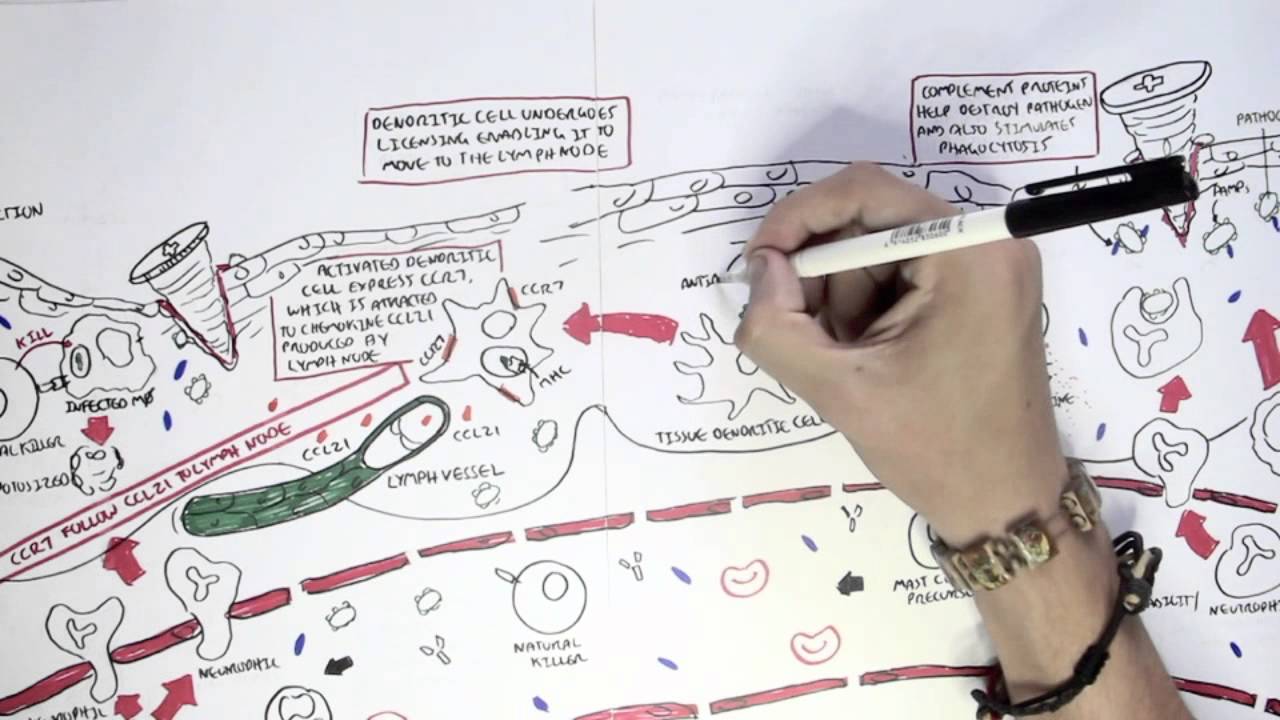
The video begins with a review of the previous discussion on plasma cells formed from immature B cells. It explains how both T helper and T killer cells leave lymph nodes to begin the immune response, circulating through lymphatic vessels to reach infected tissues. The T helper cells stimulate macrophages to engulf pathogens by secreting factors like interferon-gamma and TNF-alpha, while T killer cells target and destroy infected cells.
Role of Plasma Cells
Armando describes the long-lived plasma cells that continue circulating through the lymphatic and blood systems, where they secrete antibodies. These antibodies are crucial for mitigating infections by binding to pathogens, promoting phagocytosis, and preventing the spread of the infection to other areas of the body. The antibodies play a significant role in the Adaptive immune response.
Innate vs. Adaptive Immunity
The video shifts focus to the innate immune response, emphasizing the importance of inflammatory mediators. Armando explains that these mediators can enhance the immune response and cause pain. He categorizes inflammatory mediators into plasma protein-derived and cell-derived types, noting examples like complement proteins and histamine that are integral to the immune response.
Inflammatory Mediators
Cell-derived inflammatory mediators, such as serotonin and histamine, are discussed, highlighting their roles in vasodilation and increasing vascular permeability. Additionally, the video introduces arachidonic acid metabolites, which are secreted by macrophages and other cells and play various roles in inflammation. Prostaglandins promote vasodilation while leukotrienes contribute to vasoconstriction. Lipoxins are also mentioned as inhibitors of inflammation.
Conclusion and Future Topics
In the conclusion, Armando summarizes the overall picture of both the innate and adaptive immune systems. He teases upcoming content where he will explore mucosal immunity related to the lungs and gastrointestinal tract and discuss various hypersensitivity reactions. He encourages viewers to subscribe, share, and engage with the content.

