
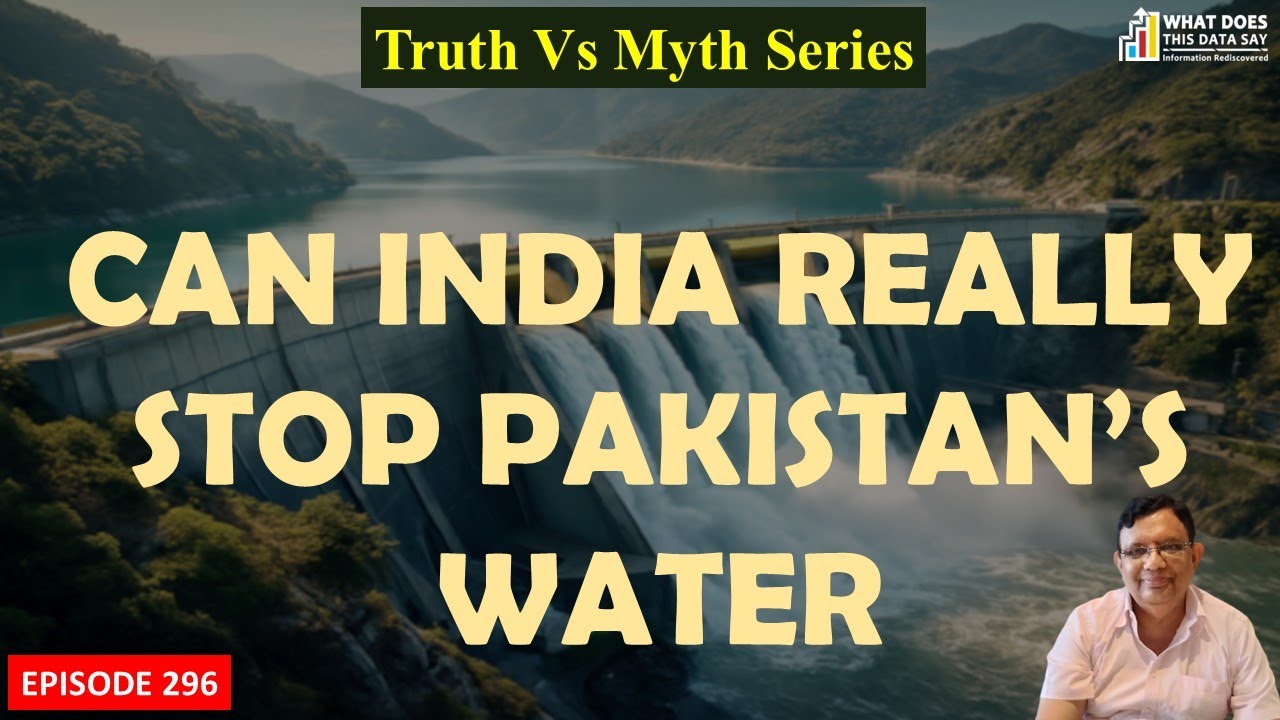
Brief Summary
This video addresses the claim that India has stopped the flow of Indus River water into Pakistan following a terror attack. It clarifies that while India has suspended the Indus Water Treaty, it lacks the infrastructure to physically stop the water flow. The video explains the limitations of India's current hydropower facilities, the geographical challenges of building large reservoirs, and the political implications of the treaty suspension.
- India's suspension of the Indus Water Treaty is largely symbolic, as it lacks the infrastructure to halt water flow.
- The existing hydropower projects on the western rivers have minimal storage capacity compared to the total river flow.
- Building sufficient storage to control the water flow is hindered by terrain, silt, seismic activity, and political factors.
Introduction: Has India Stopped Water to Pakistan?
The video begins by addressing the question of whether India has stopped the flow of Indus River water into Pakistan following the Pahelgam terror attack. It highlights the public narrative that emerged after the attack, with political leaders suggesting that India would prevent any water from flowing into Pakistan and potentially abandon the Indus Water Treaty of 1960. The video aims to separate the truth from the myth, asserting that India currently lacks the physical and engineering capabilities to completely stop the Indus River flow into Pakistan.
The Indus Water Treaty and Its Suspension
The Indus Water Treaty of 1960 divides the rivers of the Indus basin into two groups: the eastern rivers (Ravi, Basluch) allocated to India, and the western rivers (Indus, Jalam, Chennab) allocated largely for Pakistan's unrestricted use. When India placed the treaty in obeyance, it suspended data sharing, joint inspections, and other cooperative mechanisms, but it did not automatically stop the flow of the western rivers. This action carries significant political symbolism but does not equate to physically diverting or stopping the water.
India's Water Harnessing on Eastern Rivers
The video reviews how India has harnessed the water of the eastern rivers (Ravi, Bas, and Satluj) through the construction of storage dams. The Ranjit Saga Dam on the Ravi River has a gross storage of 1.25 billion cubic meters. The Pong Dam (Maharana Prattab Saga) on the Bas River has a gross storage of 8.57 billion cubic meters. The Gurugobin Saga reservoir of the Bhakarat Dam on the Satluj River has a gross storage of 9.6 billion cubic meters. The total storage capacity on these three rivers is about 20 billion cubic meters, with an active storage of about 16 billion cubic meters.
Hydropower Assets on Western Rivers
The video examines India's hydropower assets on the western rivers (Chinab, Jalam, and Indus) to determine the extent to which India can modulate the water flow. On the Chinab River, the major hydropower stations are Salal (690 MW), Dalhasti (390 MW), and BLihar (900 MW), all of which are run-of-the-river facilities with minimal active storage. The combined storage of these plants is around 44 to 45 million cubic meters, which is less than 0.03% of the western rivers' total annual flow. On the Jalam River, the key projects are UDI 1 (480 MW), UDI 2 (240 MW), Lower Jalam (105 MW), and Kishan Ganga (330 MW), all run-of-the-river with negligible storage. The Indus River has facilities like NIMU Basgo (45 MW) and Chutak (44 MW), which are also run-of-the-river with minimal pondage.
Comparison of Storage Capacity and River Flow
The video compares the available storage capacity with the total river flow of the western rivers. The Indus, Jalam, and Chinab rivers together deliver 135 to 136 million acre feet of water to Pakistan annually. The total storage capacity of all Indian reservoirs on these rivers is approximately 0.04 million acre feet, which is around 0.3% of the annual flow. Experts suggest that India would need at least 22 dams of the size of Harkra Nangal to meaningfully hold back Pakistan's water, a storage capacity that does not currently exist.
Challenges in Building More Storage
The video explains why India cannot simply build more storage on the western rivers. The terrain consists of steep, narrow Himalayan valleys unsuitable for large reservoirs. The Chennab and Jalam rivers are extremely silt-heavy, which would cause large storages to fill rapidly. The region is seismically active, increasing the risk of building large dams. Massive projects would also drown valleys, towns, and infrastructure, making them politically impossible. Additionally, even if approved, these dams would take 10 to 20 years to develop, making full stoppage technically unachievable in the long term.
Impact of Suspending the Indus Water Treaty
The suspension of the Indus Water Treaty primarily achieves political objectives rather than hydraological ones. It ends data sharing, halting the exchange of daily flow data, flood warnings, and project details with Pakistan, which raises uncertainty. It also freezes joint mechanisms, removing institutional transparency. The suspension creates strong political signaling, generating psychological pressure through statements suggesting the treaty may never be restored. However, these actions do not stop the physical flow of the Indus, Jalam, or Chinab rivers.
Potential Future Scenarios
The video considers the future scenario if all under-construction projects are completed. India is currently constructing several basin projects on the Chinab River, including Pakul Dul (1000 MW), Rattle (850 MW), and Kiru (620 MW). If all these projects are completed, India's total storage may reach 2% of the annual western river flow, allowing for timing manipulation in winter but not complete stoppage. Even with every project built, India would remain far from the 22 Bakhraiz dams required for true control.
Conclusion: Can India Stop Water to Pakistan?
The video concludes by answering the core question of whether India can stop water to Pakistan. Legally, suspending the treaty does not eliminate international obligations, and complete stoppage would trigger global backlash. Technically, India lacks the infrastructure, storage, and diversion capabilities. Hydraologically, the rivers are snow-fed and gravity-driven, flowing through India before entering Pakistan, and will continue to flow without huge storage. Politically, India can use water as a psychological and diplomatic tool, but practically, it cannot turn off the tap, not with current projects or even with the next wave of under-construction dams. The video reiterates that while India can cause temporary disruptions and political shockwaves, it cannot cut off the Indus or the Chinab with its present infrastructure.

