
Brief Summary
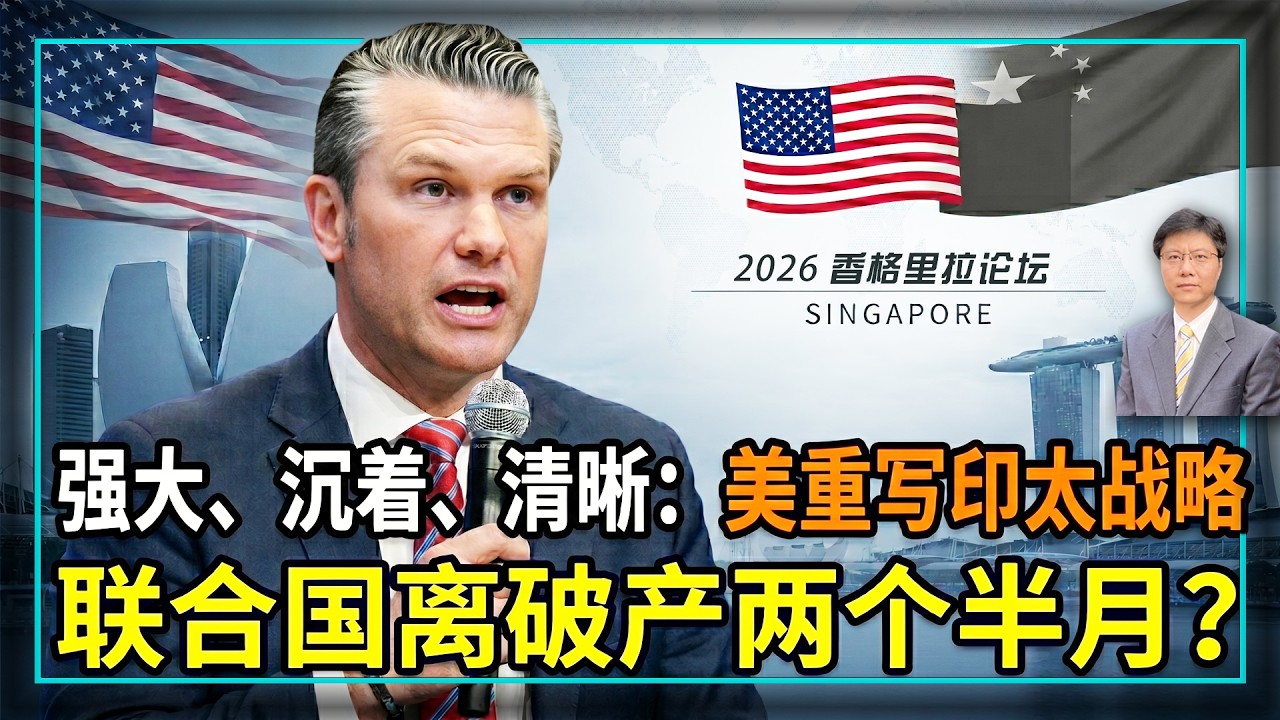
This video discusses U.S. Secretary of War Hegseth's speech at the Shangri-La Defense Forum, highlighting a shift in U.S. strategy towards the Indo-Pacific region and China. It emphasizes a move towards "high pressure with guardrails" in dealing with China, a focus on tangible contributions from allies ("commitment with a ledger"), and a re-evaluation of Taiwan's role in the broader U.S.-China competition. The video also touches on the United Nations' looming financial crisis, attributing it to the US and China payment issues, and the UN's struggle to maintain credibility amidst great power competition.
- The U.S. is adopting a "high pressure with guardrails" strategy towards China, focusing on deterrence and practical actions.
- The U.S. expects allies to demonstrate "commitment with a ledger," contributing tangibly to defense.
- Taiwan's strategic importance remains, but the U.S. is framing the issue within the broader U.S.-China competition.
- The UN faces a financial crisis due to payment issues and struggles with maintaining credibility amidst great power competition.
Introduction: Hegseth's Speech and Key Messages
The video introduces U.S. Secretary of War Hegseth's speech at the Shangri-La Defense Forum, emphasizing that it's more than just a routine U.S. statement on Indo-Pacific security. The speaker outlines three key messages from Hegseth's address: the U.S. commitment to the Indo-Pacific, a shift towards concrete deterrence against the CCP, and a demand for genuine partnership from allies. Hegseth's "strong calm clear" principle and the idea that "those who seek peace must prepare for war" encapsulate a new strategic notification to the Asia-Pacific region.
Shift in Security Language: From Ideals to Practicalities
The video highlights a significant change in the language of security, with Hegseth prioritizing military spending, production capacity, and technological advancements over traditional terms like "rules" and "values." This shift indicates a move towards materializing and engineering global security issues. The speaker attributes this change to the erosion of the international order by the CCP, which has undermined the belief that economic integration would tame geopolitical ambitions. The CCP's behavior, including its lack of reciprocity in trade and military expansion, has demonstrated that without hard power, even the most appealing rules are meaningless.
High Pressure with Guardrails: A New US Strategy Towards the CCP
The U.S. is moving away from mere verbal condemnations of the CCP towards a strategy of "high pressure with guardrails." This involves establishing "deterrence by denial" along the first island chain to make aggression unfeasible and irrational for the CCP. While reinforcing hard power and accelerating the formation of a denial system, the U.S. also aims to maintain communication and avoid misjudgments, reflecting a more institutionalized and controllable long-term competitive mechanism.
Responding to Provocative Questions: The Brunson Incident
The video analyzes Hegseth's response to a provocative question from a CCP official regarding U.S. Army General Brunson's statement about the U.S. military deployment in Korea being a "dagger pointed at the CCP." Hegseth cleverly defers to General Brunson, who reframes his statement as part of a military academic discussion, softening the tone while maintaining the core message of deterrence. This illustrates the "high-pressure with guardrails" strategy, balancing a strong stance with controlled communication.
Commitment with a Ledger: Demanding More from Allies
The U.S. is shifting its expectations of allies, moving from a model of political support in exchange for security to one of "commitment with a ledger." Allies are now expected to provide tangible contributions in budget, production capacity, and system integration. Hegseth's push for allies to meet a defense spending standard of 3.5% of GDP underscores this new approach, signaling that alliance qualifications will be measured by hard indicators. The U.S. aims to build a "capability ecosystem" by integrating allies into its military-industrial chain, supply chain, and technology chain.
Integrating Allies: Building a Capability Ecosystem
The U.S. is focused on expanding its war machine and replenishing resources by integrating allies into its capability system. This involves incorporating countries into its military-industrial chain, supply chain, data chain, technology chain, and logistics chain. The U.S. seeks to make more countries dependent on its systems in areas like production, maintenance, supply, and technology transfer, fostering true strategic alliances. The emphasis is on interoperability, with industries "entering the chain," technologies "aligning," and logistics "being compatible."
Low-Key Alignment: A New Path for Asian Countries
Many small and medium-sized Asian countries may not publicly take sides between China and the U.S., but they are likely to gradually align with the U.S. in a low-key, technical manner. This includes prioritizing equipment procurement compatible with the U.S. system, aligning supply chain collaboration with U.S. standards, deepening training cooperation, and integrating cybersecurity and data systems with the U.S. The U.S. is offering a path for these countries to integrate into its systems without having to publicly oppose China.
The Taiwan Question: Strategic Importance, Restrained Statements
Despite Taiwan's strategic importance, Hegseth did not emphasize it as a prominent issue in his speech, framing it within the broader context of U.S.-China competition. While reaffirming the U.S. position on Taiwan, Hegseth seems intentionally restrained in his public statements, aligning with Trump's overall approach. The U.S. strategy towards Taiwan involves maintaining its strategic importance while making public statements more restrained and compliant with Trump's approach.
The Brutal Reality: Power and the Erosion of Rules
The U.S. is integrating more Asian allies into its capability system, prompting the CCP to enhance its own chain and expand its military. This leads to a cycle of increased deployments and production, with everyone preparing for conflict more seriously. While the mainstream world previously focused too much on rules and theories, the new risk is that the world is starting to elevate power too high, undermining the credibility of rules and systems. The CCP's disregard for rules has led the U.S. to respond in kind, shifting the focus to strength.
The United Nations' Looming Bankruptcy: A Crisis of Credibility
The UN faces a potential bankruptcy due to funding shortages, primarily caused by the U.S. and China payment issues. The UN's financial dilemma is compounded by its inability to borrow money or massively cut down on its agencies. The UN has lost its fundamental independence and become a battleground for great power competition. The UN's credibility has been eroded, and it is now more about propping up a completely ineffective international order.

