
Brief Summary
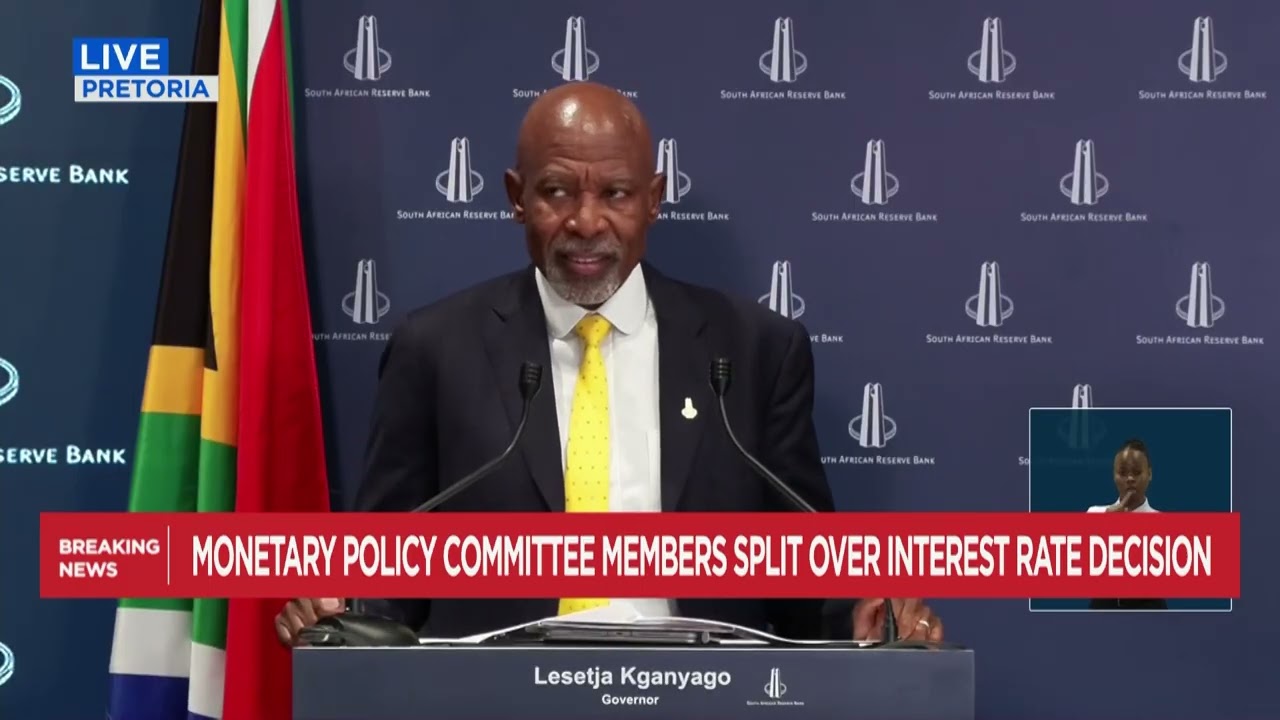
The South African Reserve Bank (SARB) has announced its decision to hold the repo rate steady at 6.75%. Governor Leja Kanyako cited global uncertainties such as geopolitical tensions, trade policy uncertainty, and elevated debt levels as key considerations. While inflation is expected to converge to the 3% target by 2028, the SARB presented scenarios stress-testing this path, considering both a stronger rand/lower oil price and a weaker rand/higher oil price. The decision reflects a balanced view of risks, with some members favoring a rate cut.
- Repo rate remains at 6.75%.
- Global uncertainties and domestic risks are balanced.
- Inflation is projected to reach 3% by 2028.
- Scenarios stress-test the inflation target path.
Introduction
The South African Reserve Bank (SARB) is announcing its latest monetary policy committee (MPC) decision, the first interest rate decision for 2026. Expectations are balanced between a rate cut of 25 basis points and a hold. The focus will be on the commentary and tone of Reserve Bank Governor Leja Kanyako, which will provide guidance on future monetary policy. The QPM model will also be closely watched to gauge the direction of interest rates for the rest of the year. The repo rate is currently at 6.75%, down from 8.25% at the start of the cutting cycle in early 2024.
Global and Domestic Economic Overview
Governor Kanyako begins by noting that 2026 has started with new shocks, including heightened geopolitical tensions and threats to central bank independence. Markets are jittery, leading to safe haven flows into precious metals like gold. Global imbalances are significant, with China's trade surplus reaching a record high and government debt growing rapidly in key economies like the US. Despite these fragilities, asset prices have been resilient, and global growth is holding up, supported by investments in AI and fiscal stimulus. Inflation slowed generally last year, allowing some central banks to adopt more neutral policies, and financing conditions for emerging markets remain benign. Turning to South Africa, growth looks steadier, with the economy expanding for four consecutive quarters, marking the longest unbroken growth phase since 2018, driven mainly by household consumption. Investment, however, has been weak, although there was a rebound in the third quarter of 2025. Forecasts show growth approaching 2% over the medium term, with some upside risks. Inflation last year was 3.2%, close to the 3% objective, but slightly higher towards the end of the year due to temporary factors. The December print came in at 3.6%, expected to be the peak, with inflation slowing from here due to a stronger rand and lower oil prices. Concerns remain about food inflation, especially meat prices affected by foot and mouth disease, and electricity prices due to NERSA's price correction. Inflation expectations have fallen, with longer-term expectations at record lows, which is important for stabilizing inflation at 3%. Goods price inflation is low, supported by the stronger rand, while services inflation is still over 4%.
Monetary Policy Decision and Outlook
The MPC has decided to keep the policy rate unchanged at 6.75%, with two members favoring a cut of 25 basis points and four preferring a hold. The quarterly projection model continues to forecast gradual rate cuts as inflation subsides, with rates reaching neutral levels during 2027. This rate path remains a broad policy guide, and decisions will continue to be taken on a meeting-by-meeting basis. Scenarios considered include a favorable one with a stronger rand and falling oil prices, and a more challenging one with a weaker rand and rising oil prices. In the adverse scenario, inflation peaks at 4%, delaying the convergence to the 3% target, while in the positive scenario, inflation gets as low as 2.3%, allowing for faster interest rate cuts. These scenarios show that even large shocks would not push inflation outside the tolerance range of 3% plus or minus one, and demonstrate how supply shocks interact with inflation expectations. Monetary policy appears well-positioned to manage the range of shocks that might come.
Conclusion and Future Economic Gains
2025 was a watershed year for the South African economy, with significant progress on domestic reforms, including a new inflation target. These efforts have been rewarded with lower borrowing costs, a rapid decline in inflation expectations, and steadier growth. Sustaining this progress is crucial for monetary policy, with the main contribution being to stabilize inflation at 3% over the next few years. Further gains in economic performance would come from reaching a prudent public debt level, lowering administered price inflation, and continuing structural reforms that raise potential growth.
Q&A Session - Global Risks and Inflation
Governor Kanyako addresses questions from the media, starting with an inquiry about the role of global factors in the decision to hold rates. She highlights heightened geopolitical tensions, trade policy uncertainty, and rising global debt levels as key global risks. Trade tensions, such as tariffs on South African exports to the US, impact the domestic economy. Domestically, electricity prices remain a risk. The risks to the inflation outlook are seen as balanced, with a strong rand and stable oil prices being positive factors.
Q&A Session - Inflation Targets and Rand Strength
The Governor addresses concerns about inflation running too hot and the reasons for holding rates. She clarifies that inflation is not running away and is expected to converge to the target by 2028. Scenarios were presented to stress test the path towards the target. Growth rising can only lead to inflation if it rises faster than potential growth, closing the output gap. The output gap is closing but is not yet a cause for concern. Regarding rand strength, she notes that central bankers do not control the exchange rate, and both push and pull factors have contributed to its strength. The rand has strengthened against many currencies, not just the dollar, and is the second-best performing currency in the emerging market universe. The adoption of a new inflation target has led to lower borrowing costs and a strengthening of the currency, as predicted. Fiscal policy and structural reforms are also contributing to the positive outlook.
Q&A Session - Global Trends and Recession Risks
The discussion addresses concerns about unsustainable global trends, specifically rising global debt and imbalances. The Governor clarifies that a reversal of these trends does not necessarily imply a recession, which is not something the bank is currently forecasting.

