
Brief Summary
This video features a discussion and presentation on two Tafsir books from Muhammadiyah: "Tafsir Sinar" by Buya Malik Ahmad and "Tafsir At-Tanwir" by the Muhammadiyah Tarjih and Tajdid Council. The presenters discuss the backgrounds of the authors, the sources and methods used in the interpretations, and the validity and characteristics of each Tafsir.
- Tafsir Sinar emphasizes reason and uses the order of revelation (tartib nuzuli).
- Tafsir At-Tanwir is a collective work that addresses contemporary issues and aims to awaken the ethos of Muhammadiyah members.
Introduction
The video begins with an introduction to a discussion on two Tafsir books: "Tafsir Sinar," authored by Buya Malik Ahmad, and "Tafsir At-Tanwir," written by the Muhammadiyah Tarjih Council. Both authors are affiliated with Muhammadiyah, with Buya Malik Ahmad being a respected figure from the 1970s and 80s. Tafsir At-Tanwir is a more recent collective effort that started around 2010-2015 and is published through the Suara Muhammadiyah magazine.
Tafsir Sinar by Buya Malik Ahmad: Biography and Sources
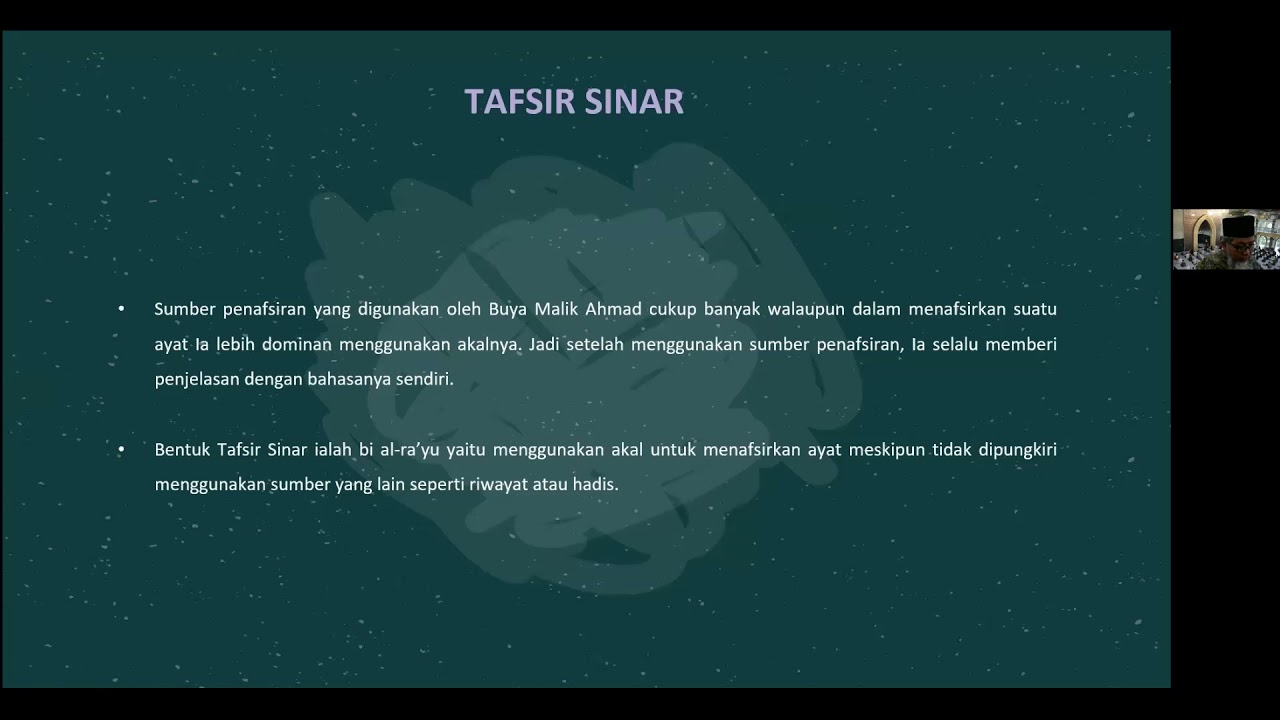
Group 7 presents on "Tafsir Sinar" by Abdul Malik Ahmad, born on July 7, 1912. His father, Ahmad bin Abdul Murid, was an Islamic reformer who studied in Mecca with Sheikh Ahmad Khatib al-Minangkabawi. Buya Malik Ahmad's interpretation relies heavily on reason while also using sources like the Quran, Hadith, and history. He often provides explanations in his own words after referencing these sources.
Sources Used in Tafsir Sinar: Quran, Hadith, and Sirah Nabawi
Buya Malik Ahmad uses the Quran as the primary source of interpretation, clarifying verses by relating them to other verses. For example, he interprets the word "rights" (al-haq) by referencing other Quranic verses that define truth as that which comes from Allah. He also uses Hadith, such as when interpreting Surah al-Mudatsir, verse 56. Additionally, he references Sirah Nabawi by Ibn Hisham and Ibn Ishaq, particularly when interpreting verses related to historical events like the compromise offer in Surah Al-Qalam.
Use of Companions' and Tabiin's Interpretations in Tafsir Sinar
Buya Malik Ahmad often incorporates the views of the companions of the Prophet and the Tabiin (followers of the companions) in his Tafsir, especially concerning the reasons for revelation (asbabun nuzul). For instance, he cites Ibn Abbas's account of the revelation of Surah al-Muzzammil. He also uses these sources to explain the meanings of verses, such as the interpretation of Surah Al-Muzzammil verse 20, which emphasizes balancing worship with worldly responsibilities.
Reasoning and Methodology in Tafsir Sinar
Buya Malik Ahmad is known for his extensive use of reason (ra'yi) in interpreting the Quran. While he uses reference sources, he always adds his own explanations based on his understanding. His method is considered "Tafsir bir-ra'yi," which involves interpreting the Quran using ijtihad (independent reasoning) and established rules. He employs a nozoeli interpretation method, following the order of appearance of the Surahs.
Validity and Epistemology of Tafsir Sinar
The validity of "Tafsir Sinar" is assessed using the theories of coherence and pragmatism. The coherence theory is supported by the use of asbabun nuzul and munasabah (contextual relevance). The pragmatism theory is validated by the interpretation's usefulness in enriching knowledge and providing insights. The sources used include the Quran, Hadith, sayings of companions and Tabiin, previous Tafsir books, and Buya Malik Ahmad's own thoughts.
Tafsir At-Tanwir: Introduction and Compilers
Group 13 presents on "Tafsir At-Tanwir" by the Muhammadiyah Tarjih and Tajdid Council. This council was founded in 1927 and officially formed in 1928. The establishment of the Tarjih Council was driven by internal factors, such as the need to unify diverse Muhammadiyah members, and external factors, such as disputes on religious issues. The council's function is to weigh and choose the strongest opinions based on the Quran and Sunnah.
Purpose and Characteristics of Tafsir At-Tanwir
The name "At-Tanwir" (enlightenment) reflects Muhammadiyah's mission to enlighten the people. The Tafsir aims to present interpretations of previous scholars in a more contextual format. The purposes of compiling "Tafsir At-Tanwir" are to provide a reading of the Quran within Muhammadiyah's mission, fulfill the aspirations of Muhammadiyah members for a collectively compiled interpretation, and utilize the Quran to build a progressive Indonesian civilization. It is a collective work by a team with diverse scientific backgrounds.
Methodology and Systematics of Tafsir At-Tanwir
"Tafsir At-Tanwir" uses the tahlili (analytical) and maudhui (thematic) methods, compiling verses from various Surahs on the same topic. Its characteristics include being responsive to current issues, touching on both the spiritual and rational aspects of the reader, and awakening the ethos of Muhammadiyah members. The systematics of the Tafsir are arranged like a scientific paper, including a foreword, transliteration guidelines, table of contents, bibliography, and a list of authors.
Interpretation of Hypocrisy in Tafsir At-Tanwir (Surah Al-Baqarah 204-207)
The presentation includes an interpretation of Surah Al-Baqarah verses 204-207, which discuss the nature of hypocrisy. Hypocrites are portrayed as those who outwardly accept the truth but are strong opponents of it internally. They cause damage on earth when they become leaders, enriching themselves while neglecting the people. They are also proud to commit sins and reject advice, ultimately facing punishment in hell.
Discussion and Q&A
The session concludes with a discussion and Q&A. Questions are raised about the historical sources used in "Tafsir Sinar" and the potential for "Tafsir At-Tanwir" to evolve and adapt to future contexts. The presenters clarify that "Tafsir Sinar" primarily uses Ibn Abbas as a source for asbabun nuzul and that "Tafsir At-Tanwir" is based on tarjih decisions that incorporate scientific theories and empirical data, allowing for potential changes in interpretation over time.

