
Brief Summary
This video explains the importance of financial statements for pharmacy students and entrepreneurs. It covers the types of financial reports (balance sheet, income statement, changes in equity, and cash flow), how to analyze them, and key financial ratios for assessing business performance. The lecture emphasizes understanding financial health, identifying weaknesses, and making informed decisions for business growth.
- Importance of financial statements for pharmacy entrepreneurs.
- Types of financial reports and their components.
- Financial ratio analysis for business assessment.
- Using financial data for strategic decision-making.
Introduction: The Importance of Financial Statements
The lecture begins by emphasizing the relevance of financial statements for pharmacy students, especially those interested in entrepreneurship. While pharmacy education often focuses on practical and technical skills, understanding financial statements is crucial for managing and growing a business, whether it's a small pharmacy or a larger innovation venture. The ability to interpret and report financial data becomes essential when seeking investments or expanding business operations.
Types of Financial Statements
The discussion covers the primary types of financial statements used in business. These include the balance sheet (which shows a company's assets, liabilities, and equity at a specific point in time), the income statement (which details revenues, expenses, and profits over a period), the statement of changes in equity (which explains changes in a company's capital), and the statement of cash flows (which tracks the movement of cash both into and out of a company). These reports are vital for assessing the financial health and viability of a business.
Balance Sheet (Neraca)
The balance sheet provides a snapshot of a company's financial position at a specific point in time, detailing assets (what the company owns) and liabilities (what the company owes). Assets are categorized as either current or non-current, while liabilities are divided into current and long-term. The balance sheet adheres to the accounting equation: Assets = Liabilities + Equity.
Income Statement (Laporan Laba Rugi)
The income statement, also known as the profit and loss statement, summarizes a company's financial performance over a specific period. It reports revenues, expenses, and net income (or net loss). By analyzing the income statement, one can determine a company's profitability and efficiency.
Statement of Changes in Equity (Laporan Perubahan Modal)
This statement outlines the changes in a company's equity over a reporting period. It includes details such as the initial capital, additional investments, net income, dividends, and any other factors affecting equity. It helps stakeholders understand how the ownership stake in the company has evolved.
Statement of Cash Flows (Laporan Arus Kas)
The statement of cash flows reports the movement of cash both into and out of a company during a specific period. It categorizes cash flows into operating, investing, and financing activities. This statement is crucial for assessing a company's liquidity and ability to meet its short-term obligations.
Notes to Financial Statements
Notes to financial statements provide additional details and explanations that are essential for understanding the financial data presented. These notes clarify accounting policies, provide breakdowns of specific line items, and disclose any significant events or transactions that impact the company's financial position. They enhance the transparency and reliability of the financial statements.
Analyzing Financial Statements
Analyzing financial statements involves using various tools and techniques to evaluate a company's financial performance and position. This includes calculating financial ratios, comparing performance to industry benchmarks, and identifying trends over time. The goal is to gain insights into a company's profitability, liquidity, solvency, and efficiency.
Benefits of Financial Statement Analysis
Financial statement analysis helps in understanding the financial position of a company, identifying weaknesses, and recognizing strengths. It aids in making necessary improvements and evaluating management performance. Additionally, it serves as a benchmark against competitors, providing insights for strategic decision-making.
Analysis of Sources and Uses of Working Capital
Analyzing the sources and uses of working capital is crucial for financial managers. It helps in understanding how funds are being utilized and how needs are being financed. This analysis involves preparing a statement of changes in the balance sheet to track the movement of working capital over time.
Objectives of Working Capital
The objectives of managing working capital include ensuring sufficient liquidity, meeting obligations, maintaining adequate inventory, and securing additional funding. Effective working capital management is essential for the smooth operation and growth of a business.
Sources of Working Capital
Working capital can come from tangible assets (equipment, land, buildings, cash) and intangible assets (licenses, patents). Human resources and their capabilities also contribute significantly to a company's working capital. These elements are crucial for achieving business goals and attracting investors.
Financial Ratio Analysis: Structure of Capital Ratios
Financial ratio analysis involves evaluating various ratios to assess a company's financial health. Capital structure ratios, such as the equity-to-asset ratio and the debt-to-equity ratio, provide insights into how a company is financed and its ability to meet its obligations.
Total Asset Turnover
Total asset turnover measures a company's ability to generate revenue from its assets. A higher turnover ratio indicates that a company is using its assets efficiently to generate sales. The formula is Revenue / Total Assets, and a ratio of at least one is generally desirable.
Activity Ratios
Activity ratios, such as current asset turnover and inventory turnover, assess how efficiently a company is using its assets. Inventory turnover, for example, measures how quickly a company is selling its inventory, with a target range of 12 to 24.
Days Sales Outstanding (DSO)
Days Sales Outstanding (DSO) measures the average number of days it takes for a company to collect payment after a sale. A lower DSO indicates that a company is collecting payments quickly. The target range is typically between 50 to 70 days, depending on the industry and payment terms.
Profitability Ratios
Profitability ratios measure a company's ability to generate profits relative to its revenue, assets, and equity. These ratios include gross profit margin, operating profit margin, and net profit margin. They provide insights into a company's efficiency and ability to control costs.
Operating Margin Ratio
The operating margin ratio measures a company's profitability from its core operations. A higher operating margin indicates that a company is generating more profit from each dollar of sales. A good range is between 5% and 20%.
Return on Assets (ROA) and Return on Equity (ROE)
Return on Assets (ROA) measures how efficiently a company is using its assets to generate profit. Return on Equity (ROE) measures how efficiently a company is using its equity to generate profit. These ratios are important for investors to assess the profitability of their investment.
Point of Sale (POS) Systems for Financial Analysis
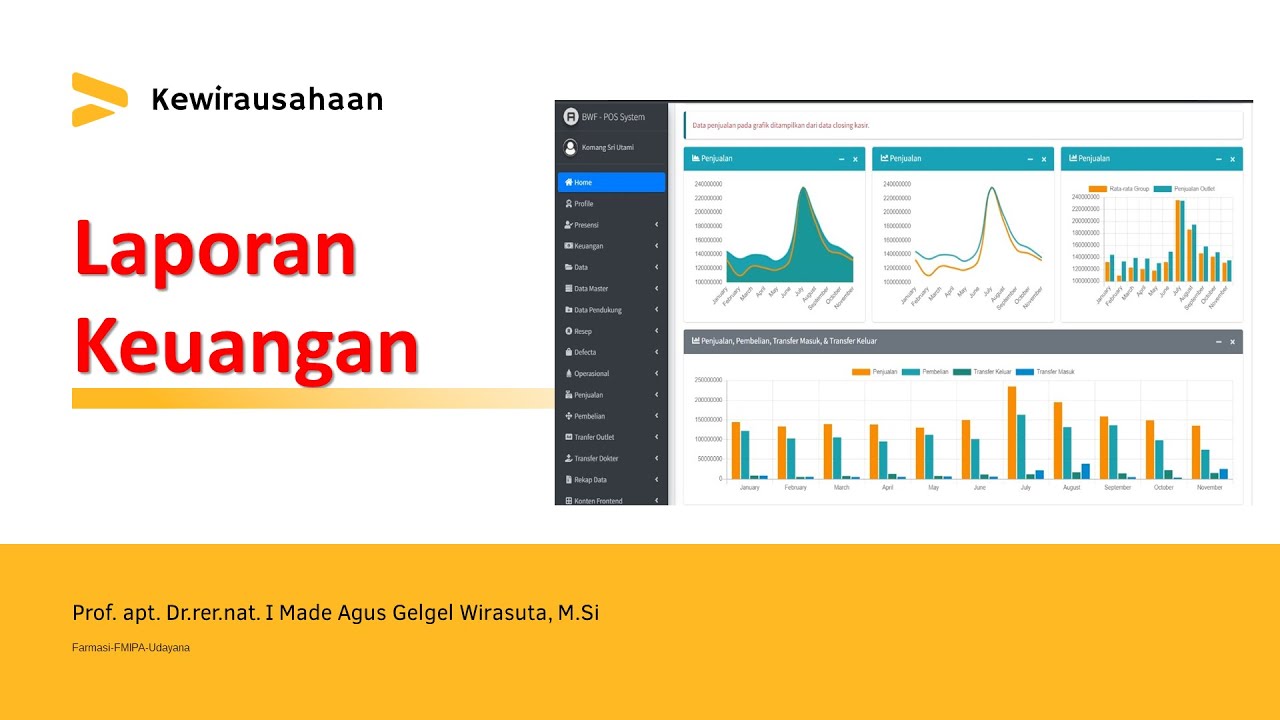
The lecture highlights the use of Point of Sale (POS) systems for real-time financial analysis. These systems provide daily insights into sales, inventory, and customer behavior, enabling businesses to make informed decisions about purchasing, pricing, and marketing.
Conclusion: The Importance of Financial Literacy
The lecture concludes by reiterating the importance of financial literacy for pharmacy professionals and entrepreneurs. While pharmacists may not be trained as accountants, understanding financial statements is crucial for managing and growing a successful business. The availability of technology and software solutions makes financial analysis more accessible and efficient.

