
Brief Summary
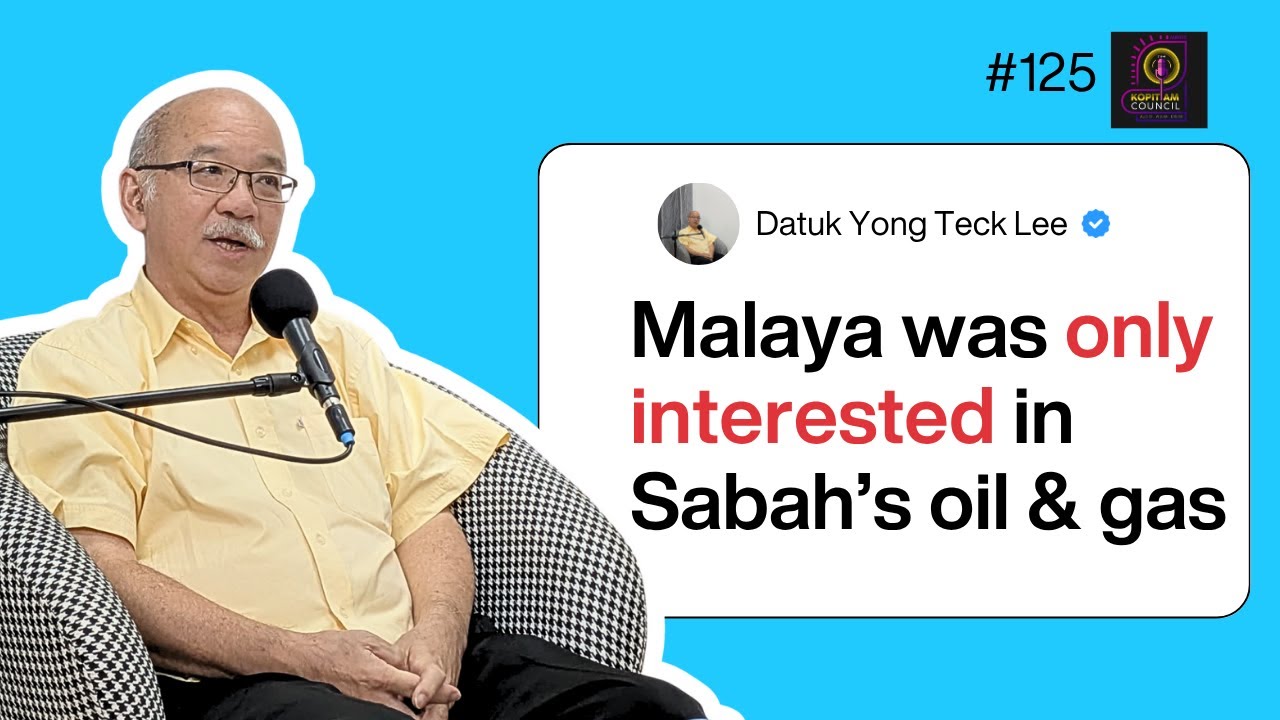
This episode of Kopitiam Council features veteran Sabah politician and lawyer, Nat Sri Panga Yongi, discussing his political journey, Sabah's development, and key issues facing the state. He shares insights on the rotation system for Chief Minister, the formation of SAPP, the challenges of working with national parties, and the importance of local parties collaborating for Sabah's autonomy. Yongi also addresses concerns about Chinese investment and the Belt and Road Initiative, advocating for a stronger, fearless state government to negotiate for Sabah's rights and economic well-being.
- Yongi discusses his early political involvement, triggered by the federalization of Labuan, and his experience as Chief Minister.
- He explains the rationale behind forming SAPP to ensure Sabah's inclusion in national development.
- Yongi critiques the influence of national parties and advocates for local party collaboration, drawing parallels with Sarawak's successful model.
- He addresses concerns about Chinese investment, emphasizing the importance of accessing China's market while protecting local businesses.
- Yongi stresses the need for a strong state government to negotiate for Sabah's autonomy and fair revenue sharing, referencing the 40% revenue entitlement and continental shelf issues.
Introduction
The Kopitiam Council introduces Nat Sri Panga Yongi, a veteran Malaysian politician and lawyer from Sabah. He is known for serving as the 10th Chief Minister of Sabah from 1996 to 1998 and is the founder of the Sabah Progressive Party (SAPP). The hosts highlight his current roles as Chairman of PIC Sabah and a nominated member of the state legislative assembly, setting the stage for a discussion about his political background and perspectives on Sabah's development.
Early Political Career and Motivation
Yongi recounts his early involvement in politics, starting in 1984. His decision to join competitive politics was triggered by the federalization of Labuan. He believed that the electoral process was the only way to address such major developments. He joined the PBS party in 1985 and emphasizes that neither he nor his friends initially believed they could form a government.
Chief Ministership and the Rotation System
Yongi reflects on becoming Chief Minister at 37, which was unexpected. He discusses the two-year rotational system among Sabah's three main ethnic groups, designed to prevent any single group from dominating political power. He notes that the system, while unprecedented, aimed to share power and provide stability by maintaining the civil service and administrative systems despite changes in leadership. He describes his time as Chief Minister as hectic but acknowledges the support of a strong team.
Formation of SAPP and National Mainstream
Yongi explains the rationale behind forming SAPP, stating that it was created because Sabah was outside the mainstream of national development. He clarifies that SAPP aimed to bring Sabah into the national mainstream, not to integrate national parties into Sabah's mainstream. He discusses the changing political landscape, including the decline of national parties and the rise of local parties, particularly after the 2008 and 2013 elections.
GRS Coalition and PH Influence
Yongi discusses SAPP's involvement with the Gabungan Rakyat Sabah (GRS) coalition and its subsequent exit. He expresses his reservations about working with Pakatan Harapan (PH), particularly DAP, citing concerns about unrealistic promises and what he perceives as scams. He contrasts the political dynamics in Sabah with Sarawak, where a 100% local party government has been successful. He emphasizes that Sabah should learn from Sarawak and align with the spirit of MA63, advocating for a Sabah government consisting only of local parties.
Kinabalong Move and Attempts to Collaborate with Warisan
Yongi reveals that during the Kinabalong move, he attempted to reach out to Warisan to form a Sabah local party government. He was surprised that Bung Moktar thought he had the numbers to form a government. He tried to contact Shafie Apdal but was unsuccessful in getting him to collaborate in time. He expresses hope that local parties will work together to win the upcoming election, but notes Shafie's stance of contesting all 73 seats, which closes the door to other parties.
Electoral Cooperation Among Local Parties
Yongi emphasizes the need for electoral cooperation among local parties, including KDM, to achieve a realistic chance of winning a simple majority. He refutes the notion that any single party can contest all 73 seats and win on its own. He clarifies that unlike the past, where coalitions were often defined by racial or religious lines, all local parties today are multi-racial.
CCP Subnational Influence in Malaysia
Yongi addresses allegations of affiliation with CCP influence platforms, stating that SAPP has no connection with any political parties outside Malaysia, including the CCP. He dismisses the hypothesis of CCP influence as a Western narrative and points out inaccuracies in the referenced article.
Belt and Road Initiative (BRI) and East ASEAN
Yongi discusses the Belt and Road Initiative (BRI), noting that it has not benefited East ASEAN, which includes Sabah, Brunei, and Kalimantan. He criticizes Beijing's approach of dealing only with national governments, which results in funds being hijacked to other areas. He argues that the BRI should focus on developing less developed provinces far from national capitals. He views the BRI as an alternative source of development funds but cautions against falling into a "debt trap."
Chinese Investment and Local Business Protection
Yongi addresses concerns about Chinese investment in Sabah, stating that China's biggest asset is its market. He suggests that having Chinese investors in Sabah can help local businesses penetrate the Chinese market. He acknowledges that some Chinese contractors face challenges due to infrastructure problems and higher unit costs. He stresses the importance of protecting local businesses and contractors from being displaced by more competitive Chinese or West Malaysian companies. He also highlights the need to address the lack of capital and management know-how among local businesses.
Priorities for the New Government
Yongi outlines priorities for the new government after the upcoming elections, emphasizing the need to engage with trade associations and chambers of commerce to identify areas where the influx of big businesses should be restricted. He suggests putting conditions on trade licenses to protect local businesses from dumping practices. He also points out specific examples, such as the city hall car parking app being managed by a West Malaysian company, and suggests bringing such services back to Sabah.
40% Revenue Repayment and Financial Autonomy
Yongi stresses the need for a strong and fearless state government to ensure the 40% revenue repayment from the federal government. He emphasizes that leaders should not be compromised by corruption charges or other vulnerabilities. He suggests that taxes should be collected in Sabah, with the state retaining 60% and remitting 40% to the federal government. He also highlights the issue of big companies doing business in Sabah but paying taxes in Kuala Lumpur, advocating for the consolidation of Sabah's business operations to ensure proper tax allocation.
Negotiating with the Federal Government and Learning from Sarawak
Yongi compares Sabah's approach to negotiating with the federal government to that of Sarawak, noting that Sarawak is often more prepared and effective in its demands. He reiterates the importance of not negotiating out of fear and suggests engaging veterans and retired civil servants in negotiations with Petronas. He also emphasizes the need to support the continental shelf case and prioritize political autonomy for Sabah, consistent with MA63.
Perfect Storm and Declassified Documents
Yongi describes a "perfect storm" of factors that have brought Malaysia to its current state: a more educated population, the internet and social media, and the declassification of previously secret documents. He notes that these declassified documents reveal promises made to Sabah and Sarawak, as well as the British concerns about Malaysia becoming a new colonial power.
Parliamentary Seats and Equal Status
Yongi expresses skepticism about increasing parliamentary seats for Sabah and Sarawak, noting that any increase would likely be accompanied by an increase for Malaya, maintaining the imbalance. He criticizes the promise of "equal status" as a scam, questioning whether it truly equates Sabah to Malaya. He suggests that amending the constitution to increase Sabah's representation is unlikely, given the current political dynamics.
Personal Interests and Closing Remarks
Yongi shares that his favorite travel destination is his hometown, Lad, where he enjoys watching birds. He mentions that he is currently reading about Confucianism and Islamic civilization in preparation for a keynote speech. The hosts thank Yongi for sharing his insights and war stories, highlighting the unique perspective he brings as a veteran politician.

