
Brief Summary
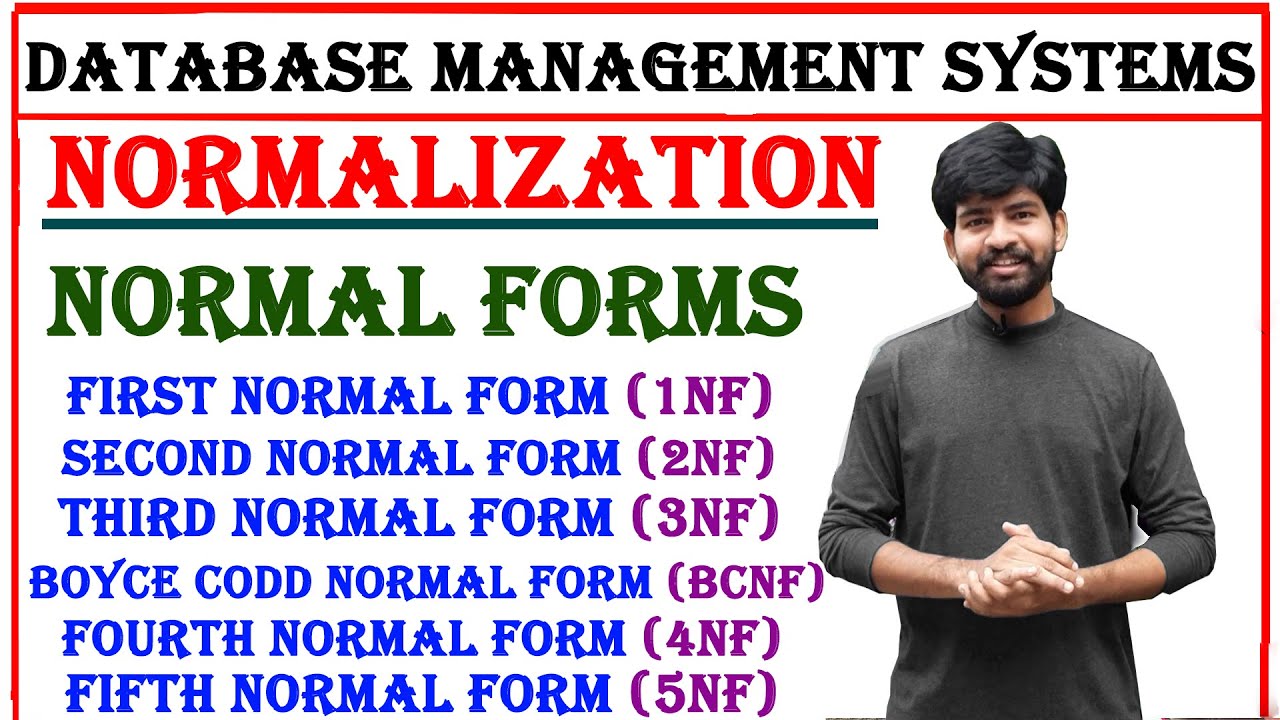
This video explains database normalization, a process of organizing data to reduce redundancy and improve data integrity. It covers various normal forms (1NF, 2NF, 3NF, BCNF, 4NF, and 5NF) with examples, detailing the advantages and disadvantages of normalization, including how it eliminates anomalies like insertion, update, and deletion errors.
- Normalization reduces data redundancy by eliminating duplicate values.
- Different normal forms have specific rules to ensure data integrity and consistency.
- Higher normal forms may decrease performance due to increased complexity.
Introduction to Normalization
Normalization, also known as schema refinement, is the process of organizing data in a database to reduce data redundancy, which refers to duplicate values. Data redundancy can lead to anomalies or errors in the database. Database administrators use normalization to maintain the database effectively by removing these anomalies. The goal is to bring the database to a consistent state by eliminating issues like data redundancy and integrity problems that arise as the database grows.
Anomalies in Databases
Data redundancy leads to anomalies such as insertion anomalies, where data cannot be inserted due to missing columns; updation anomalies, which occur when the same data items are repeated with the same values; and deletion anomalies, where deleting one part of the data deletes other necessary information. Normalization uses a series of stages called normal forms, each applying constraints or rules to the table.
Advantages and Disadvantages of Normalization
Normalization offers several advantages, including the removal of duplicate values, ensuring data consistency (correctness), and maintaining data integrity (completeness). However, it also has disadvantages. Performing fourth and fifth normal forms can decrease performance, and the first normal form disallows multi-value attributes, meaning it does not support multiple values in a single column.
First Normal Form (1NF)
A relation is in 1NF if it contains only atomic values, meaning single values in each column. If any column contains multiple values, the table is not in 1NF. To convert a table to 1NF, multi-value attributes must be converted into single-value attributes by creating new records for each value.
Second Normal Form (2NF)
A relation is in 2NF if it is in 1NF and contains no partial dependency, meaning the primary key should not contain duplicate values. If there are duplicate values in the primary key column, the table has partial dependency and must be split into multiple tables to remove this dependency. One table contains the primary key and other attributes, while another table contains the primary key and the dependent attributes.
Third Normal Form (3NF)
A table is in 3NF if it is in 2NF and there is no transitive dependency for non-prime attributes. Transitive dependency occurs when one non-primary key attribute depends on another non-primary key attribute. To achieve 3NF, the table must be in 2NF, and any transitive dependency must be removed by creating separate tables for the dependent attributes.
Boyce-Codd Normal Form (BCNF)
BCNF, also known as 3.5 normal form, is an extension of 3NF with stricter rules. A table is in BCNF if it is in 3NF, and for any dependency where column B depends on column A, column A must be a super key. If a column is not a super key, the table is not in BCNF and must be divided into multiple tables to satisfy this condition.
Fourth Normal Form (4NF)
A relation is in 4NF if it is in BCNF and has no multi-value dependency. Multi-value dependency occurs when two non-primary key columns depend on a single primary key column. To remove multi-value dependency and achieve 4NF, the table must be split into multiple tables, each with only one non-primary key column depending on the primary key column.
Fifth Normal Form (5NF)
A relation is in 5NF if it is in 4NF and does not contain any joint dependency. Joint dependency means one column depends on another column. To achieve 5NF, the large table must be broken down into smaller sub-tables, and any duplicate values must be removed. Each sub-table represents a different dependency, ensuring there is no redundancy.

