
Brief Summary
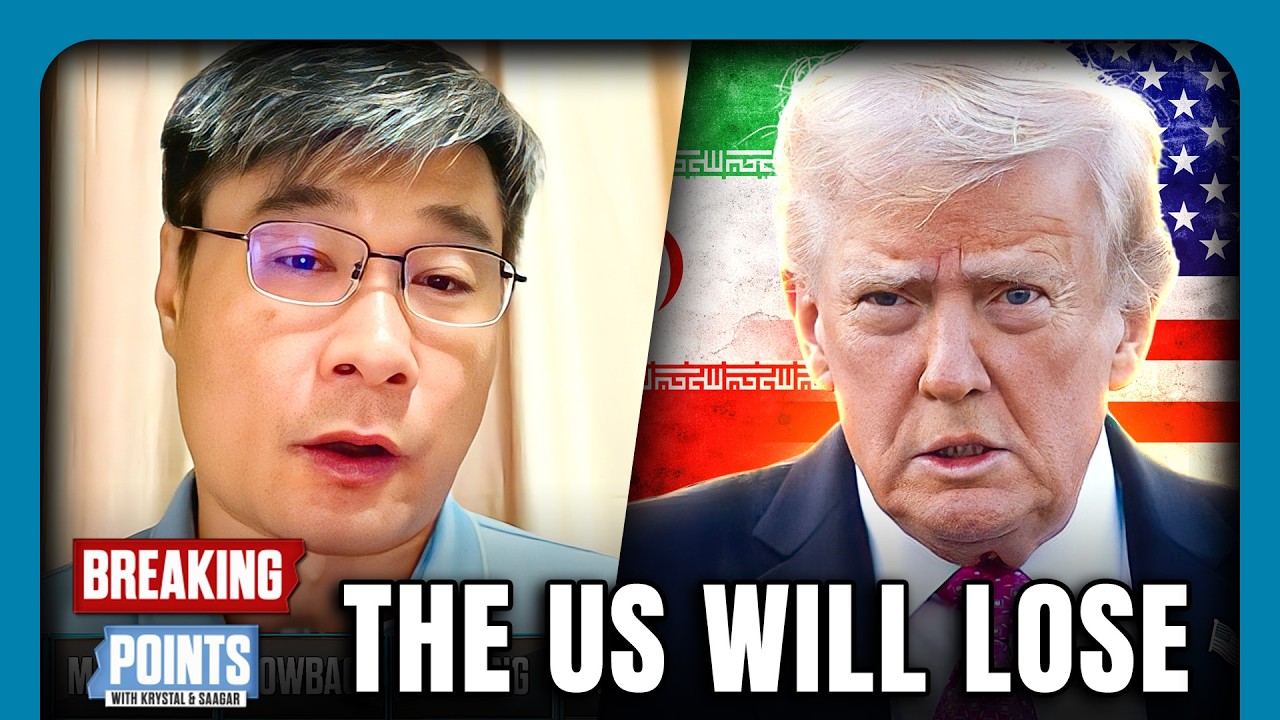
In this episode of Breaking Points, Professor Cien from the YouTube channel Predictive History discusses his predictions regarding a potential war between the United States and Iran. He stands by his prediction that the U.S. will lose such a conflict, citing Iran's strategic advantages, the unsustainability of the U.S.'s current military approach, and the potential collapse of the petrodollar system. The conversation also explores the possibility of U.S. ground troops being deployed in Iran, the motivations behind a potential U.S. attack on Iran, and the broader geopolitical implications of the conflict.
- Iran has prepared for a war of attrition with the U.S. for 20 years, and has been practicing through its proxies.
- The U.S. military is not designed to fight a 21st-century war, relying on expensive, unsustainable technology.
- A U.S. invasion of Iran is possible, driven by pressure from the GCC countries and Israel, despite a lack of public support.
- Trump's decision to engage in conflict with Iran may be influenced by hubris, personal financial gain, and eschatological beliefs.
Predictions and Iran's Advantages
Professor Cien begins by reaffirming his prediction that the United States will lose a war against Iran. He argues that Iran has several advantages, including 20 years of preparation for such a conflict, viewing it as a religious war against the "Great Satan." Iran has been studying the strike capabilities of the U.S. and Israel, and its proxies like the Houthis, Hezbollah, Hamas, and Shia militias have gained a good understanding of the American mentality. Iran is waging war against the global economy by targeting the critical energy infrastructure of GCC countries, including potential strikes on water desalination plants, which provide 60% of the GCC's water supply. The closure of the Strait of Hormuz by Iran could threaten the very existence of Saudi Arabia, UAE, Bahrain, and Qatar, which are crucial to the American economy through the petrodollar system and investments in the U.S. stock market and AI sector.
Munitions and Military Strategy
The discussion shifts to the United States' munitions and military strategy, highlighting the asymmetry in cost between U.S. interceptors and Iranian missiles and drones. The U.S. military is described as being designed for Cold War-era muscle flexing rather than 21st-century warfare, relying on expensive and sophisticated technology that is not sustainable in the long term. This situation is puncturing the aura of invincibility that has sustained American hegemony for the past 20 years, signaling a reordering of the global economy and a move towards a multipolar world.
Potential Ground Invasion
Professor Cien addresses the possibility of the U.S. invading Iran with ground troops, noting that Secretary of War Pete Hexath did not rule out the option. While such a move is considered the worst-case scenario, the U.S.'s commitment to regime change in Iran may necessitate it, as air power alone is unlikely to achieve this goal. Pressure from GCC countries and Israel, which are being targeted by Iran, could push the U.S. to either bribe Iran with a massive indemnity or deploy ground troops to eliminate the Iranian threat. Despite a lack of public support for military action against Iran, the U.S. may still proceed, especially if the GCC countries, which are vital to the petrodollar system, are at risk.
Motivations Behind Attacking Iran
The conversation explores the motivations behind a potential U.S. attack on Iran, including the role of Saudi Arabia and Israel. Both countries are seen as heavily invested in regime change in Iran, with Saudi Arabia viewing Iran as a greater existential crisis due to its reliance on oil and the theocratic opposition of Iran. Saudi Arabia's economy is suffering, and it needs to control the oil resources of the Middle East to survive. Despite Saudi Arabia's claims of wanting peace, it is helping Israel and the U.S. by allowing them to use its airspace.
Trump's Calculus
Professor Cien discusses the reasons why Trump might decide to attack Iran, despite warnings from top military officials. He suggests three possibilities: hubris, internal political calculus, and eschatological factors. Hubris, stemming from the successful Muro kidnapping, may have made Trump overconfident in the American military's capabilities. Trump may also be benefiting financially and politically from bribes from the Saudis and Israelis, who are investing in his son-in-law's private equity fund and financing his vocal career. Additionally, a war with Iran could give Trump emergency war powers, allowing him to influence the midterms and potentially secure a third term. Finally, eschatological beliefs held by secret societies, such as the Illuminati, which control the military and national security apparatus, may be driving the conflict as part of a script to create heaven on earth.

