
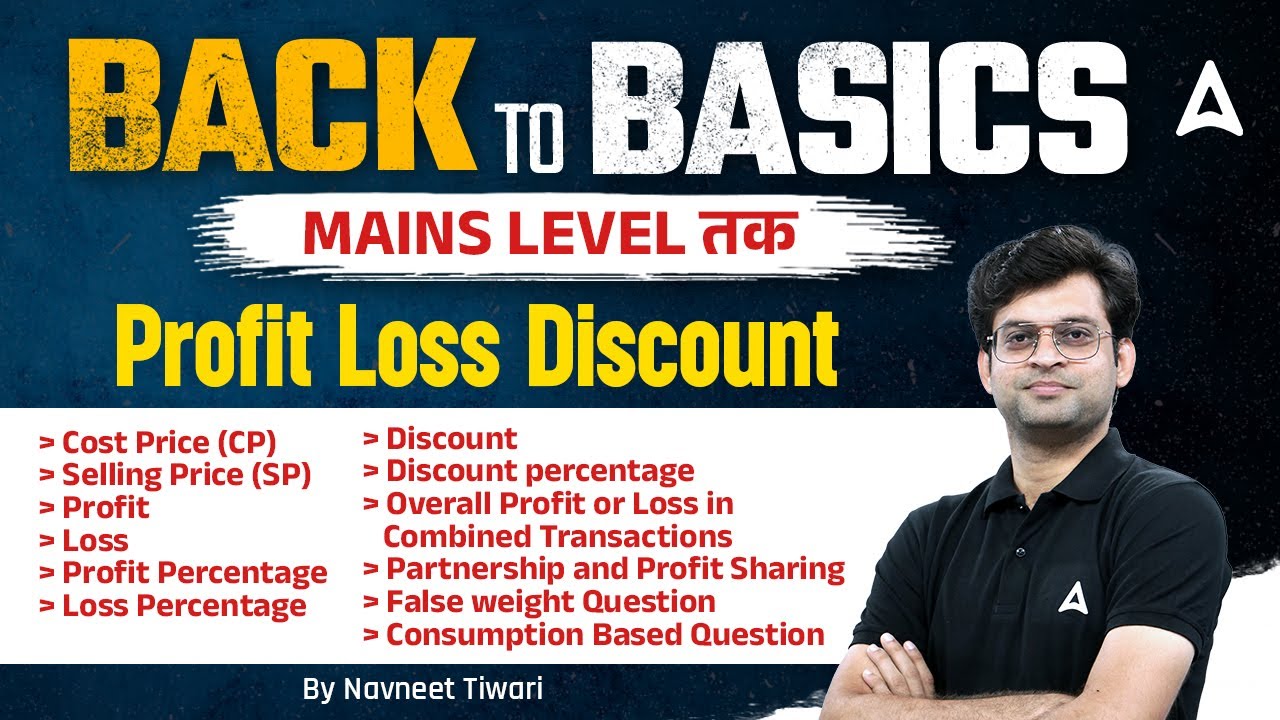
Brief Summary
This YouTube video by Adda247, features Navneet Tiwari, who provides an in-depth explanation of profit and loss concepts. The session aims to address common difficulties students face with this topic, offering solutions to understand basic to advanced problems. The lecture covers fundamental terms, formulas, and various approaches to solving profit and loss questions, including percentage increase/decrease, chain approach, zoom approach, and more.
- Basic concepts of cost price (CP), selling price (SP), profit, and loss are explained.
- Formulas for calculating profit percentage and loss percentage are derived and applied.
- Advanced techniques like chain approach and zoom approach are introduced for efficient problem-solving.
Introduction
The instructor, Navneet Tiwari, welcomes viewers to the session, highlighting that many students find profit and loss a challenging topic despite understanding basic arithmetic. He assures that by the end of the video, viewers will not only understand the concepts but also find the topic enjoyable. The video aims to provide a comprehensive understanding suitable for students from class 6 to competitive exam aspirants.
Basic Concepts: CP, SP, Profit, and Loss
The session begins with the basic definitions of cost price (CP), the price at which an item is bought, and selling price (SP), the price at which an item is sold. Profit occurs when the selling price is greater than the cost price, and loss occurs when the selling price is less than the cost price. Formulas for calculating profit (SP - CP) and loss (CP - SP) are introduced.
Relating Profit and Loss to Cost Price
The lecture explains that profit and loss are always based on the cost price. Without knowing the CP, it's impossible to determine profit or loss. This leads to the formulas for profit percentage (Profit / CP * 100) and loss percentage (Loss / CP * 100).
Basic Questions and Profit Percentage
The instructor provides example questions to calculate profit and profit percentage. For instance, if an item is bought for ₹500 and sold for ₹800, the profit is ₹300. The profit percentage is then calculated as (300 / 500) * 100 = 60%.
Loss Questions and Loss Percentage
Example questions are provided to calculate loss and loss percentage. If an item is bought for ₹1000 and sold for ₹700, the loss is ₹300. The loss percentage is then calculated as (300 / 1000) * 100 = 30%.
Finding Selling Price with Profit Percentage
The session moves on to finding the selling price when the cost price and profit percentage are given. For example, if an item costs ₹500 and the profit percentage is 10%, the selling price can be calculated using multiple approaches.
Approach 1: Basic Formula
The selling price is calculated by adding the profit to the cost price. The profit is 10% of ₹500, which is ₹50. Therefore, the selling price is ₹500 + ₹50 = ₹550.
Approach 2: Percentage Increase
To find the selling price, increase the cost price by the profit percentage directly. Multiply ₹500 by 110% (100% + 10%), which equals ₹550.
Approach 3: Fraction Value
Convert the profit percentage to a fraction. 10% is equal to 1/10. Increase the cost price by this fraction: ₹500 * (1 + 1/10) = ₹500 * (11/10) = ₹550.
Approach 4: Zoom Approach
Use ratios to find the selling price. If the profit is 10%, the ratio of CP to SP is 10:11. If CP is ₹500, then 10 parts equal ₹500, so 1 part equals ₹50. Therefore, SP is 11 parts, which equals ₹550.
Finding Selling Price with Loss Percentage
The instructor demonstrates how to find the selling price when given the cost price and loss percentage, using chain and zoom approaches.
Chain Approach
If the cost price is ₹800 and the loss percentage is 12.5%, decrease the cost price by this percentage. 12.5% is equal to 1/8. Therefore, the selling price is ₹800 * (1 - 1/8) = ₹800 * (7/8) = ₹700.
Zoom Approach
Use ratios to find the selling price. If the loss is 12.5%, the ratio of CP to SP is 8:7. If CP is ₹800, then 8 parts equal ₹800, so 1 part equals ₹100. Therefore, SP is 7 parts, which equals ₹700.
Finding Cost Price with Selling Price and Loss Percentage
The session explains how to find the cost price when the selling price and loss percentage are given.
Chain Approach
If the selling price is ₹1000 and the loss percentage is 9 1/11%, decrease the cost price by this percentage. 9 1/11% is equal to 1/11. Therefore, the cost price is ₹1000 / (1 - 1/11) = ₹1000 / (10/11) = ₹1100.
Zoom Approach
Use ratios to find the cost price. If the loss is 9 1/11%, the ratio of CP to SP is 11:10. If SP is ₹1000, then 10 parts equal ₹1000, so 1 part equals ₹100. Therefore, CP is 11 parts, which equals ₹1100.
Finding Cost Price with Selling Price and Profit Percentage
The session explains how to find the cost price when the selling price and profit percentage are given.
Chain Approach
If the selling price is ₹3200 and the profit percentage is 6 2/3%, increase the cost price by this percentage. 6 2/3% is equal to 1/15. Therefore, the cost price is ₹3200 / (1 + 1/15) = ₹3200 / (16/15) = ₹3000.
Introduction to Marked Price (MRP) and Discount
The lecture transitions to discussing marked price (MRP) and discount, explaining that discount is a process to maximize profit.
Understanding Discount
Discount is defined as a process to maximize profit, not just a reduction in price. The instructor uses a story to illustrate how raising the marked price and then offering a discount can still lead to a sale at the desired profit level.
Key Terms: MRP, Discount, Selling Price
The key terms are defined: MRP (Marked Retail Price), discount, and selling price. The formula MRP - Discount = Selling Price is introduced.
Discount Percentage Formula
The discount percentage is always based on the MRP. The formula for discount percentage is (Discount / MRP) * 100.
Important Case: Merging Equations
An important case is presented where MRP, discount, CP, and profit are all related. The equation CP + Profit = MRP - Discount is introduced.
Example Questions on MRP and Discount
Example questions are provided to calculate selling price and discount percentage.
Finding MRP with Discount Percentage and Selling Price
The session explains how to find the MRP when the discount percentage and selling price are given.
Advanced Question: Ratio of CP, SP, and MRP
An advanced question is presented to find the ratio of CP, SP, and MRP when the discount percentage and profit percentage are given.
Solving the Ratio Question
The discount percentage is used to find the ratio of MRP to SP, and the profit percentage is used to find the ratio of CP to SP. The ratios are then equated to find the overall ratio of CP, SP, and MRP.
Alternative Approach: Direct Calculation of CP and MRP Ratio
An alternative approach is introduced to directly calculate the ratio of CP and MRP using the formulas: CP = 100 - Discount Percentage and MRP = 100 + Profit Percentage.
Concept: Profit Percentage on Selling Price
The session introduces the concept of calculating profit percentage on the selling price instead of the cost price.
Example Question: Profit on Selling Price
An example question is provided to find the ratio of CP and SP when the profit percentage is calculated on the selling price.
Concept: Selling Price of Multiple Articles
The session explains how to solve questions where the selling price of a certain number of articles is equal to the cost price of another number of articles.
Example Question: Selling Price of Articles
An example question is provided to find the profit or loss percentage when the selling price of a certain number of articles is equal to the cost price of another number of articles.
Concept: Successive Discounts
The session introduces the concept of successive discounts, where multiple discounts are applied one after the other.
Approaches to Successive Discounts
Various approaches to calculating successive discounts are explained, including calculating the discount step-by-step, using fractions, and using a formula.
Formula for Successive Discount Percentage
The formula for calculating the effective discount percentage for two successive discounts a and b is a + b - (ab / 100).
Example Question: Successive Discounts
An example question is provided to find the selling price when multiple successive discounts are applied.
Concept: Buy Some Get Some Free
The session explains how to solve questions where a certain number of articles are offered free with the purchase of another number of articles.
Example Question: Buy Some Get Some Free
An example question is provided to find the discount percentage when a certain number of articles are offered free with the purchase of another number of articles.
Concept: Dishonest Shopkeeper
The session introduces the concept of a dishonest shopkeeper who promises to sell goods at cost price but uses a faulty weight.
Example Question: Dishonest Shopkeeper
An example question is provided to find the profit percentage of a dishonest shopkeeper who uses a faulty weight.
Example Question: Dishonest Shopkeeper 2
Another example question is provided to find the profit percentage of a dishonest shopkeeper who uses a faulty weight.
Concept: Selling Multiple Articles at Same Price
The session explains how to solve questions where a person sells multiple articles at the same price, with different profit or loss percentages on each article.
Example Question: Selling Multiple Articles at Same Price
An example question is provided to find the overall profit or loss percentage when a person sells three articles at the same price, with different profit or loss percentages on each article.
Variable Based Questions
The session transitions to solving variable-based questions, which are common in mains-level exams.
Example Question: Variable Based
An example question is provided to find the value of a variable when an article is marked up by a certain percentage and then sold at a discount.
Example Question: Variable Based 2
Another example question is provided to find the value of a variable when an article is marked up by a certain percentage and then sold at a discount, with additional conditions.
Example Question: Variable Based 3
Another example question is provided to find the value of a variable when an article is marked up by a certain percentage and then sold at a discount, with additional conditions.
Example Question: Variable Based 4
Another example question is provided to find the value of a variable when an article is marked up by a certain percentage and then sold at a discount, with additional conditions.
Closing Remarks
The instructor concludes the session, expressing hope that the viewers found it helpful and learned a lot. He encourages viewers to purchase his book and enroll in his courses for more in-depth learning.

