
Brief Summary
This video explains the process of protein digestion and absorption in the human body. It covers the mechanical and chemical digestion of proteins, starting from the mouth and stomach, and continuing into the small intestine where enzymes from the pancreas and intestinal cells break down proteins into amino acids, dipeptides, and tripeptides. The video also details how these smaller peptides and amino acids are absorbed into the bloodstream and transported to the liver.
- Mechanical and chemical digestion of proteins.
- Role of enzymes like pepsin, trypsin, chymotrypsin, and carboxypeptidase.
- Absorption of amino acids, dipeptides, and tripeptides in the small intestine.
- Transport of amino acids to the liver for protein synthesis or storage.
Introduction to Protein Digestion
The video introduces protein digestion and absorption, explaining that proteins from food sources like meat are composed of amino acids linked together. Proteins have an amino terminal with an amine group and a carboxy terminal with a carboxy group, which allows amino acids to link. The presenter notes that the explanation is simplified and not a full biochemistry lesson.
Digestion in the Stomach
The process begins with mechanical digestion in the mouth, followed by chemical digestion in the stomach. The stomach secretes pepsinogen, which converts to pepsin in the presence of hydrochloric acid. Pepsin hydrolyzes peptide bonds, breaking proteins into large polypeptides. Hydrochloric acid triggers the conversion of pepsinogen to pepsin, which then breaks down proteins into large polypeptides.
Digestion in the Small Intestine
The polypeptides move into the duodenum, the first part of the small intestine, where the pancreas secretes enzymes like trypsinogen, chymotrypsinogen, and procarboxypeptidase. These enzymes are zymogens, or precursors, that need to be activated. These enzymes are activated by enteropeptidases found on the surface of intestinal cells. Enteropeptidases convert trypsinogen to trypsin.
Activation of Pancreatic Enzymes
The pancreas secretes inactive enzyme precursors: chymotrypsinogen, trypsinogen, and procarboxypeptidase. Enterokinase, found on intestinal cells, converts trypsinogen to trypsin. Trypsin then activates more trypsinogen, chymotrypsinogen (to chymotrypsin), and procarboxypeptidase (to carboxypeptidase). Chymotrypsin and trypsin hydrolyze peptide bonds, while carboxypeptidase hydrolyzes bonds from the carboxy end of the protein.
Final Stages of Protein Digestion
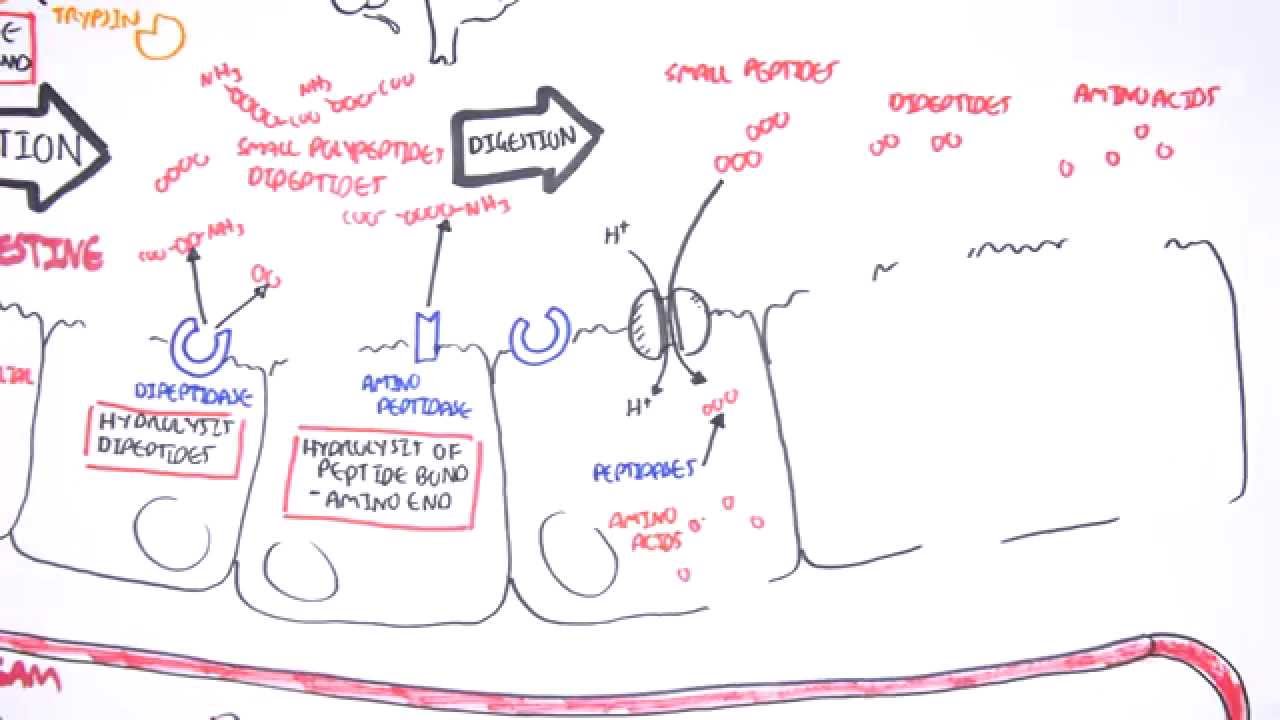
After encountering enzymes like trypsin, chymotrypsin, and carboxypeptidase, large polypeptides are further digested into smaller polypeptides, dipeptides, and tripeptides. Brush border enzymes, such as dipeptidases and aminopeptidases, on the surface of intestinal cells further break down these peptides into tripeptides, dipeptides, and amino acids. Dipeptidases hydrolyze dipeptides, and aminopeptidases hydrolyze peptide bonds from the amino terminal.
Absorption of Amino Acids and Peptides
Amino acids are absorbed with sodium via a specific channel. Tripeptides and dipeptides are absorbed through co-transport with hydrogen ions. Inside the cell, peptidases hydrolyze tripeptides and dipeptides into amino acids, which then diffuse into the bloodstream. Hydrogen ions are pumped back out in exchange for sodium.
Transport to the Liver
The absorption of amino acids, dipeptides, and tripeptides leads to a net absorption of sodium, which causes water to be absorbed as well. Sodium is reabsorbed into the extracellular matrix in exchange for potassium via the sodium-potassium pump. The absorbed amino acids are transported to the liver, where they are used to synthesize new proteins or stored.

