
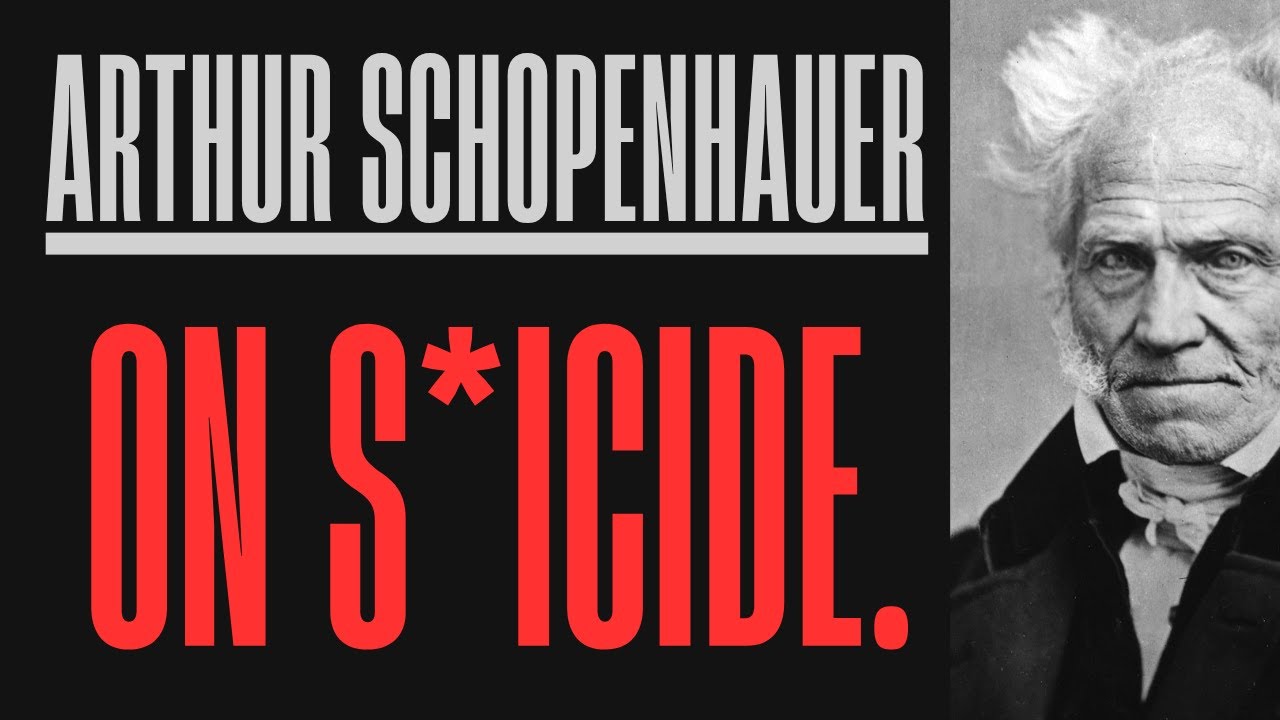
Brief Summary
This video summarizes Arthur Schopenhauer's views on suicide, contrasting them with religious perspectives and societal attitudes. Schopenhauer argues that suicide is often unfairly condemned, particularly by monotheistic religions, and explores the philosophical justifications and historical contexts surrounding the act. He views suicide as a release from suffering, questioning the moral grounds on which it is universally condemned.
- Suicide is not inherently a crime and is often driven by unbearable suffering.
- Religious condemnations of suicide lack strong philosophical or biblical support.
- Suicide can be seen as a personal choice in the face of overwhelming pain.
Introduction
The video begins by addressing viewers who may be experiencing suicidal thoughts, urging them to seek help from trusted individuals or professionals. It emphasizes that seeking help is a sign of strength and that no one is alone in their struggles. The introduction then transitions into an exploration of Arthur Schopenhauer's philosophy on suicide.
Religious Views on Suicide
Schopenhauer observes that only those adhering to monotheistic religions, particularly Judaism, consider suicide a crime. He finds this peculiar because neither the Old Testament nor the New Testament explicitly prohibits or condemns suicide. Religious teachers, therefore, rely on philosophical reasons to denounce suicide, but these reasons are often weak. To compensate for the lack of strong arguments, they resort to vilifying suicide, labeling it as cowardice or an act of madness.
Societal and Legal Perspectives
The video highlights the hypocrisy in condemning suicide while acknowledging an individual's fundamental right over their own life and body. Suicide is still considered a crime, leading to shameful burials and property confiscation in some countries like England. Juries often deliver verdicts of insanity in suicide cases. The video prompts viewers to consider whether suicide is a crime by contrasting the reactions to murder or theft with the sympathy and respect sometimes afforded to those who end their own lives.
Historical and Philosophical Justifications
The video contrasts modern views with those of the past, noting that ancient people did not necessarily view suicide negatively. Pliny wrote that life is not so precious that it must be prolonged at all costs, and that death is a gift from nature to those in suffering. In some societies, like Massilia and Ceos, magistrates even provided poison to those who had valid reasons for ending their lives. Stoics considered suicide a noble act, with Seneca praising it extensively. The video also mentions how Hindus view suicide as a religious act in certain contexts.
Suicide in Literature and Philosophy
The discussion extends to portrayals of suicide in theater, citing characters like Palmyra, Mamer, Othello, Countess Terzky, and Hamlet. Hamlet's monologue is presented not as the thoughts of a criminal, but as a contemplation of whether death, with the guarantee of oblivion, would be preferable to life. The video criticizes the weak and easily refuted arguments against suicide put forth by religious clergy and philosophers aligned with them, referencing David Hume's essay "On Suicide," which was suppressed due to the Church of England's influence.
Moral and Philosophical Arguments
Schopenhauer states that in his main book, he presented only one valid reason against suicide, which is related to morality: suicide deprives a person of true liberation and offers only a false one, but this is only a mistake, not a crime. Christianity views suffering as the true purpose of life, thus opposing suicide because it thwarts this purpose. However, this argument is valid only if one accepts a very high moral standard that European moral philosophers have not adopted. Without this high standard, there is no valid moral reason to condemn suicide.
Hidden Reasons and the Fear of Death
The video suggests that the clergy's vehement opposition to suicide, unsupported by the Bible or strong reasoning, may stem from a hidden motive: suicide is a negative commentary on the claim that everything in the world is good. This reflects the religions' blind optimism, condemning suicide to avoid being condemned by it. The video explains that people often end their lives when the fear and suffering of life outweigh the fear of death, which normally acts as a deterrent.
The Nature of Suicide
Death has a positive aspect: the destruction of the body. People fear this because the body is the manifestation of their will to live. However, the struggle is often less daunting than it appears because physical and mental pain often suppress each other. Intense or prolonged physical pain can make one forget other troubles, focusing solely on recovery. Similarly, severe mental pain can diminish the perception of physical pain. This interplay makes suicide seem easier, as the physical pain of the act is overshadowed by the overwhelming mental anguish.
The Act of Suicide and its Implications
The video notes that those who commit suicide due to overwhelming anger or sadness often do not require special courage. They act impulsively when caregivers are briefly absent. Suicide is likened to waking up from a terrifying nightmare, where the horror vanishes upon awakening. Life, too, is a dream, and when the greatest fear becomes unbearable, life collapses.
Suicide as an Experiment
Suicide is also viewed as an experiment, a question posed to nature to force an answer about what exactly changes after death and how one's thoughts and reality will be. However, this experiment is futile because it destroys the very consciousness that poses the question and awaits the answer.

