
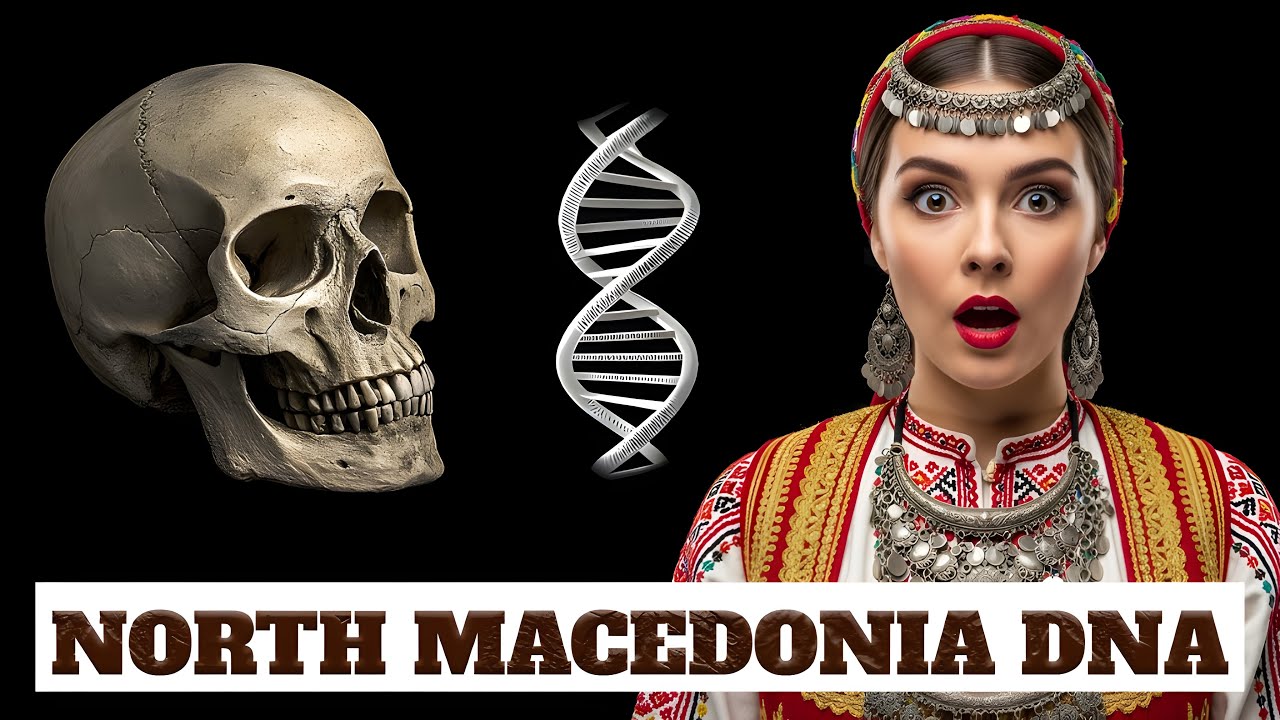
Brief Summary
This video explores the complex and often misrepresented genetic history of North Macedonia, challenging nationalist claims of direct descent from Alexander the Great. It uses forensic genetics, archaeology, and historical analysis to reveal a layered past shaped by various migrations and cultural influences. The video uncovers the truth about the region's genetic makeup, revealing connections to Slavic populations, pre-Slavic tribes, and even Anatolian farmers, while also questioning long-held beliefs about royal burials and ancient artifacts.
- Challenges the claim that 30% of North Macedonians are direct descendants of Alexander the Great.
- Reveals genetic links to Slavic populations, pre-Slavic tribes, and Anatolian farmers.
- Questions the identity of remains found in Tomb I, believed to be Philip II's burial site.
- Explores the influence of Roman and other empires on the region's genetic and cultural diversity.
- Highlights the potential role of Eurydice I, Alexander the Great's grandmother, in shaping the dynasty.
The Myth of Macedonian Descent
The video starts by addressing the widely spread claim that 30% of modern North Macedonians are direct descendants of Alexander the Great, a claim propagated by a private company called iGENEA. This company's assertion, based on vague regional profiles and modern Balkan DNA, lacks scientific backing and peer-reviewed data. Experts found no evidence of ancient Macedonian samples being used, and iGENEA themselves later admitted the data was useless, revealing the claim to be more about political identity than genetic fact.
Unmasking the Real Genetic Fingerprint
A six-year forensic investigation at the Forensic Medicine Institute in Skopje sought to uncover the true genetic fingerprint of North Macedonia. The study, involving over 1,000 individuals, revealed that modern North Macedonians align genetically with Slavic-speaking populations, particularly Bulgarians and Serbs, with common haplogroups I2 and R1a. This finding, supported by additional genome-wide analyses, indicates that Balkan DNA is a layered mixture of Neolithic Anatolian farmers, Bronze Age steppe herders, and Slavic migrations from the 6th century CE, challenging nationalist narratives.
The Tomb That Lied: Rewriting Royal History
The video questions the long-held belief that Tomb I in Vergina contains the remains of Philip II of Macedon. A 2025 study published in the Journal of Archaeological Science revealed that the male in Tomb I died too early to be Philip II, and his isotopic signature pointed to a rural upbringing, not a royal one. Additionally, DNA showed that the woman buried nearby was not maternally related, suggesting a staged legend and mistaken identity that has fueled nationalist pride.
Echoes of Forgotten Tribes
Before the arrival of the Slavs, North Macedonia was inhabited by tribes such as the Paeonians, Lyncestians, Dardanians, Illyrians, and Thracians. These tribes, though largely erased from the surface by Romanization and Hellenization, contributed 40 to 60% of modern North Macedonian DNA. Archaeogenetic studies reveal a blend of Anatolian farmer DNA with steppe herder ancestry, predating the Slavs by over 1,000 years, indicating a continuity of deep roots that empires could not fully erase.
The Slavic Waves: A Demographic Tsunami
Between 550 and 700 CE, Slavic families migrated across the Balkans, bringing their language, culture, and genes to North Macedonia. Genome-wide studies show that 30 to 60% of modern Balkan DNA comes directly from these early Slavic migrants, with Y-DNA haplogroups R1A and I2A dominating the profiles. This migration resulted in a layering of ancestries, with the old whispers of Paeonians, Illyrians, and Thracians surviving beneath the new Slavic veneer, marking the real birth of a people.
The First Farmers: Seeds of a Revolution
Around 6,000 BCE, Neolithic farmers from Anatolia brought agriculture to the Balkans, leaving behind bloodlines carved into the mitochondrial DNA of today's Macedonians. These farmers mixed with local hunter-gatherers, leading to the first agrarian societies. By the Bronze Age, a new wave from the Pontic-Caspian Steppe arrived, bringing new burial customs, horses, and the Y chromosome marker R1B Z2106, contributing to the layered identity of the region.
The Roman Empire: A Genetic Frontier
Under the Roman Empire, Macedonia became a stage for diverse people and DNA from Anatolia, Africa, and beyond. Studies show that the empire was a mosaic, with individuals from various regions mingling in Balkan soil. For example, a teenage boy with 100% East African ancestry was found buried with a Jupiter-emblazoned lamp. The Roman Empire expanded identity by refashioning the land and planting seeds of diversity through mothers, travelers, and traders.
Bones Out of Time: A Cultural Collision
Inside Tomb I at Vergina, archaeologists discovered the bones of infants from the Roman era, centuries after the Argead elite were laid to rest. This suggests that Roman-era families breached the tomb to discard infants and animal remains, possibly as a form of ancestral veneration or a desperate act to bury infants who died too young for proper funeral rights. This cultural collision transformed the tomb from a symbol of dynastic power into a vessel for grief and ritual meaning.
Stones That Speak: Architecture and Identity
In North Macedonia, the discovery of Gradishte, an ancient Greek city dating back to 325-300 BCE, reveals the influence of Greek culture beyond its traditional borders. The site features Ionic capitals, rock-cut sanctuaries, and Hellenistic urban plans. This is not proof of an ethnic Greek colony but a story of cultural influence and osmosis, demonstrating how culture can travel faster than genes and that identity is layered.
Forging a Nation: Identity and Ancestry
North Macedonia's nationhood was born in the 20th century, built on 8,000 years of DNA. The language, institutions, and borders were crafted in 1945, rooted in southwestern Bulgarian dialects. Genetic studies reveal a Balkan story of overlapping and entwined ancestries, with Y-DNA haplogroups reflecting pre-Slavic, Ottoman, Roman, and Anatolian influences. Macedonians cluster genetically with Eastern Balkan populations, confirming that identity is lived through decisions, dialects, rituals, and chosen futures.
The Lost Royal Matriarch: Eurydice I
Archaeologists now believe they may have found the ground where Eurydice I, Alexander the Great's grandmother, once walked. Historians speculate that Eurydice was born in Lyncestis, a kingdom in what is now North Macedonia. Excavations at the Gradishte archaeological site have brought this theory to life, with coins, tools, and Byzantine traces suggesting royal memory. If future mtDNA tests match remains from Gradishte with known Argead genetic markers, it could confirm that the bloodline of Alexander the Great may have risen from the hills of North Macedonia.

