
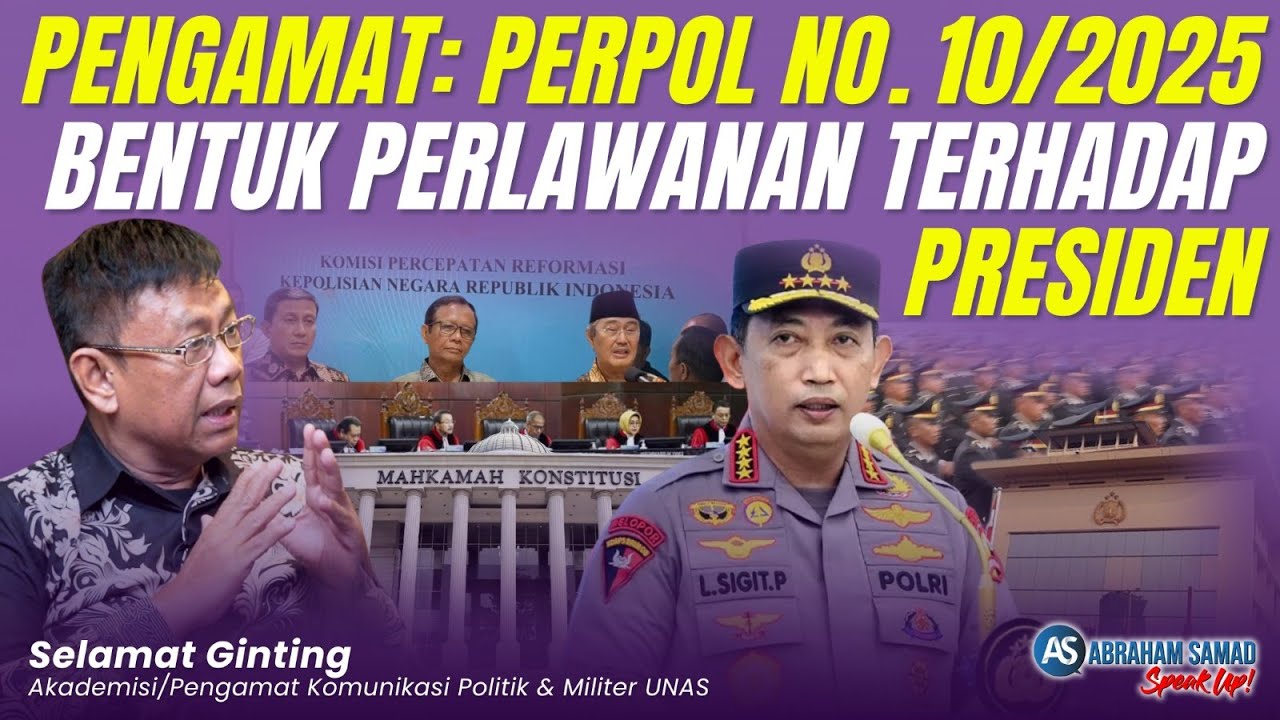
Brief Summary
This YouTube video features a discussion on the controversial issuance of a police regulation (Perpol) that seems to contradict a Constitutional Court (MK) ruling regarding active police officers holding civilian positions. The speakers analyze the implications of this regulation, potential reasons behind the government's silence on the matter, and the broader issue of the police force's growing power and influence. They also discuss potential actions that can be taken to address the situation and uphold the rule of law.
- The issuance of Perpol No. 10/2025, which allows active police to hold positions in civilian institutions, is seen as a defiance of the Constitutional Court's ruling.
- The government's silence on the issue suggests a possible consensus among political elites, dependence of the DPR on law enforcement, and normalization of violations.
- The police force's increasing power and influence, particularly during Jokowi's administration, is a concerning trend that undermines civilian supremacy and the rule of law.
- Potential solutions include judicial review, coalition of civil society and academics, and consistent public pressure to ensure accountability and uphold constitutional principles.
Introduction
Abraham Samad introduces Dr. Samad Ginting, a political communication expert, to discuss a controversial issue: a police regulation that appears to contradict a Constitutional Court decision. The regulation, issued by the National Police Chief (Kapolri), allows active police officers to hold positions outside the police force, specifically in 17 listed institutions, despite the MK's ruling that active police officers must retire or resign if they wish to take civilian positions.
Clash with Constitution
Dr. Ginting asserts that the Kapolri's regulation is a defiance of the constitution, the Constitutional Court's decision, the Law on the Police, and the Law on State Civil Apparatus. He explains that the regulation violates the hierarchy of legal norms, as a police regulation is subordinate to the Constitution, laws, and government regulations. The regulation is not just a difference in interpretation but a violation of the legal and governmental order.
Possible Reasons for Government's Silence
Dr. Ginting suggests three possible reasons for President Prabowo's silence on the issue. First, there may be a consensus among political elites, including those in the government, political parties, the DPR, and the police, as the police force serves as a tool for political stability for the ruling government. Second, the DPR's oversight function is weak due to its dependence on law enforcement and the ethical vulnerabilities of its members. Third, there is a normalization of violations, where continuous and widespread violations are considered normal.
DPR's Ineffectiveness and Public Impact
The DPR is failing to control state institutions like the police due to fear and widespread ethical violations among its members. This inaction harms the public, and it is the duty of academics and the press to provide social control. The government's silence and the DPR's support for the police indicate a dependency on the executive and security apparatus.
Jokowi's Influence and Power Dynamic
The speakers discuss whether Jokowi's influence still affects Prabowo's decisions. Dr. Ginting believes that the issue is not just about Jokowi's name but also about the powerlessness of control institutions because the police have infiltrated them. This infiltration is a legacy of the previous administration, with police officers in the KPK, PPATK, Debagri, and OJK, compromising structural independence.
Police as a Tool of Power
The phenomenon of the police being used as a tool of power is not new but has become more pronounced during Jokowi's administration. The police are powerful because they wield both weapons and the law. Dr. Ginting illustrates this with examples of character assassinations and the difficulty of pursuing legal cases against police officers.
Restoring Constitutional Order
To restore constitutional order, President Prabowo must adhere to the hierarchy of laws, with the Constitution at the top, followed by laws and government regulations. The current situation, where police regulations seem to override laws, indicates a shift from a state based on law to one based on power. Prabowo should heed the advice of legal experts like Prof. Mahfud MD and Prof. Jimli Assidiki, who view the situation as a defiance of the constitution.
Kapolri's Defiance and Government Inaction
The Kapolri's actions defy the DPR, the President, and the Constitutional Court, constituting a defiance of the constitution. The government's inaction normalizes this defiance, potentially leading to a situation where regulations override laws. The process for filling civilian positions with active police officers should involve consultation with parliament and legal experts, and should wait for revisions to the law on the police.
Historical Context and Current Concerns
The Kapolri's defiance is not an isolated incident, as seen in the past when the police formed their own reform team, undermining the President's initiative. The police have become too powerful during Jokowi's administration, leading to concerns that the Kapolri is acting as a "shadow president." The delay in replacing the Kapolri, who has been in office for nearly five years, is also raising questions about his influence and the lack of consolidation of power by President Prabowo.
Implications and Expectations for Prabowo
The Kapolri's actions, including the issuance of Perpol No. 10/2025, are likely known to President Prabowo, possibly as part of a political consolidation strategy. The Kapolri may be protecting his colleagues and pursuing a power motive, prioritizing politics over the law. The lack of a direct meeting between the Kapolri and President Prabowo to discuss the regulation is concerning, and the speaker awaits a statement from the President on the matter.
Upholding the Constitution and Legal Processes
The focus should be on adhering to the Constitutional Court's decision and waiting for revisions to the law before implementing any new regulations. The government should not create regulations based on police regulations, as this reverses the legal order. The speaker concludes that the country is operating based on power rather than law, which sets a bad precedent and could lead to public disobedience.
Presidential Action and Potential Outcomes
The speaker believes that the Perpol was not directly consulted with the President, or if it was, the President remained silent. He urges Prabowo to take decisive action and not be seen as weak. He emphasizes the importance of civilian control over the security apparatus and expresses concern that the police are behaving like the ABRI (Armed Forces of the Republic of Indonesia) of the past, which was heavily criticized during the reform era.
Consequences of Inaction and Call to Action
The state's silence sets a bad example for future generations and could lead to political apathy. The speaker warns of potential resistance from young people if they witness the erosion of legal principles. He suggests constitutional resistance through judicial review, a coalition of civil society and academics, and consistent public pressure. He also highlights the need for independent media and the importance of separating criticism of institutions from personal attacks.
The Core Issue: Rule of Law vs. Power
The speaker concludes that the core issue is the struggle between the rule of law and the power of the state. He warns against allowing the constitution to become a mere symbol and the law to be used as a tool of power. However, he remains optimistic, emphasizing that as long as there is a critical public, courageous campuses, and a concerned young generation, it is not too late to reverse the trend.

