
Brief Summary
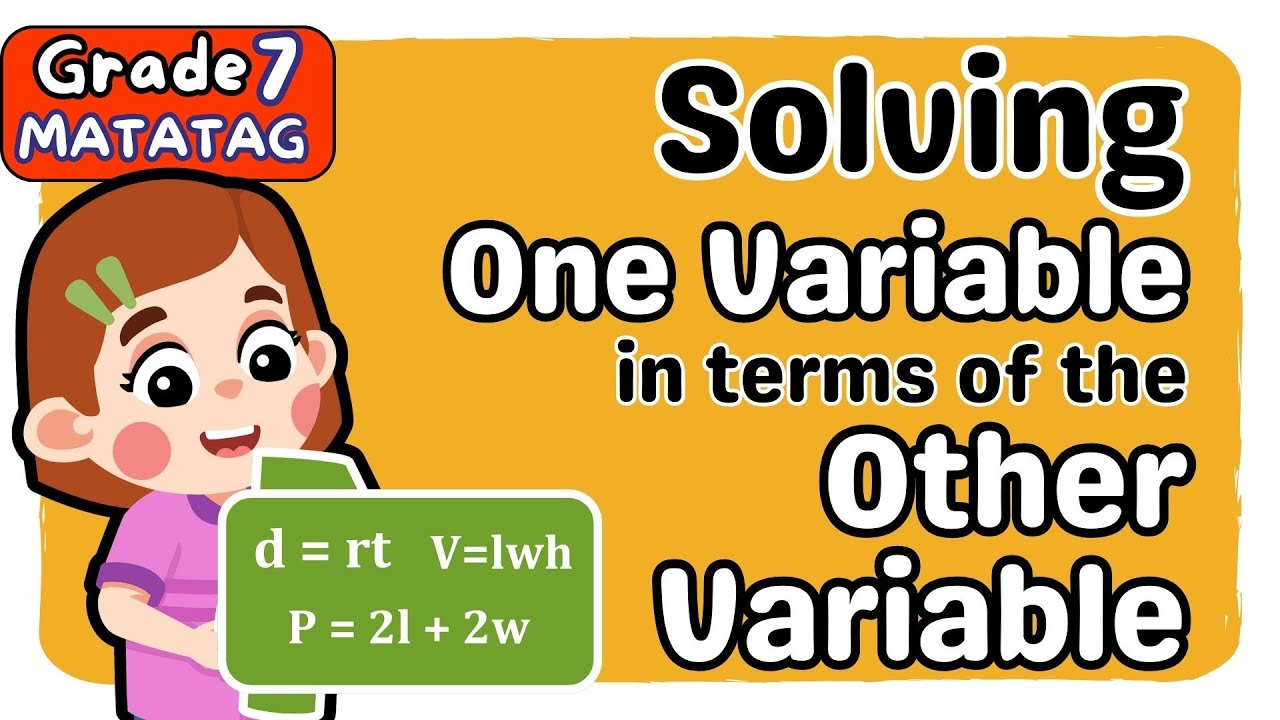
This video tutorial by Math Isip explains how to solve for one variable in terms of another within a formula, focusing on literal equations. It covers identifying literal equations, manipulating formulas using properties of equality (division, multiplication, and symmetric), and applying these techniques to real-world problems such as calculating travel time. The lesson includes several examples and practice problems to reinforce understanding.
- Definition of literal equations and their components.
- Step-by-step examples of solving for specific variables in various formulas.
- Application of algebraic properties to isolate and solve for variables.
Introduction: Solving for Variables in Formulas
The lesson introduces the concept of solving for one variable in terms of another within a formula. It starts with a real-life problem: a car travels 150 km at 50 km/h, and the task is to find how long it took. The presenter highlights the formula for distance (d = r * t) and explains that the goal is to rearrange this formula to solve for time (t).
Understanding Literal Equations
The presenter defines literal equations as equations containing two or more variables. Examples include formulas for the area of a triangle (A = 1/2 * b * h), the volume of a rectangular prism (V = l * w * h), the perimeter of a rectangle (P = 2l + 2w), interest (I = p * r * t), and the circumference of a circle (C = π * d). The lesson focuses on manipulating these types of formulas to solve for a specific variable.
Example 1: Solving for Time Using the Distance Formula
The presenter demonstrates how to solve for time (t) in the distance formula (d = r * t). By applying the division property of equality, both sides of the equation are divided by 'r' to isolate 't'. This results in the formula t = d / r. The symmetric property of equality is then used to rewrite the formula with 't' on the left side.
Example 2: Solving for Height in the Volume Formula
This example focuses on solving for height (h) in the volume formula for a rectangular prism (V = l * w * h). The division property of equality is used to divide both sides of the equation by length (l) and width (w), isolating 'h'. The resulting formula is h = V / (l * w), which is then rewritten using the symmetric property.
Example 3: Solving for Height in the Area of a Triangle Formula
The presenter explains how to solve for height (h) in the formula for the area of a triangle (A = 1/2 * b * h). The multiplication property of equality is used to multiply both sides by 2, eliminating the fraction. This simplifies the equation to 2A = b * h. Then, the division property of equality is applied by dividing both sides by 'b' to isolate 'h', resulting in the formula h = 2A / b.
Example 4: Solving for Length in the Perimeter of a Rectangle Formula
The lesson demonstrates solving for length (l) in the perimeter formula for a rectangle (P = 2l + 2w). The subtraction property of equality is used to subtract 2w from both sides, isolating the term with 'l'. This gives P - 2w = 2l. Then, the division property of equality is used to divide both sides by 2, resulting in the formula l = (P - 2w) / 2. The presenter also shows an alternative simplification, l = P/2 - w, by separating the terms and reducing the fraction.
Practice Activity
The video includes a practice activity with four problems, challenging viewers to solve for specific variables in given formulas and to indicate the properties of equality used. Viewers are encouraged to pause the video, solve the problems, and then compare their answers with the provided solutions.
Solution to the Initial Problem
The presenter revisits the initial problem of the car traveling 150 km at 50 km/h. Using the derived formula t = d / r, the values are substituted to find the time: t = 150 km / 50 km/h, which equals 3 hours. This demonstrates the practical application of solving for a variable in a formula.

