
Brief Summary
This video features a song about education and innovation in West Java, followed by interviews with student interns at DISDIK JABAR, and a seminar on disaster mitigation in educational units, focusing on earthquake preparedness and response, particularly concerning the Caesar Lembang fault line.
- Song promoting education and innovation in West Java.
- Interns sharing experiences at DISDIK JABAR.
- Seminar on disaster mitigation, focusing on earthquake preparedness.
Opening Song
The video starts with a song that promotes education, innovation, and collaboration within the DISDIK JABAR (Dinas Pendidikan Jawa Barat) framework. The lyrics emphasize readiness for challenges, embracing change, and striving for excellence to create a superior and golden generation. It also highlights being resilient, healthy, tested, and always grateful while working together to achieve success through creativity and high achievement.
Intern Introductions
The video transitions to introductions of student interns from various universities who are working at Tikomdik. Cahya Wulan Sugestari from Universitas Komputer Indonesia, majoring in Ilmu Komunikasi, introduces herself. Nurhanah, also a communication student from Unikom, mentions her internship at Tikompedia. Syifa Nurjana, another Ilmu Komunikasi student from Universitas Komputer Indonesia, states that she is in the Tikompedia division.
Intern Experiences
Syifa discusses her daily tasks, which primarily involve creating and revising scripts, as well as shooting in the comment center. She mentions that the biggest challenge she faced was learning the detailed operation of cameras, as the training at university was not as in-depth. She overcame this by asking her colleagues for help. Syifa enjoys eating with her colleagues and being treated by her superiors. She initially thought TKOMDK stood for teknologi informasi dan komunikasi pendidikan and found it aligned with her interests. She shares an amusing story about her mentor, Kang Sandi, involving a past accident. Syifa notes that her internship experience exceeded her expectations, as she found the work environment to be flexible and enjoyable, contrary to her initial perception of government institutions being rigid. People appreciated her internship at Komik, part of Dinas Pendidikan, and were happy to hear about her positive experiences. She mentions that sudden deadlines were initially daunting but ultimately helped her think faster and improved her performance in college. The most memorable project for her was a film pendidikan, which involved extensive script revisions and a trip to Sumedang. She admits to sometimes pretending to understand when her mentor was explaining something complex, especially regarding social media.
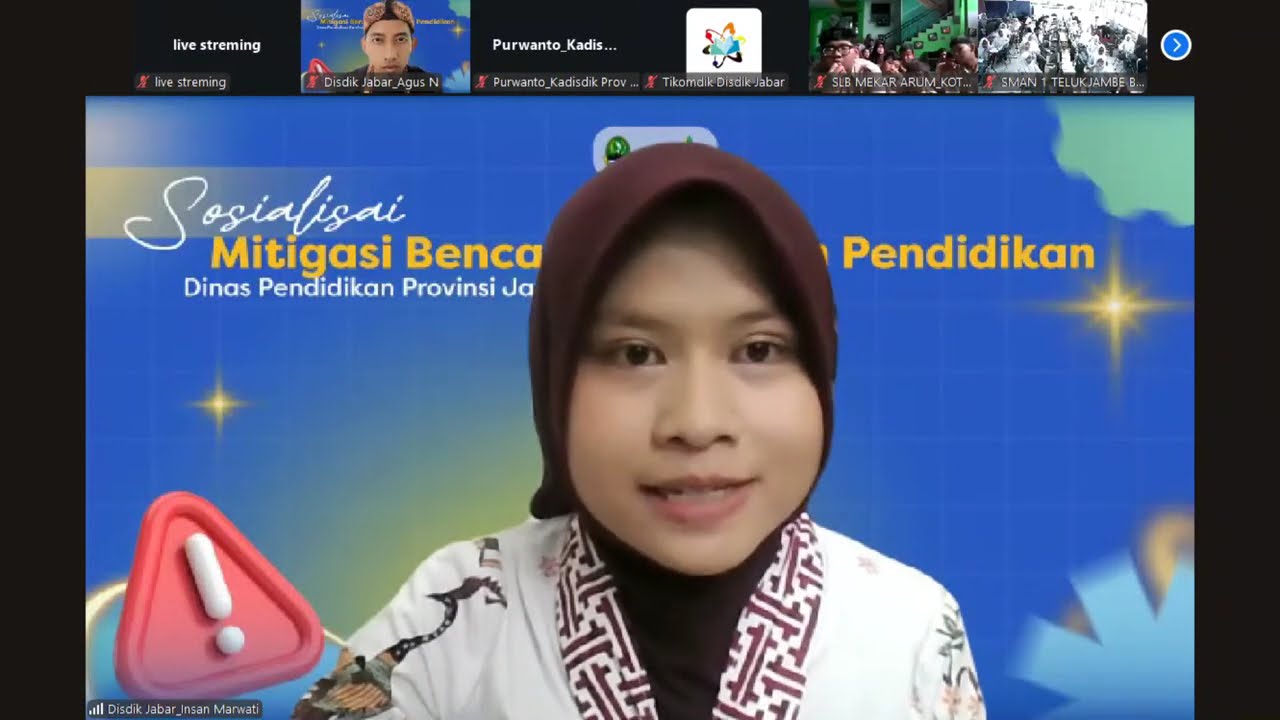
Mitigation of Disaster Socialization Event Opening
The video transitions to a formal event, a socialization of disaster mitigation in educational units. The event begins with the Indonesian national anthem, "Indonesia Raya," followed by a prayer led by Bapak Agus Nurhidayat, seeking protection from disasters and guidance in implementing mitigation efforts.
Speech by Head of DISDIK JABAR
The Head of Dinas Pendidikan Provinsi Jawa Barat expresses gratitude to the attendees, including Bapak Sekda and the Head of BPBD Provinsi Jawa Barat. He emphasizes the importance of disaster mitigation in educational settings to protect students and ensure their safety. He stresses that information and mitigation efforts must be communicated effectively to schools, ensuring children are protected and understand how to prepare for potential disasters. He thanks BPBD and all participating schools and teachers, hoping they will actively participate in the event. He underscores the importance of readiness in facing potential disasters and the value of knowledge in disaster preparedness.
Speech by Regional Secretary of West Java Province
The Regional Secretary of West Java Province addresses the audience, highlighting the potential for an earthquake along the Caesar Lembang fault line. He emphasizes that it is not a matter of "if" but "when" an earthquake will occur, urging everyone to be prepared, especially in the seven most vulnerable regencies/cities. He stresses the importance of pre-disaster preparedness and the need for students and educators to be vigilant and resilient. He urges schools to inform their communities about the potential earthquake risk and to minimize casualties through awareness and preparedness. He introduces a key phrase to remember: "If an earthquake occurs, the answer is GEMPA," which stands for "Gerakan Menunduk Lindungi Kepala" (Move to Duck and Protect Your Head). He instructs schools to map assembly points and evacuation routes and conduct simulations.
Presentation by Head of Prevention and Preparedness BPBD West Java Province
The Head of Prevention and Preparedness at BPBD Provinsi Jawa Barat, Dr. Andes Edi Heryadi, delivers a presentation on disaster mitigation in educational units. He reiterates the potential threat of earthquakes and the need for increased vigilance and preparedness. He discusses the Caesar Lembang fault, explaining its characteristics and potential impact. The fault spans 29 km from Ngampra to Cilengkrang and Cimin, with sinistral movement causing surface changes. It consists of six segments and has a history of earthquakes every 170 to 670 years. Recent increased seismic activity near the fault has raised concerns. BMKG scenarios suggest potential earthquakes of 6.5 to 7 magnitude, with the worst-case scenario being 7 magnitude at a depth of 30 km, causing significant damage. The impact could extend to 27 regencies/cities in West Java, with the most severe effects in Bandung Raya and surrounding areas. Historical data from a 2011 earthquake in Kampung Muril shows the potential for damage, especially in areas with non-earthquake-resistant buildings.
Earthquake Hazards and Mitigation
The presentation continues by outlining the dangers of earthquakes, including ground shaking, surface ruptures, landslides, and liquefaction. Liquefaction occurs in areas with former swamps or ancient lakes, causing the ground to behave like a liquid. The presentation emphasizes that the primary cause of casualties is the collapse of poorly constructed buildings. Visuals from past earthquakes, including the Cianjur earthquake, illustrate the devastation. The presentation also shows video footage of earthquake aftermaths, including collapsing structures and the effects of liquefaction in Palu. The presentation stresses the importance of building earthquake preparedness, referencing research from Japan that highlights the importance of individual and community preparedness. The Inaris Personal application is introduced as a tool for assessing disaster risks in specific areas.
Disaster Preparedness Teams and Evacuation Procedures
The presentation emphasizes the need for schools to establish disaster response teams, including an Incident Commander, security, rescue and evacuation, medical, fire suppression, document and asset salvage, and engineering teams. A floor captain is needed to direct evacuation efforts and account for all individuals. The presentation reiterates the "GEMPA" acronym (Gerakan Menunduk Lindungi Kepala) and stresses the importance of not running during the initial shaking. Evacuation should follow established routes to designated assembly points. Evacuation routes must be clearly marked with directional signs. Buildings should be equipped with alarms, fire extinguishers, helmets, vests, communication devices, and evacuation maps.
Pre-Earthquake Preparations and Building Safety
The presentation outlines pre-earthquake preparations, including monitoring official sources like BMKG, creating disaster preparedness content for schools, training disaster response teams, and maintaining a list of emergency contact numbers. It also emphasizes the importance of having a disaster preparedness kit containing essential supplies for at least three days. The presentation provides guidance on building earthquake-resistant structures, including strong foundations, reinforced concrete columns, and secure attachments for fixtures. It also advises on arranging furniture to prevent hazards and ensuring gas and electrical safety.
During and After an Earthquake
The presentation reiterates the "GEMPA" protocol (Gerakan Menunduk Lindungi Kepala) for what to do during an earthquake. It advises seeking shelter under sturdy furniture or in doorways. It warns against running outside during the shaking and advises staying away from power lines, unstable buildings, and steep slopes. If driving, it advises stopping the car and seeking shelter. The presentation provides guidance on safe evacuation procedures, including using stairwells instead of elevators and avoiding crowded areas. After an earthquake, it advises accounting for all individuals at the assembly point and deploying response teams to assess damage and provide assistance.
Disaster Preparedness Equipment and Safe School Implementation
The presentation lists essential equipment for disaster response, including first aid kits and stretchers, which can be improvised using blankets and poles. The presentation concludes by discussing the implementation of safe school programs, which involve creating a school environment that protects students and staff from disasters. This includes ensuring safe school facilities, implementing disaster management plans, and integrating disaster risk reduction into the curriculum. The three pillars of a safe school are safe facilities, disaster management, and risk reduction education. The presentation highlights the importance of incorporating disaster preparedness into school activities, such as drills and simulations.
Question and Answer Session
The session addresses questions from various schools. One question concerns how to build a culture of safety in schools, to which the response emphasizes continuous training, simulations, and integrating disaster preparedness content into the curriculum. Another question asks about the safest course of action during an earthquake in a two-story building; the response advises to first take cover under a desk or near a pillar during the shaking and then evacuate to the assembly point after the shaking stops. A question about the areas in Bandung most severely affected by an earthquake is answered by stating that the entire city could experience significant damage, with areas on former lakebeds potentially experiencing greater amplification of ground shaking. The role of AI and big data in disaster mitigation is discussed, with a caution against unverified information and a recommendation to rely on official sources. The causes of earthquakes are explained, differentiating between tectonic, volcanic, and human-induced earthquakes, and emphasizing that while cycles can be studied, prediction remains impossible.
Closing
The session concludes with thanks to the participants and a reminder that the presentation materials are available for download.

