
Brief Summary
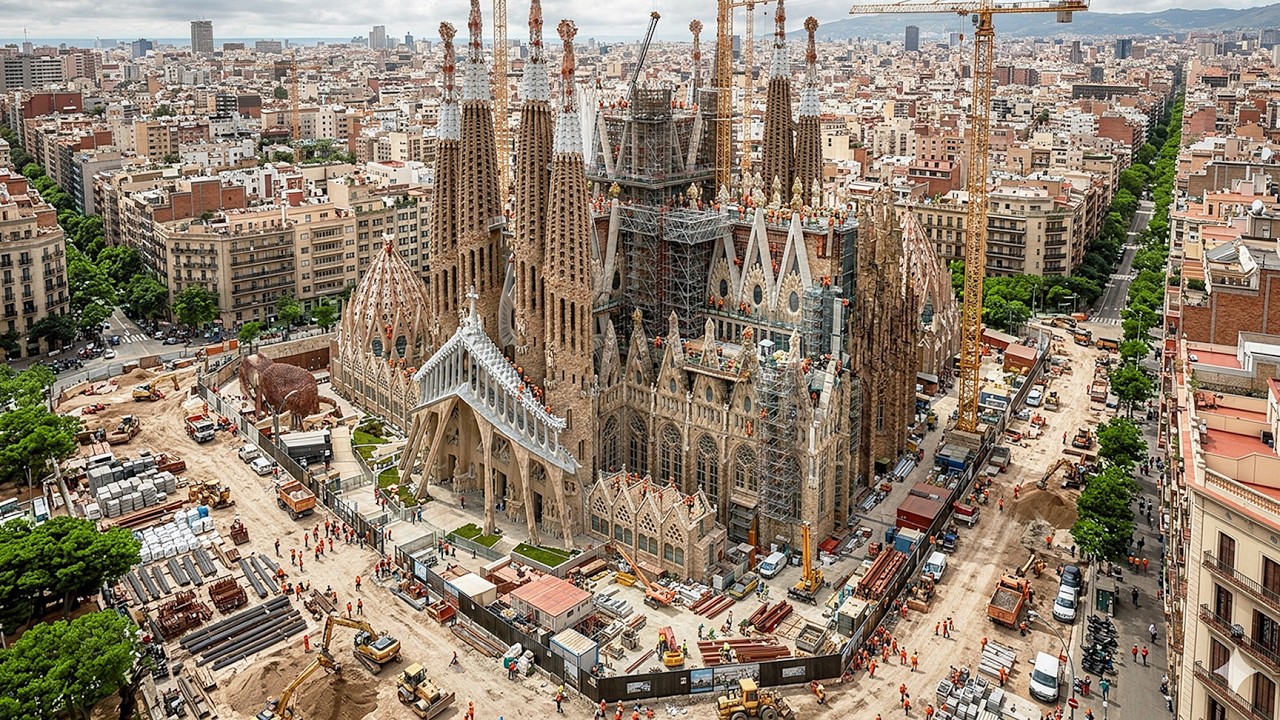
The Sagrada Familia, begun in 1882 by Antoni Gaudí, is a colossal architectural project in Barcelona that has spanned generations. Despite facing numerous challenges, including wars and the destruction of original designs, the structure has continued to rise. The basilica is designed with 18 towers, natural stone, and a unique light-filled interior. The construction involves advanced techniques like prefabricated stone modules and integrated steel frameworks to withstand earthquakes. The completion of the central tower in 2026 will mark a significant milestone, with the entire project expected to be finished by 2035.
- The Sagrada Familia is designed with 18 towers, each with religious meaning.
- The construction uses prefabricated stone modules and integrated steel frameworks.
- The interior features a vast stained glass system that transforms sunlight into part of the architecture.
Intro
The Sagrada Familia, a project started in 1882 by Antoni Gaudí, has become the tallest church in the world after 144 years of construction. The church has survived two world wars, a civil war that destroyed original design drawings, and a global pandemic. The structure is approaching completion after more than a century of work.
Overview
The Sagrada Familia began in the late 19th century as an expiatory church funded by public donations. Antoni Gaudí transformed the initial Gothic design into an architectural experiment, drawing inspiration from nature. Gaudí used plaster and hanging chain models to calculate structural forces. After Gaudí's death in 1926, the project faced historical upheavals, including the destruction of design models during the Spanish Civil War. Later architects reconstructed Gaudí's vision from remaining fragments, making it one of the longest architectural projects in history, with completion moving closer by 2026.
Central Tower Structure
The Sagrada Familia's design differs from traditional Gothic architecture by transferring the entire load through internal stone columns. The basilica is organized around 18 towers, including twelve for the apostles, four for the evangelists, one for the Virgin Mary, and the central tower for Jesus Christ. The central tower will reach 172 meters, making the Sagrada Familia the tallest church in the world, deliberately one meter shorter than Montjuic Hill. Inside, the columns twist and branch out like tree trunks, supporting the vault without massive walls and creating a vast, light-filled space.
Central Tower Structure
Natural stone is the primary material, initially Montjuic stone, now sourced from global quarries due to depletion. The stone is carefully extracted and tested for durability. A large portion of the stone is used for the Tower of Jesus Christ, the tallest part of the basilica, reaching 172.5 meters with a 17-meter cross covered in glass and ceramic. The tower is constructed using prefabricated stone modules to manage load distribution, vibrations, and wind resistance.
Assembly of the Tower Panels
Each panel is a structural module of 16 stone blocks, precisely cut using CNC machines and assembled with hidden steel components. Each panel functions as an independent structural unit, bearing loads and transferring forces. Eight panels form a complete level of the tower. This system allows for precision control and inspection before transport to the construction site. The modular approach enhances safety and reduces construction time, enabling the tower to be erected 16 times faster than traditional methods.
Panel Lifting
Each panel weighs between seven and ten tons and is lifted to heights using specialized tower cranes. Precise coordination is required due to the risk of misalignment from even small oscillations. Panel lifting occurs only within safe wind speed limits, with an allowable tolerance of just 1 millimeter. Workers make on-site adjustments to ensure perfect alignment. Movements are slow and controlled, with continuous observation and adjustments. The panel becomes a fixed part of the tower only after all connection points are fully tightened and inspected.
Stone Fabrication
The complex geometry of the columns and stone surfaces presents a significant challenge. Unlike straight columns, those in the basilica continuously change shape, transforming from hexagonal to octagonal and splitting into branches. Creating these stone blocks requires raw material extraction, advanced machining, and craftsmanship. Large stone blocks are cut from quarries and tested for strength, structure, and color. Machines cut and shape curved surfaces with high accuracy, and technicians refine each piece by hand. This combination of technology and craftsmanship completes a complex stone block in a few hours, compared to weeks by hand.
The Earthquake Challenge
For a structure built primarily from natural stone, managing continuous horizontal vibrations from strong winds and earthquakes is critical. Stone is strong under compression but lacks flexibility. Vibration control is a key factor in completing the central towers.
Steel Structure
To address the vibration challenge, a high-strength steel system is integrated inside the stone panels, acting as a hidden structural framework. Steel bars and cables run through each stone module, connecting the panels vertically. Tightening these cables locks the stone blocks into a unified mass, creating a monolithic effect with greater control over forces. The combination of stone and steel maintains the appearance of a traditional stone church with the load-bearing capacity of a modern engineered structure.
Stained Glass
The stained glass system shapes the interior experience. The basilica is enveloped by a vast stained glass system, where sunlight becomes part of the architecture. These panels control how light moves through the space. Blue and green shades on the eastern side create a soft morning light, while vibrant reds and oranges on the western side ignite the interior with color as the sun sets. The light inside the basilica continuously shifts, turning the interior into a living canvas.
Windows
The windows are designed with hyperbolic and parabolic geometries instead of traditional rectangular openings. These curved forms allow light to enter softly and distribute evenly, while also reducing the load on the stone walls. This design allows the basilica's walls to be thinner while maintaining strength and structural stability.
Fifty-Six Massive Columns
As light spreads from the stained glass windows, a system of 56 massive columns is revealed, supporting the vaults and towers. Each column is crafted from different types of stone based on the load it bears. Smaller columns use lighter materials, while central columns carrying the greatest loads are made from red porphyry quarried in Iran. A single central column can carry up to 6,000 tons of load from the tower above.
The Tower
After over a century of construction, the Sagrada Familia is approaching its most symbolic moment. On February 20, 2026, the final section of the 17-meter cross will be installed on the Christ Tower, completing the basilica's highest point at 172.5 meters, making it the tallest church in the world. The central tower is expected to be completed by 2026, with the remaining parts finished by around 2033. The entire main structural system, including all 18 towers and vaults, is expected to be completed by 2033, with final decorative details finished by 2035.
Outro
The Sagrada Familia is built by multiple generations over more than a century. Each historical stage has left its mark, from Gaudí's plaster models to modern CNC robots. When the final stone is placed around 2035, the Sagrada Familia will transition from a centuries-long construction site to a completed monument, revealing Gaudí's full vision.

