
Brief Summary
This video is an introduction to the course on optimal and learning-based control taught by Professor Marco Pavone at Stanford. The course focuses on robotic autonomy, covering essential topics such as mathematical modeling, control systems, and performance criteria. Key components include graded assignments, practical coding in Python, and a final exam.
- The course includes four graded problem sets and a final exam.
- Students need a background in calculus, linear algebra, and some familiarity with optimization and machine learning.
- The course aims to provide a comprehensive overview of optimal control techniques while balancing breadth and depth.
Course Overview
Professor Marco Pavone begins by introducing himself and the course, emphasizing his dual role at Stanford and Nvidia. He explains the structure of the course, which includes four graded problem sets, a final exam, and the importance of participation. Students are encouraged to keep up with assignments and are provided with a set of free late days for submissions. Essential materials such as lecture slides and course notes will be available online.
Recitations and Foundational Tools
The first four weeks will feature Friday recitations aimed at providing foundational knowledge on tools like Jax and regression models, beneficial for understanding the course content. These recitations can be attended in person or will be recorded. A strong understanding of multivariable calculus, linear algebra, and some knowledge in optimization is required to succeed in this class.
Prerequisites and Preparation
Students should be comfortable with calculus and linear algebra, and it would help to have some exposure to optimization, machine learning, and control theory. To assess readiness for the course, students are given a non-graded "homework zero" that helps identify areas needing improvement.
Course Objectives and Content
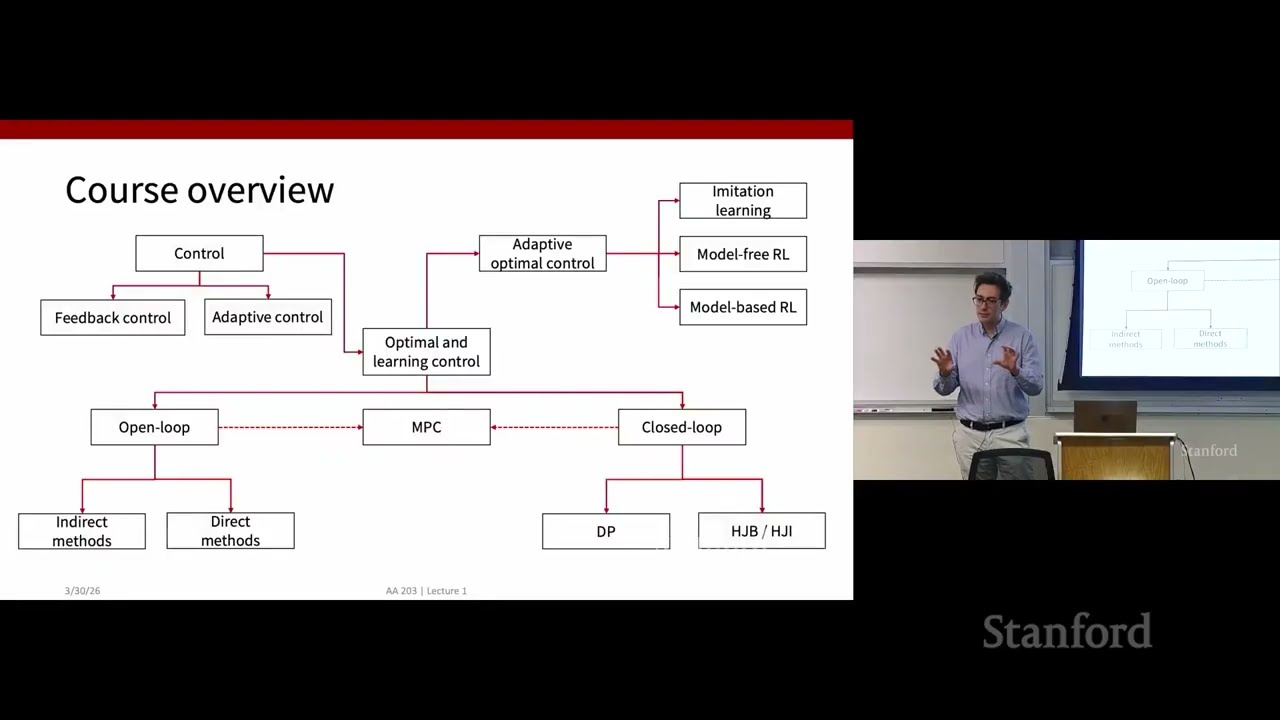
The class focuses on providing a broad understanding of optimal control and learning-based techniques used in robotics and AI. The course will cover various topics, including classical optimal control methods, learning models, and decision-making processes. It aims for a comprehensive overview while acknowledging inherent challenges due to the variety of topics presented.
Control Systems Fundamentals
Professor Pavone discusses the fundamental concepts of control systems. At its core, a control system involves a physical or digital system that needs to be managed to achieve desired outputs using controllers. Examples include managing vehicle trajectories, temperature control, and the underlying principles of closed-loop control are introduced.
Challenges in Control Systems
The talk then shifts to the challenges faced within control systems, such as handling disturbances and sensor inaccuracies, and outlines general desiderata in control such as stability, tracking objectives, disturbance rejection, and robustness. These elements are important in designing effective control systems.
Optimal Control vs. Classical Control
Pavone distinguishes between classical control approaches, which focus on stability and performance, and optimal control, which emphasizes performance metrics like energy efficiency and speed. He discusses the historical development of optimal control during significant military advancements, attributing key concepts to researchers Richard Bellman and Pontryagin.
Open-loop vs. Closed-loop Control
The lecture covers the differences between open-loop and closed-loop control methods, emphasizing that open-loop controls are predetermined and executed without feedback. In contrast, closed-loop systems utilize ongoing state feedback to optimize their operations dynamically. This explains the advantages and limitations of leveraging open-loop versus closed-loop control strategies.
Model Predictive Control (MPC)
Model Predictive Control (MPC) is presented as a bridge between open-loop and closed-loop systems, combining the advantages of both methods. MPC iteratively computes an open-loop control solution which is adjusted based on real-time feedback.
Data-driven Control and Learning
The latter half of the course will focus on data-driven approaches, where control systems learn from data instead of relying on known models. This includes methodologies such as imitation learning and reinforcement learning, allowing for adaptive behavior in control systems.
Performance Index in Control
The course will explore how performance indices are defined and optimized in control scenarios. Such indices encompass criteria for evaluating system performance, including costs associated with control actions over time and desired states at the conclusion of operation.
Formulating Optimal Control Problems
Pavone outlines the formulation of optimal control problems, highlighting that they consist of a mathematical model of a system, constraints, and performance criteria. Understanding how to construct and solve these problems is crucial as students progress through the course.
Introduction to Classical Optimization
The video concludes with a preview of the upcoming classes that will cover classical optimization techniques and their application in solving the challenges of optimal control. Students will learn about necessary and sufficient conditions for optimization in both finite and infinite-dimensional contexts.

