
Brief Summary
This video demonstrates a standard dental examination procedure performed by a dentist. It covers the preparation, examination of the oral cavity, recording of dental formula, and recommendations for further treatment. Key points include:
- Proper preparation and sterilization of equipment.
- Systematic examination of the oral cavity.
- Recording of dental formula.
- Recommendations for treatment of identified issues.
Introduction
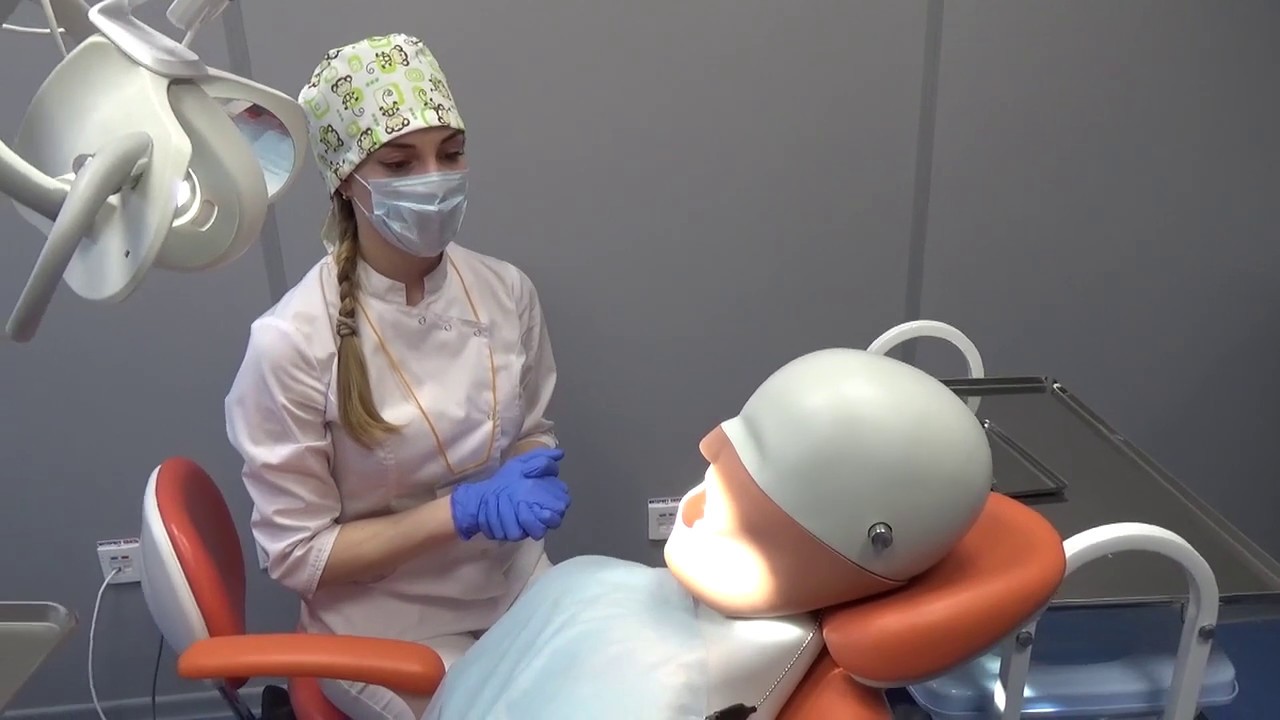
The video starts with an introduction to a dental examination setting. The dentist prepares for the examination.
Preparation for Examination
The dentist introduces herself as the patient's doctor and asks the patient to confirm their identity for medical documentation purposes. She explains that she will perform a dental examination, during which the patient needs to keep their mouth open while she uses dental instruments. The dentist checks if the patient has any questions and confirms that the informed consent form has been signed. She then washes her hands using a hygienic method and verifies that the work area is equipped with sterile dental instruments, medical gloves, masks, and containers for class A and class B waste. The dentist positions herself correctly relative to the patient, ensuring the patient is comfortable in the dental chair and adjusting the chair to a suitable working position.
Putting on Protective Gear
The dentist prepares and puts on medical gloves and a mask. After use, the packaging is disposed of in the appropriate waste container.
Examination of the Oral Cavity
The dentist begins the examination by observing the facial area, noting that the skin around the mouth is normal in color without visible pathological changes. She palpates the lymph nodes, which are not palpable. The dentist assesses the degree of mouth opening and checks for any issues with the temporomandibular joint by placing a finger on the tragus of the ear and asking the patient to slowly open and close their mouth. The dentist notes that the mouth opens fully without any clicking or crunching sounds. The red border of the lips shows no visible pathological changes, and the lip closure is correct and complete along the line of Klein.
Examination of the Oral Mucosa and Teeth
The dentist examines the vestibule of the oral cavity, noting it is of average depth, approximately 7 millimeters. The teeth are in central occlusion, with an orthognathic bite. The dentist proceeds to examine the oral mucosa, which is pale pink, moderately moist, and without visible pathological changes. The tongue is of normal size, evenly covered with filiform papillae. The dentist assesses the oral hygiene, noting a small amount of soft plaque on the frontal teeth of the lower jaw and some supragingival calculus.
Recording the Dental Formula
The dentist records the dental formula, noting the condition of each tooth: 18, 17 are healthy; 16 has caries; 15, 14 have fillings; 13, 12, 11 are healthy; 21, 22, 23 are healthy; 24, 25 have fillings; 26 has caries; 27, 28 are healthy; 38, 37, 36 are healthy; 35 has a filling; 34, 33 are healthy; 31, 32 are healthy; 41, 42, 43, 44 are healthy; 45 has a filling; 46, 47 have caries; 48 is healthy.
Recommendations and Conclusion
The dentist concludes the examination and recommends that the patient seek treatment from a general dentist to address the caries. She explains that if left untreated, the caries can progress, leading to pulp inflammation and further spread to the surrounding bone tissue. The dentist advises the patient to seek treatment soon to prevent negative consequences, noting that invasive treatment is currently the primary method for addressing caries.
Post-Examination Procedures
The dentist removes and disposes of the gloves in class B waste and the mask in class B waste. She then performs a chemical treatment on her hands.

