
Brief Summary
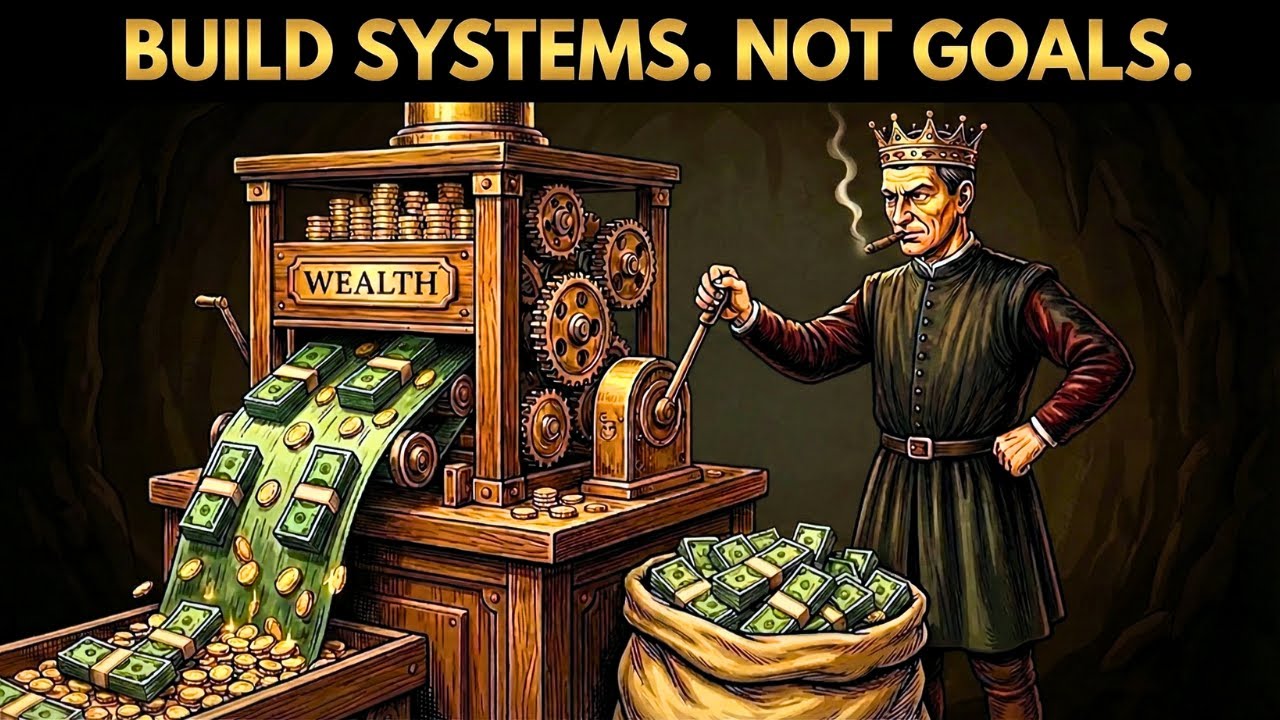
This video challenges the conventional wisdom of relying on hope and goals for success, arguing instead for the implementation of robust systems. It emphasizes that in moments of crisis, individuals default to their established systems, not their aspirations. The video advocates for rigorous self-auditing, strategic rigidity, and environmental design to ensure consistent performance and long-term dominance. By automating routine tasks and eliminating unnecessary choices, individuals can conserve cognitive energy for strategic decision-making and build structures that endure beyond their immediate involvement.
- Goals are sedative; systems are coercive mechanisms.
- Self-narratives are often lies; measurement exposes the truth.
- Choice is friction; strategic rigidity is efficient.
- Build systems that outlive you for lasting power.
The Fraud of Hope and the Biology of Collapse
The video starts by stating that goals are often a sedative, providing a false sense of achievement without real progress. Declaring a goal can reduce the internal pressure needed for action, as the brain mistakes intention for completion and releases dopamine prematurely. It argues that relying on goals is a weakness, allowing individuals to feel ambitious while remaining stagnant. Instead of rising to the level of their goals under pressure, people collapse to the level of their systems. The Rothschilds are presented as an example, where their success came from a private communication system, not just the desire to be wealthy. Without a system, collapse is inevitable due to the law of least resistance, where people default to what is easiest when energy is depleted. Motivation is unreliable, and relying on desires makes one a slave to moods. Systems, unlike goals, are coercive mechanisms that dictate reality without regard for feelings or fatigue.
The Sovereign’s Audit: Measurement Without Mercy
Transitioning from dreaming to mastering reality requires acknowledging that self-narratives are often lies. Most people navigate life based on feelings, but the elite operate on a clinical audit of reality. It is safer to be feared than loved, and this fear should be applied to one's own excuses. Measurement is about exposure, stripping away comforting stories to reveal raw, unforgiving data. Numbers report outcomes, regardless of intentions or circumstances. James Simons and his hedge fund Renaissance Technologies are highlighted as an example of a system that relies on quantitative models, removing the human element. A system without constant measurement decays due to entropy. The strong track their behavior, auditing their systems with the same lack of mercy a general uses to audit supplies before a siege. Every decision forced in the moment is a leak in power; choice is friction and an opening for weakness. Willpower is finite, so high-level operators eliminate choice at the tactical level by following predefined checklists.
Strategic Rigidity and the Impersonality of Power
Choice undermines absolute command. In the modern world, choice is often celebrated, but it introduces friction. Every option creates a leak for energy and resolve. Negotiating with a weaker version of oneself guarantees a compromise that favors comfort over outcome. Disciplined individuals appear rigid because they are sealing off paths to self-sabotage. The Prussian general staff under Helmuth von Moltke the Elder is presented as an example of an impersonal system of war-making that replaced individual brilliance with a standardized process. Habit is something you do, while infrastructure is something you live within. Undisciplined individuals live in constant adaptation, which they mistake for flexibility. Masters decide once and in advance, locking decisions into an impersonal structure. Automating execution removes the self as a bottleneck, making progress a matter of design rather than belief. This mechanical approach offends the ego, but automating the trivial frees the mind for strategy.
The Endgame: Environmental Dominance
The ultimate weakness of any structure is its dependence on your presence. Infrastructure endures your absence, and only that which endures deserves the title of power. A mature system operates when you are tired or distracted, containing its own defaults and fail-safes. Durable systems assume mediocrity and plan around it. The British East India Company is presented as an example of a bureaucratic company state that could govern from London due to its rigid internal protocols. The question shifts from "can I do this today?" to "can this continue without me?". Breaking the structure starts to feel irrational, and consistency enforces itself. This is called lock-in, the ultimate advantage of the elite. Those who never build this infrastructure must constantly restart their lives, while those who do never need to restart at all. The final goal is not productivity, but continuity, which allows results to compound. In this endgame, motivation loses relevance, and action occurs because the environment demands it. The system replaces intention with inevitability, leading to environmental dominance.

