
Brief Summary
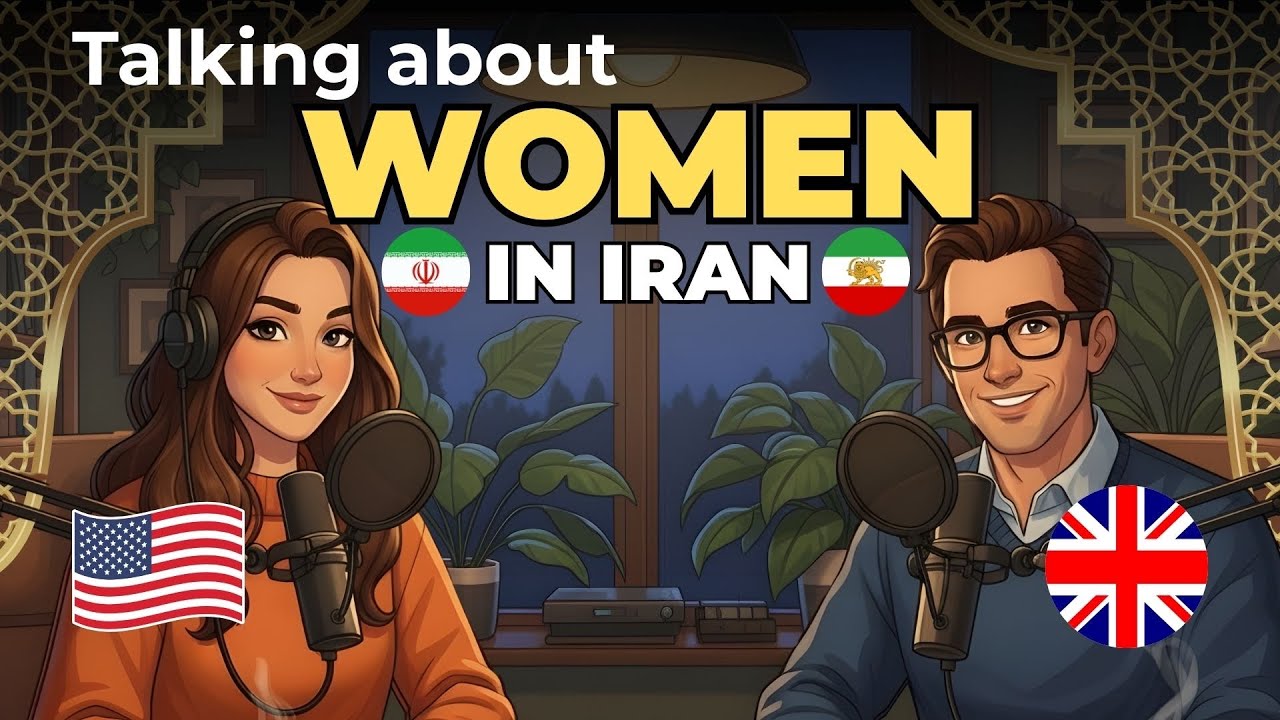
This podcast episode addresses the complexities surrounding the discussion of women in Iran, emphasizing the importance of moving beyond stereotypes and understanding their diverse experiences, contributions, and activism. It covers historical context, educational achievements, legal frameworks, and the nuances of personal choices like wearing the hijab. The hosts provide vocabulary and guidance for respectful and accurate conversations, encouraging listeners to amplify Iranian women's voices and recognize their agency.
- Iranian women are not a monolith; they have diverse experiences and perspectives.
- It's crucial to avoid stereotypes and acknowledge their agency in navigating complex realities.
- Understanding the historical context and legal framework is essential for respectful discussions.
Introduction
The hosts, Mike and Jane, introduce the podcast episode focusing on discussing important global topics in English, specifically the multifaceted topic of women in Iran. They aim to provide context and complexity often missing in mainstream media, which tends to reduce the topic to headlines without depth. They highlight that Iranian women are diverse individuals with varying experiences, professions, and perspectives, challenging the notion of a monolithic group.
Challenging Stereotypes and Personal Experiences
Jane and Mike discuss the importance of understanding that Iranian women are not a monolithic group and their experiences vary greatly based on factors like location, family background, and personal beliefs. Mike shares examples of former students, such as a software engineer from Tehran who wears a hijab by choice and is the primary breadwinner for her family, and another who left Iran due to restrictive hijab laws, to illustrate the diversity of experiences. The episode aims to provide vocabulary, historical context, and diverse realities to facilitate respectful discussions about women in Iran without resorting to stereotypes.
Historical Context
The discussion shifts to the historical context of women in Iran, noting that their rights and restrictions have varied over time. In ancient Persia, women held relatively high status compared to other civilizations, with queens like Atossa and Purandokht wielding significant political influence. Iranian women were pioneers in the Middle East, actively participating in the Constitutional Revolution of 1906, a movement for democracy and a constitution. Formal rights were gradually gained throughout the 20th century, with women obtaining the right to vote and run for parliament in 1963 under the Shah, earlier than in some European countries.
Impact of the Islamic Revolution
The Islamic Revolution of 1979 brought contradictory changes for Iranian women. While some laws expanded their access to education and healthcare, particularly in rural areas, others imposed restrictions such as mandatory hijab and limitations on certain professions. The post-revolution government invested heavily in female education, leading to dramatically increased literacy rates, but mandatory hijab became law, and women faced restrictions in legal areas like divorce, child custody, and inheritance. Despite these challenges, Iranian women navigate their lives with creativity, resilience, and diverse strategies, working within the system to expand rights, challenging restrictions through activism, and balancing legal requirements with personal choices.
Education and Employment
Iranian women are highly educated, comprising over 60% of university students, a rate higher than many Western countries. They excel in STEM fields, medicine, engineering, and humanities. Despite this, they face challenges in the workforce, including gender segregation and restrictions in certain professions like judgeships. While many women work successfully, barriers to using their education exist, depending on the field, family, and individual circumstances.
Contributions to Society
Iranian women have made significant contributions to society in various fields, including arts, sciences, literature, and sports. Examples include poet Samine Behbahani, mathematician Maryam Mirzakhani (the first woman to win the Fields Medal), film directors like Samira Makhmalbaf, and athletes like Kimia Alizadeh (Iran's first female Olympic medalist). Despite facing restrictions, Iranian women continue to produce world-class work in diverse fields.
Activism and Protests
Iranian women have a long history of activism, advocating for expanded rights, legal reforms in marriage, divorce, custody, and employment, and against mandatory hijab. They use various methods, including official channels, art, film, literature, civil disobedience, and social media. The protests following Masha Amini's death in 2022 were significantly led by women and girls demanding freedom of choice regarding hijab and broader rights. When discussing these protests, it's important to use accurate language, acknowledge their agency, and amplify their voices and stated goals.
Hijab: Legal Requirement vs. Personal Choice
Since 1979, hijab has been legally mandatory for women in public spaces in Iran, requiring them to cover their hair and wear modest clothing. Enforcement varies, creating tension. Some women wear hijab by choice for religious reasons, while others do so only because it's legally required, and some have complex feelings about it. It's crucial not to assume a woman's beliefs, education level, or political views based on whether or how she wears hijab. English speakers often mistakenly assume that all women who wear hijab are oppressed or uneducated, or that all women who oppose mandatory hijab are anti-religion or pro-Western. The focus should be on freedom of choice, not the hijab itself.
Family Dynamics and Marriage
Family is extremely important in Iranian culture, with women playing roles as daughters, mothers, wives, and increasingly, family breadwinners. Family dynamics vary, ranging from traditional to egalitarian, influenced by factors like urban vs. rural settings, religious vs. secular beliefs, and education levels. Marriage patterns are changing, with the average age of marriage rising and more women prioritizing education and career. Divorce rates have increased, often initiated by women, who can negotiate marriage contracts to include specific rights.
Stereotypes and How to Avoid Them
The biggest stereotype is that Iranian women are helpless victims with no agency, which erases their intelligence, strategies, accomplishments, and activism. It's also a misconception that all Iranian women think and feel the same way. Western media often presents a single narrative, either portraying them as oppressed and needing saving or as content with their situation, neither of which is true. To avoid stereotyping, use specific language, avoid generalizations, and always acknowledge agency, recognizing that Iranian women are active agents in their own lives.
Discussing Iranian Women in Different Contexts
In academic or formal contexts, use precise terminology and cite sources. In casual conversations, remain respectful and accurate. When someone shares their personal experience, listen without correcting or generalizing. Honor individual experiences, as people's lived experiences outweigh statistics and generalizations.
Key Vocabulary for Discussing Women's Rights
Key vocabulary includes: agency (the capacity to make independent choices), autonomy (self-governance), empowerment (increasing someone's ability to make choices), oppression (prolonged unjust treatment), restriction (specific limitations), and intersectionality (recognizing multiple identities). Use these terms carefully and specifically to avoid sweeping claims.
Intersectionality and the Iranian Diaspora
Intersectionality means recognizing that people have multiple identities (gender, class, ethnicity, religion, education, location) that intersect, creating different realities. An upper-class educated woman in Tehran has different experiences than a working-class rural woman. The Iranian diaspora includes millions of women with diverse experiences, some who left decades ago and others more recently, maintaining Iranian identity while integrating into their new countries.
Challenging Stereotypes and Learning Authentically
Iranian women challenge stereotypes through excellence, visibility, and voice, including athletes competing internationally, scientists publishing research, and filmmakers winning awards. Social media plays a huge role, with Iranian women using platforms to share their lives, art, activism, and perspectives directly. To learn more authentically, read books by Iranian women authors, watch films by Iranian women directors, follow Iranian women activists, journalists, and artists on social media, and listen to their podcasts.
Main Takeaway and Vocabulary Review
The main takeaway is that Iranian women are complex, brilliant, resilient, diverse, strategic, creative, and powerful human beings, not victims or symbols, but full human beings with agency, voices, and accomplishments. The episode concludes with a vocabulary review, teaching 10 essential words and phrases for discussing women's experiences, rights, and agency in Iran and beyond: agency, autonomy, mandatory, empowerment, literacy, discrimination, activism, patriarchy, stereotype, and intersectionality.
Vocabulary Review
The hosts review 10 essential words for discussing women's experiences and rights:
- Agency: The capacity to act independently and make free choices.
- Autonomy: The right to self-government and freedom to make one's own choices.
- Mandatory: Required by law or rules, distinguishing between choice and compulsion.
- Empowerment: The process of becoming stronger and more confident, especially in controlling one's life.
- Literacy: The ability to read and write, a key indicator of development and women's rights.
- Discrimination: Unjust treatment based on categories like race, age, or gender.
- Activism: Vigorous campaigning for political or social change.
- Patriarchy: A system where men hold the power and women are largely excluded.
- Stereotype: An oversimplified, generalized idea about a group of people.
- Intersectionality: The interconnected nature of social categorizations creating overlapping systems of discrimination.
Conclusion
The episode concludes by emphasizing the importance of understanding the history, educational achievements, contributions, and activism of Iranian women, as well as the complex realities they navigate. The hosts stress the diversity of Iranian women's experiences and the need to recognize their agency and amplify their voices. They encourage listeners to share their thoughts and experiences, particularly from Iranian women themselves, and provide resources for further learning. The hosts remind listeners to choose nuance over stereotypes and humanity over headlines, recognizing that Iranian women are not symbols or abstractions but individuals with dreams, talents, struggles, and agency.

