
Brief Summary
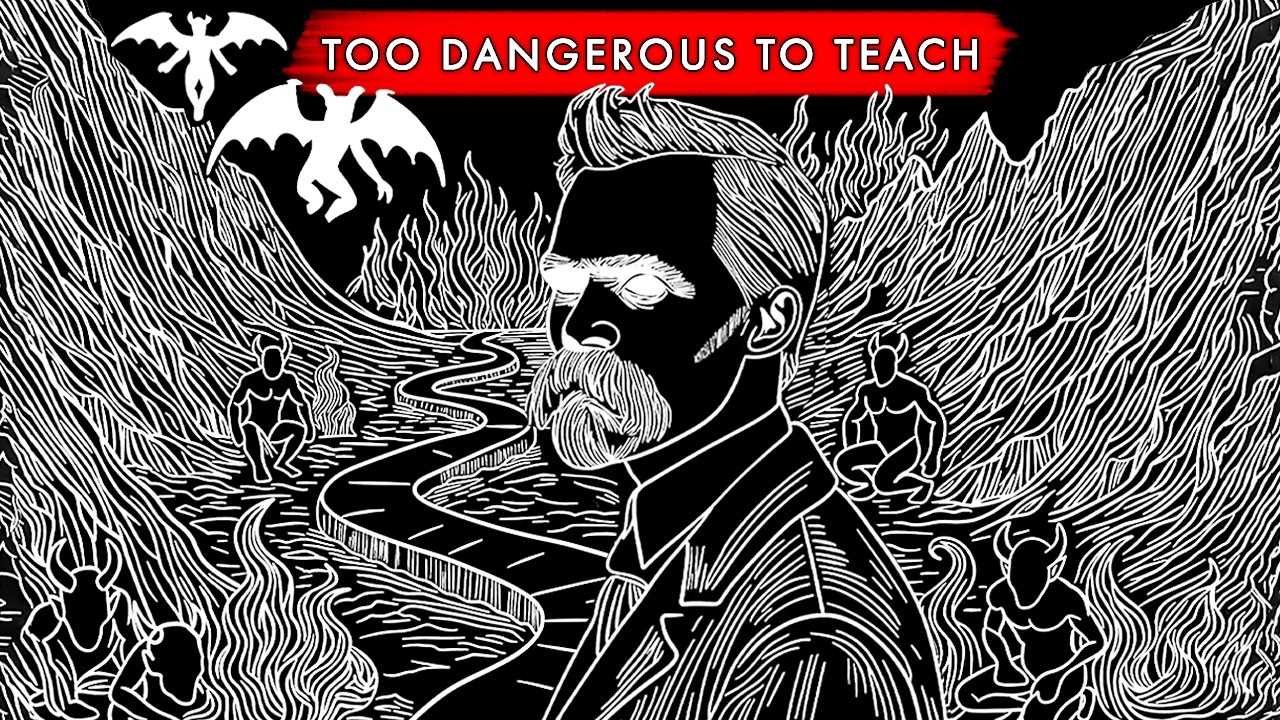
This video explores seven controversial philosophies of Friedrich Nietzsche, emphasizing their challenge to conventional thinking and their potential for personal transformation. It covers his critique of morality, the concept of "God is dead," the will to power, going beyond good and evil, amor fati (love of fate), the Übermensch (Overman), and eternal recurrence. Nietzsche's ideas encourage individuals to question societal norms, create their own values, and embrace life's challenges, promoting a life of authenticity and self-overcoming.
- Nietzsche challenges conventional morality and encourages individuals to create their own values.
- The concept of "God is dead" signifies the collapse of traditional meaning systems and the need for individuals to create their own meaning.
- The will to power is about self-overcoming and personal growth, not domination over others.
- Amor fati is the acceptance and love of one's fate, including suffering, as a means of personal transformation.
- The Übermensch is an ideal of self-mastery and authenticity, not a call for superiority or dominance.
- Eternal recurrence is a thought experiment that challenges individuals to live a life they would be willing to repeat forever.
Ideas Too Dangerous to Teach
Friedrich Nietzsche is portrayed as a cultural earthquake whose provocative ideas challenge established norms in religion, academia, and government. His philosophies, such as "God is dead" and "What does not kill me makes me stronger," are not meant to be comforting but to awaken individuals to the true nature of the world, free from illusions. Nietzsche's work dismantles unquestioned beliefs, challenges the foundations of morality and religion, and encourages independent thinking.
War on Morality
Nietzsche challenges the traditional view of morality as sacred, stable, and universal, particularly its Christian roots that value humility and selflessness. He questions the origins and beneficiaries of moral rules, suggesting that traditional morality is a coping mechanism invented by the weak to control the strong, which he terms "slave morality." Nietzsche contrasts this with "master morality," which values strength and independence. He argues that slave morality has become the dominant system, suppressing individual potential and enforcing conformity. Nietzsche calls for honesty and the courage to live with integrity on one's own terms, urging individuals to question inherited values and create their own.
"God is dead"
Nietzsche's declaration that "God is dead" is not a celebration of atheism but a warning about the erosion of belief in God and the collapse of a whole system of meaning. He mourns the loss of a shared story and moral direction that religion once provided, foreseeing a rise in nihilism, the sense that nothing really matters. Nietzsche fears that people will turn to false idols and mass movements to fill the void left by religion. He urges people to replace dying beliefs with something deeper and stronger, calling for a new kind of spirituality built on strength and self-honesty.
Will To Power
The "will to power" is often misunderstood as domination, but Nietzsche intended it to mean the fundamental drive in all beings to grow, expand, and express themselves. It's the inner force behind creativity, ambition, and self-transformation, not necessarily violent but vital. Nietzsche contrasts this with Darwinism, arguing that creatures don't just want to survive, they want to flourish and shape the world. True power, according to Nietzsche, is internal and found in self-overcoming, confronting one's weaknesses and limitations.
Beyond Good and Evil
Nietzsche challenges the illusion that good and evil are fixed, eternal truths, arguing instead that they are human inventions shaped by culture, power, and historical context. He believes that moral beliefs often reveal more about personal values and social roles than any universal truth. Nietzsche criticizes the herd mentality, where people passively adopt values without questioning them, and advocates for the creation of one's own values. He promotes the idea of the "free spirit," someone whose ethics come from conscious creation rather than unconscious imitation.
Amor Fati
Amor fati, or "love of fate," is not just enduring fate but embracing every moment, hardship, and failure as if chosen. Nietzsche encourages affirming life, not just when it's easy but when it's brutal. This challenges the modern obsession with comfort and positivity, demanding that individuals stop running from suffering and transform it into something meaningful. Living with amor fati means living without resentment, refusing to waste life wishing things were different, and turning pain into purpose.
The Overman
The Übermensch (Overman) is a misunderstood concept, often associated with dominance and superiority, but Nietzsche intended it as an ideal for personal, spiritual, and psychological growth. It's his answer to living meaningfully in a world without God or absolute truths. The Übermensch is someone who creates their own values, lives with courage, and refuses to be defined by societal limitations. This individual doesn't conform, doesn't need validation, and is self-created, representing a lifelong process of self-overcoming.
Eternal Recurrence
Eternal recurrence is a thought experiment that challenges individuals to imagine reliving every moment of their lives, both good and bad, over and over again for eternity. It's not a scientific theory but a philosophical test to determine if one is living a life worth repeating. If the thought horrifies you, then you may not be living the life you want to live. Eternal recurrence is a tool for radical self-responsibility, forcing individuals to treat every moment as significant and align their actions with their deepest values.

