
Brief Summary
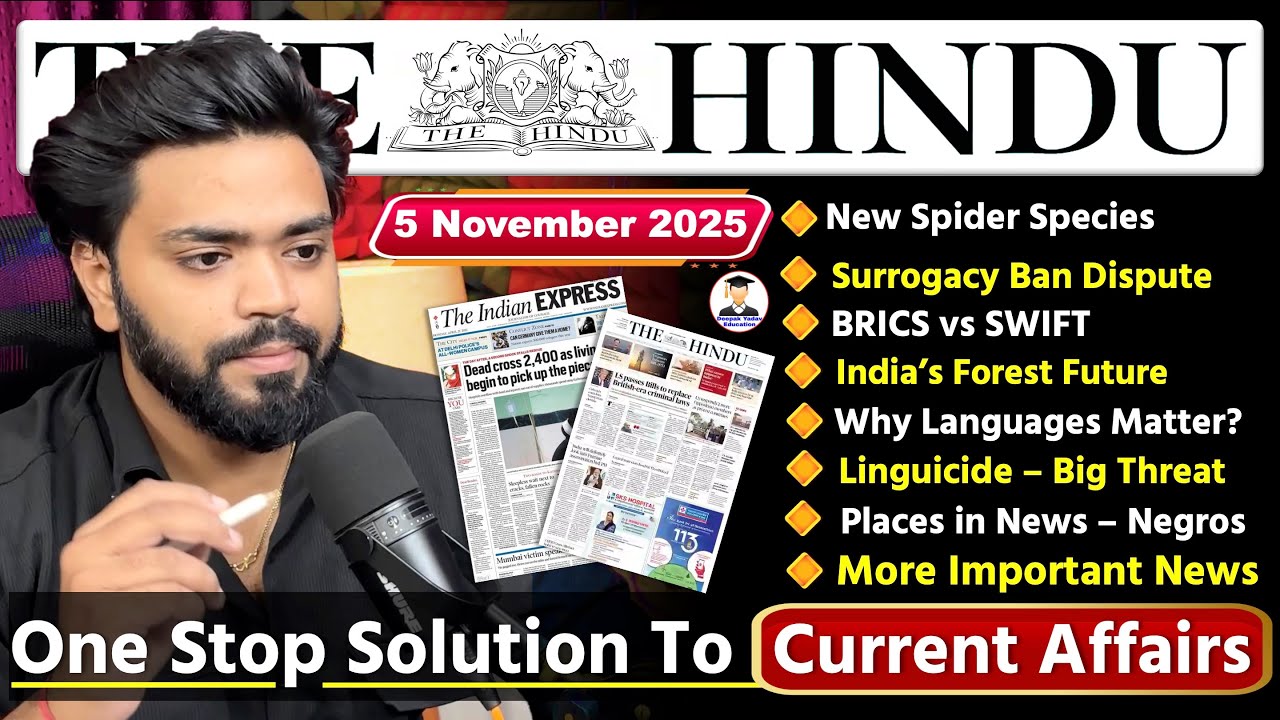
This YouTube video by Deepak Yadav Education provides a detailed analysis of The Hindu newspaper, dated November 5, 2025. It covers a range of topics relevant to the UPSC examination, including environmental issues, surrogacy laws, BRICS vs. SWIFT, and the importance of forest conservation and linguistic diversity in India. The video encourages viewers to participate by answering questions in the comment section and also promotes a paid group for comprehensive study materials.
- Discussion on a newly discovered spider species and its significance for environmental studies.
- Analysis of the surrogacy ban in India, touching upon fundamental rights and population control.
- Examination of the BRICS initiative to challenge the SWIFT system and promote de-dollarization.
- Importance of forest conservation and the Green India Mission for climate change mitigation.
- Highlighting the need to preserve linguistic diversity and the challenges posed by globalization and digitization.
Map Question: Negros Island
The lecture starts with a map-based question, tasking viewers to locate Negros Island on a map and comment their findings. This exercise aims to improve long-term memory and geographical awareness among the audience.
New Spider Species Discovery
The discussion begins with a focus on a new species of jumping spider, named "Pilia Melindu," discovered in the Chikmagalur district of Karnataka by researchers. This rediscovery after 123 years makes it significant for the Environment section of GS paper number three. The spider, belonging to the Pilea genus, was found on only two plant species: Memisylon Omlethum and Mesylon melebaricum. The discovery indicates the potential for ecosystem recovery and highlights the importance of species conservation. Additionally, a damsel fly named Saffron Redetail, found only in the Western Ghats, was also mentioned. A question is posed to the audience regarding the characteristics of Pilia Melanidu.
Surrogacy Ban Analysis
The video analyzes the surrogacy ban in India, particularly the petition filed in the Supreme Court to lift the ban on surrogacy for couples seeking a second child. The lecture explains surrogacy, its types (traditional and gestational), and the Surrogacy Act 2021. Traditional surrogacy is not allowed in India, while gestational surrogacy is permitted under strict conditions. Altruistic surrogacy is allowed, but commercial surrogacy is prohibited. The discussion includes the legal aspects, fundamental rights (Article 21), and the government's perspective on population control. The Supreme Court's review of the petition and potential future orders are also discussed. A question is posed to the audience regarding the Surrogacy Regulation Act 2021.
BRICS vs SWIFT
The lecture examines how BRICS (Brazil, Russia, India, China, and South Africa) is challenging SWIFT (Society for World Wide Interbank Financial Telecommunications), a global financial messaging network. SWIFT, dominated by Western countries, facilitates international transactions but is perceived as being controlled by the United States, the United Kingdom, and the European Union. BRICS aims to reduce dependence on SWIFT and promote de-dollarization by using local currencies for trade. The discussion covers the motivation behind BRICS, the creation of the New Development Bank, and the challenges in establishing a stable alternative due to internal relations and external pressures from the USA. The concept of BRICS Pay, an initiative to interconnect national payment systems, is also explained. A question is posed to the audience regarding the BRICS Cross Border Payment Initiative.
India's Forests and Future
The editorial analysis focuses on the importance of India's forests for its future, balancing economic growth with environmental sustainability. The Green India Mission, under the National Action Plan on Climate Change, aims to restore 25 million hectares of degraded forest and non-forest land by 2030. The lecture highlights the progress made, the challenges in achieving carbon efficiency, and the need for community participation. Examples of states like Tamil Nadu, Himachal Pradesh, Uttar Pradesh, Osa and Chhattisgarh are given. The CAMPA (Compensatory Afforestation Fund Management and Planning Authority) Fund is discussed, along with the need for proper utilization and transparency. The importance of empowering local communities and maintaining transparency in fund utilization is emphasized. A question is posed to the audience regarding the Green India Mission.
Celebrating and Conserving Language
The lecture discusses the importance of celebrating and conserving languages, especially in the face of globalization and digitization. India, described as a "Garden of Languages," faces the challenge of linguisticide, the death of languages. The lecture emphasizes the role of language in reflecting culture, identity, and knowledge. It also covers the 11 classical languages in India and the need to protect smaller languages. The impact of the digital era, including the dominance of English and the need for digitizing literature and manuscripts, is discussed. The Bhashini Project, aimed at multilingual real-time translation, is mentioned. The lecture also addresses the misuse of language through digital shortcuts and the importance of constitutional support for linguistic diversity. A mains question is posed to the audience regarding India's Linguistic Diversity.

