
Brief Summary
This episode of The Diary Of A CEO features Morgan Housel, a financial guru, discussing the psychology of spending, saving, and achieving financial independence. He emphasizes that spending is more complex than it seems and is deeply rooted in psychology, social aspirations, and personal values. Housel argues that money is a tool that can enhance happiness if used wisely, but it is not a guaranteed solution to unhappiness. He also touches on the importance of independence and purpose in life, the dangers of social comparison, and the need to manage expectations to achieve contentment.
- Spending money is more complex than it seems and is deeply rooted in psychology, social aspirations, and personal values.
- Money is a tool that can enhance happiness if used wisely, but it is not a guaranteed solution to unhappiness.
- Independence and purpose are essential for a fulfilling life.
- Social comparison can lead to dissatisfaction and reckless financial decisions.
- Managing expectations is crucial for achieving contentment.
Intro
Morgan Housel, a financial guru, challenges conventional wisdom about saving and spending money, suggesting that our biggest downfalls may stem from misunderstandings in these areas. He argues that the assumption that more money automatically leads to a better life is a lie, as spending often serves as a psychological itch that people try to scratch. Housel points out that life is often viewed as a competition, with material possessions used as tangible markers of success relative to others. He cautions against letting status control one's personality, likening it to an addiction. He also notes that extreme saving can be as dangerous as overspending.
The Importance of Spending Money
Morgan Housel explains why he wrote "The Art of Spending" despite having written extensively on investing and finance. He realized he hadn't articulated his own spending philosophy. He noticed a lack of literature on spending, assuming it was because people thought the topic was obvious: more and fancier is better. However, he observed that wealthier people's relationship with spending is more complex. He emphasizes that while money can make people happier, it's not as simple as spending more. The book explores the psychology behind spending, including greed, envy, social aspiration, and the desire to impress others.
Why Will This Podcast Make My Life Better?
Morgan Housel believes that many people assume that more money will solve their problems, but this is not always the case. He views money as a clear window into understanding people's values, fears, and aspirations. He uses the term "post-traumatic broke syndrome" to describe how people who grew up poor may be afraid to spend money even after becoming successful. He emphasizes that spending is not just about material possessions but also about signaling to others and oneself what one has overcome. He suggests that if one were on a deserted island where no one could see their possessions, they would likely gravitate towards utility over status.
Is There Something Wrong With Chasing Status?
Morgan Housel says that there is nothing inherently wrong with status, especially at certain points in life. He admits that his own desire to show off material possessions stemmed from having nothing else to offer the world, such as intelligence or wisdom. He quotes Warren Buffett, stating that success in life is when the people you want to love you do love you. He emphasizes that it's important to define who you want to love you and to realize that most people are not paying as much attention to your possessions as you think they are. He references a quote from Jimmy Carr, who says that people in their 20s worry about what others think of them, in their 30s they stop caring, and in their 40s they realize nobody was thinking about them in the first place.
What’s the Evolutionary Basis for This Stuff?
Morgan Housel explains that life is a competition, and it matters how well one is doing relative to others. He notes that there is no absolute definition of wealth, as everything is relative. He argues that because we live in a world of material abundance, the competition for bigger and nicer things is more intense than ever. He attributes this to social media, which makes people more aware of others' possessions, and the internet, which has democratized access to audience and attention, making it easier to become wealthy. He suggests that people need to develop the skill of disconnecting their admiration from their aspirations to live a good life.
There's Always a Trade-Off
Morgan Housel emphasizes that everything in life involves trade-offs. He references a Jimmy Carr quote, "Everyone is jealous of what you've got. Nobody's jealous of how you got it." He introduces the concept of the reverse obituary, which involves writing down what you want your obituary to say to help clarify what you actually want in life. He notes that it would be absurd to include material possessions in an obituary, which helps people realize that those things are not what truly matter.
Saving Addiction
Morgan Housel believes that savings addiction is equally bad as spending addiction because both are the exact same thing which is money's controlling you. He argues that money should be a tool to become a better, happier version of oneself, but it becomes dangerous when it controls one's personality. He notes that many financial advisors have clients who have saved enough for retirement but are afraid to spend it because they have become too accustomed to the identity of being a saver.
Can Money Make You Happy?
Morgan Housel says that money can make you happier, but there's an asterisk. He explains that if you are already an unhappy person, more money will not help you much, but if you are already a happy person, more money will give you a better life. He uses the example of someone who is overweight, unhappy, divorced, and estranged from their children but lives in a mansion with a Ferrari, versus someone who lives in a modest house and drives an old car but loves their job, has a great relationship with their spouse, and is admired by their children. He emphasizes that it would be psychotic to choose the miserable person in the mansion over the content person in the middle-class house if your goal is to live a good life.
Are We All Stuck in a Status Game?
Morgan Housel says that the formula for a pretty good life is independence plus purpose. He believes that the best thing to spend money on is independence, which he views as purchasing it through saving. He notes that independence exists on a spectrum, and every dollar saved is a little bit more independence than before. He defines purpose as something higher than oneself, such as friends, family, career, or religion. He argues that loyalty to people who deserve it is a wonderful thing, while loyalty to those who don't is terrible.
Is the "Freedom" Culture Actually Making People Unhappy?
Morgan Housel says that the promise of independence and freedom has a secret hidden dark trade-off that people don't talk about. He notes that humans seem to be happier when they are dependent on others and have a purpose. He argues that the public narrative of optimizing for freedom and independence may be making people unhappy because they lack purpose. He emphasizes that it's important to choose who you want to be dependent on and to avoid being loyal to things you hate.
Your Favorite Form of Saving Is Spending
Morgan Housel says that a good measure of medium level of independence is to have enough money to keep yourself going for six months if you lose your job. He notes that this is a level at which you can exhale to a degree that most people have never been able to do before. He emphasizes that the flexibility to give yourself time to find a good job is the purpose of savings.
Jealousy of Other People’s Wealth
Morgan Housel says that if you win the lottery, the probability of your neighbor going bankrupt increases because they see your newfound wealth and try to emulate it, leading to reckless financial decisions. He emphasizes that our definition of success is often based on what other people around us have. He advises being careful who you socialize with because you will anchor to them as a baseline level of success and happiness. He notes that people were happier in Lake Tahoe, California, before it became wealthy because the definition of success was a two-bedroom house and a pickup truck, whereas in Los Angeles, it was a mansion and a Bentley.
The Spectrum of Financial Independence
Morgan Housel says that financial independence is on a spectrum, not a binary state of either having to work or not. He argues that every dollar saved is a piece of your future that you own, while every dollar of debt is a piece of your future that someone else controls. He outlines the stages of financial independence, starting from being homeless and reliant on the kindness of strangers, to being completely reliant on a job you don't like, to having some opportunities and savings, to being able to live and work where you want, to ultimately not needing to work anymore.
How Do People Achieve Financial Independence?
Morgan Housel says that the most important thing to achieve financial independence is to manage what you want, as all wealth is what you have minus what you want. He references his late grandmother-in-law, who lived happily off of $1,700 a month because she didn't want anything more. He argues that she was happier financially than some billionaires because she was content. He notes that happiness might be the wrong word, and the word people actually want is content.
How Does Dopamine Factor Into All of This?
Morgan Housel says that dopamine, the chemical for wanting, plays a huge role in people's desires and aspirations. He notes that it's easier said than done to completely control your desires, but just knowing why you're doing it and realizing that it's probably not going to give you the happiness you want can go a long way. He admits that he still has moments where he wants to buy a new car or a bigger house, but he reminds himself that it's not going to make him happier. He suggests that people can shift their addiction to something more productive, such as building businesses or being a great parent.
We're Wired to Want More
Morgan Housel says that everyone is addicted to something, and it's just a matter of harnessing that process for productivity. He notes that a money addiction tends to be the classic addiction of telling yourself that if only you get one more hit, then you'll be satiated, but that's not true. He references the arrival fallacy, which is the false belief that once you get to a certain point, then you'll be good. He emphasizes the importance of appreciating what you have now and finding joy through things that don't have the arrival fallacy, such as spending time with your kids.
People Retiring Early Tend to Wish They Hadn't
Morgan Housel says that a lot of people who retire early end up going back to work because they realize that what actually makes them happy is purpose. He notes that for many people, their purpose can be their career, or they realize that all of their friends are working and don't have time to play golf with them on Tuesday afternoon. He reiterates that the formula for a good life is independence plus purpose, and those who retire early may gain independence but lose their purpose.
Passive Income Myths
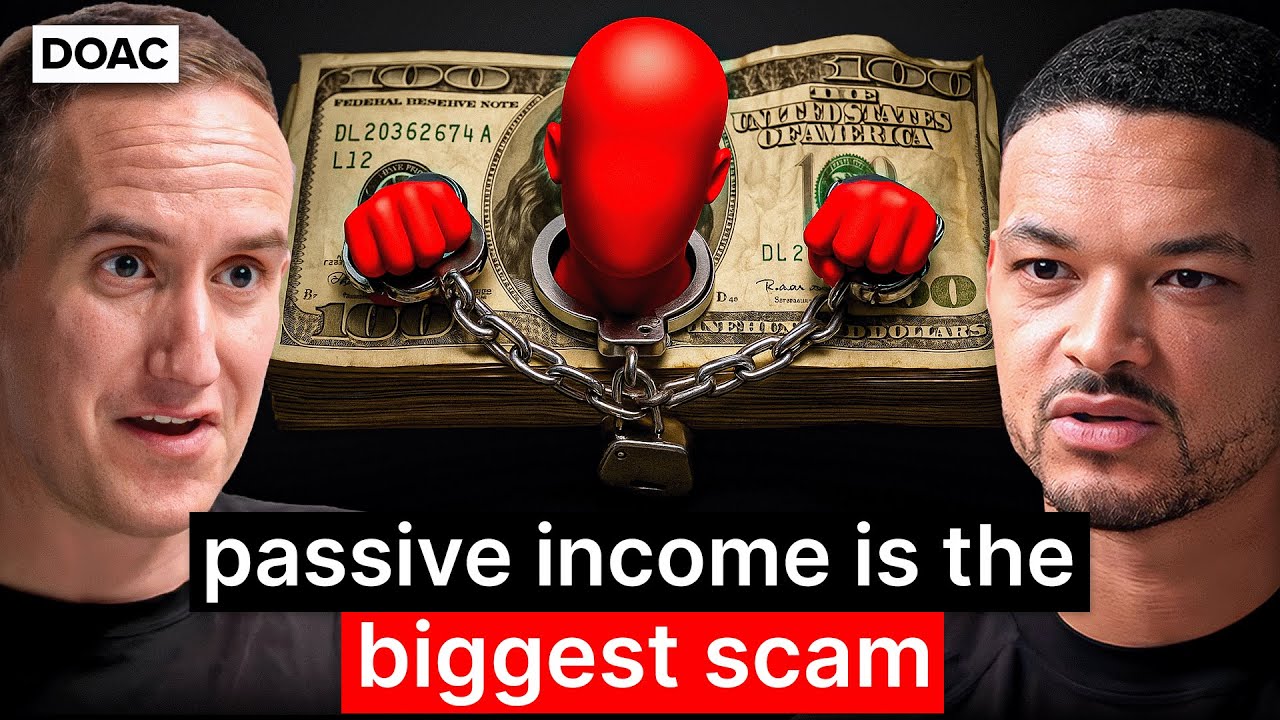
Morgan Housel says that passive income is largely a myth. He argues that there are only two ways to get wealthier: sacrifice more or want less. He notes that even if you put your money in a savings account that pays interest, you had to sacrifice to earn that money and delay the gratification of that money.
Do I Need to Know Economics for This?
Morgan Housel says that it's not necessary to understand economics to understand your own spending behaviors, how to get wealthy, or how to save. He argues that you don't need a PhD in biology to be healthy, just as you don't need to understand how the Federal Reserve works to be financially successful. He notes that learning about finance can actually backfire for some people by increasing their confidence more than their ability. He suggests that it's more important to be an informed citizen and voter than to have extensive financial knowledge.
What’s Going On in the World?
Morgan Housel says that while statistics may show that the average American family is better off than they were 25 years ago, many people would disagree because their expectations have gone up. He notes that statistics don't account for the individuality of how people spend their money. He argues that there is always something legitimate to complain about, and it's not just a matter of people needing to be more grateful. He says that the rich are getting richer, and the poor are treading water, but when one group of society is getting richer, treading water feels like you're falling.
How Wealth Inequality Is Dividing People
Morgan Housel says that what you want to avoid more than anything in society is when a third of the population wakes up every morning and says this isn't working. He notes that we are either there or precariously close to there in a lot of areas in the world. He argues that social media makes this situation a hundred times worse than it's ever been because it amplifies division and extremism.
The Charlie Kirk Shooting
Morgan Housel says that social media has the ability to dehumanize other people at a faster rate than in history. He notes that it's easy to find people celebrating the assassination of Charlie Kirk on social media, which was not the case in the past. He argues that once you dehumanize any group of people, you can do anything to them. He uses the example of road rage to illustrate how people can become angry and hateful when they are not looking at someone eye to eye.
Is There a Way Back From This Divide?
Morgan Housel expresses hope that the current era of political division will be seen as a bottom from which society grew out of in the future. He acknowledges that this sounds crazy today, but that's always been the case throughout history. He suggests that the younger generation may be the one that recognizes the dangers of social media and AI and becomes more attuned to how quickly they can be led astray.
What Should We Be Doing to Help?
Morgan Housel says that people with public platforms need to remind themselves that social media has been designed to deliver the most anxiety-inducing information, not the best information. He notes that people go on social media to perform and that it's not a proxy for the real world.
Are You Optimistic About the Western Economy?
Morgan Housel says that he is optimistic about the Western economy long-term, but realistic about what growth means. He notes that the reason we tend to have growth is specifically because there's short-term chaos. He guarantees that the biggest risk to the economy in the next 10 years is something that no one is talking about whatsoever.
Favorite Chapter From the Book
Morgan Housel says that his favorite chapter from "The Psychology of Money" is the one on reasonable versus rational. He argues that people should not pretend to be purely rational and that their financial decisions don't have to make perfect sense. He emphasizes that as long as your financial decisions are merely reasonable, that's good. He says that people should use money as a tool for a better life, even if it doesn't always make sense.
Why You Should Try New Things
Morgan Housel says that it's important to try new things because you don't know what your thing that you really enjoy in life is going to be. He notes that it might not be intuitive and that everyone is different. He emphasizes that you have to try a million different kinds of spending before you realize what you like and don't like.
Are You Chasing a Lifestyle That's Not Right for You?
Morgan Housel says that a lot of what throws people off with money is chasing a lifestyle that is right for somebody else but not right for them. He emphasizes that it's important to cultivate self-awareness and to realize that everyone is unique and different. He argues that it's immature for people to say that everyone else should enjoy life in the exact same way that they do.
Does Jack Think Steven Is Happy?
Jack, the producer of the show, says that he would not want Steven's life because of the amount of people bidding for his attention and the magnifying glass that is on him. He notes that Steven is always trying to chase the next thing and that he is a businessman at his core. He says that he thinks Steven is happy, but not content. He also notes that Steven's life is engineered to be super efficient, which means that he doesn't get to experience the messiness of life.
Should We Feel Guilty About Lacking Contentment?
Morgan Housel says that it's not wrong to constantly want to chase and pursue things because that's how humans have evolved. He argues that at the core of it is competition with others who might be doing better than you or who might take your place if you were to step back. He emphasizes the importance of asking yourself if you are doing things because they actually fulfill you or because you are competing with other people and trying to gain their attention.
The Relationship Between Money and Kids
Morgan Housel says that every parent wants to use their hard work to give their kids a better life, but what the kids need to do is learn on their own. He emphasizes that kids will learn vicariously the values that you have about money by watching you, not by being lectured.
The Exact Formula for Spending
Morgan Housel says that the common denominator between all three of his books is the idea that there is no formula for living a better life. He argues that this is actually the best news because it means that you don't have to follow somebody else's playbook and can do it your own way. He emphasizes that it's easier to do it your own way when you come to terms with the fact that nobody is paying as much attention to you as you think they are.
Humble Bubble
Morgan Housel likes the term "humble bubble" and wants to live in one. He wants to live in a bubble where his expectations don't leave his own house. He notes that the only thing that's going to make him happy exists underneath his roof, such as good health, happy kids, and a good marriage.
Do You Have Major Regrets in Life?
Morgan Housel says that he doesn't have any huge regrets. He admits that he sometimes wonders what life would have been like if he had more kids, as his kids have given him so much meaning and purpose. He notes that it's not until you've closed a door on your life that you realize what could have been.

