
Brief Summary
This video explores the science behind hit songs, aiming to uncover the "formula" that makes certain tracks successful. It examines various scientific studies and analyzes a vast collection of songs to identify the key elements that separate hits from misses. The video covers aspects like genre selection, beat creation using Spotify data, song structure based on psychological experiments, melody composition, and lyric writing, all while creating a song to test these findings.
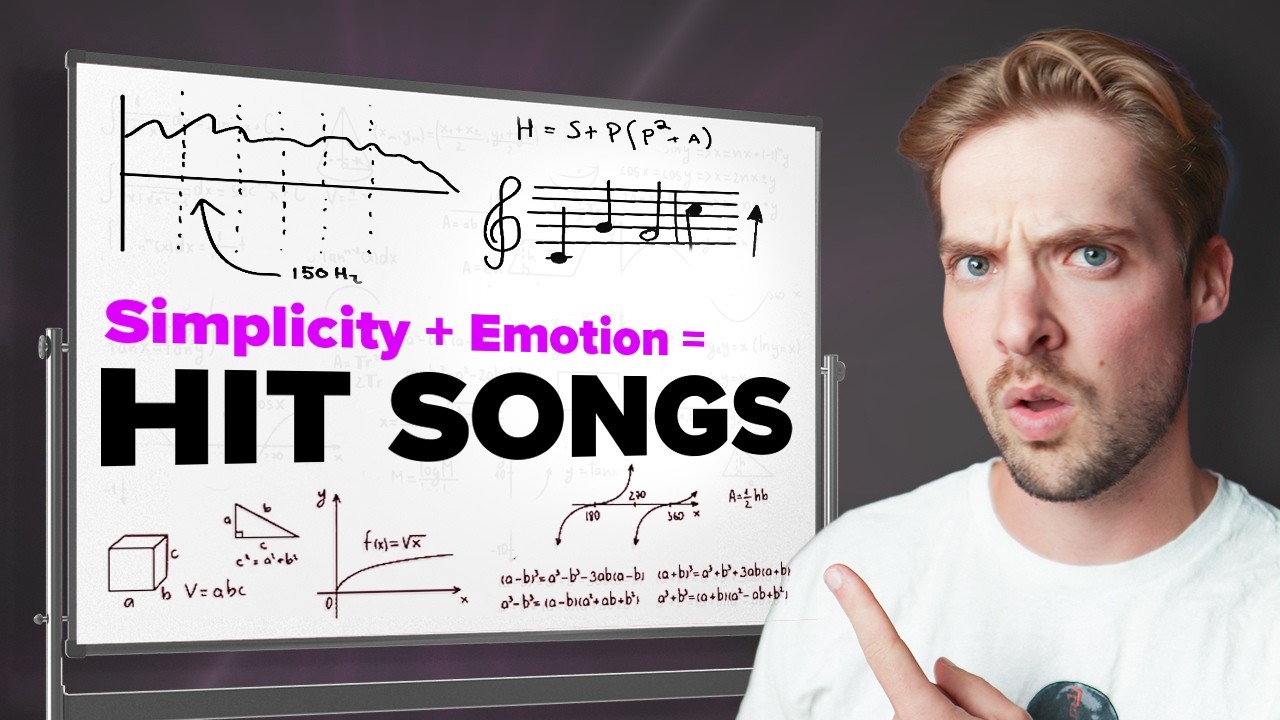
- Hit songs often have simple melodies, lyrics, and ideas.
- Unpredictability and predictability are used to hook listeners.
- Repetitive patterns in melodies, song structure, and drum grooves enhance engagement.
- Hit songs evoke strong emotions through melody, beat, production, and lyrics.
Intro
The video introduces the concept of a scientific formula behind hit songs, suggesting that success isn't just about vibes or luck. The creator aims to find this formula by analyzing scientific studies and over a million songs from 1950 to the present, while also creating a song to illustrate the process. The goal is to understand what makes people repeatedly listen to certain songs and how to use this knowledge to craft hit songs.
The Problem
The creator discusses the initial problem that sparked the investigation: an algorithm developed by Stanford researchers that could predict Billboard hits with 75% accuracy. Further research revealed another algorithm with 88% accuracy. The creator questions what patterns these algorithms are identifying in hit songs that differentiate them from others. To test the ability to predict hits, the creator quizzes themself on past popular songs, achieving only 36% accuracy, highlighting the difficulty in predicting hit songs compared to the algorithms' success. Studies confirm that people generally struggle to predict hit songs, with accuracy rates often below 50%.
Act 1: The Genre
The video transitions into the process of creating a song to test the hit-making formula, starting with genre selection. Research indicates that pop music is the most popular genre worldwide, while hip hop and R&B dominate the US market. Despite considering hip hop due to its US popularity, the creator decides to produce a pop song, aligning with their expertise and international appeal.
Act 2: The Beat
The focus shifts to creating the beat, utilizing a data set of Billboard Hot 100 hits from Kaggle. This data set includes Spotify metrics like danceability, energy, speech, acousticness, liveness, instrumentalness, and valence, which were also used in the 88% accuracy study. Spotify's definitions of these metrics are explained: danceability (tempo, beat strength, rhythm consistency), energy (loudness, timbre, entropy), speech (amount of talking vs. singing), valence (happiness or sadness), acousticness (rawness of the song), and popularity (number and recency of plays). The creator decides not to use popularity for beat creation, as it is more useful for predicting hits than making them. Averages from the data set are used to establish a starting point for the song's characteristics. The creator combines averages from their initial data set with those from another study to create a range of values. Reference songs are selected based on these ranges to guide the beat creation process, including songs for danceability, energy, acousticness and speech.
Act 3: The Structure
The video addresses song structure, referencing a study that analyzed chords in classic Billboard pop songs and found that musical pleasure arises from the right balance of uncertainty and surprise. The study suggests that listeners enjoy unexpected chords in simple progressions and predictable elements in complex progressions. An experiment involving rats and musical sounds is presented, revealing that rats maintain attention when presented with unpredictable note patterns, such as AAB ABC. This pattern is then related to song structure, with A representing verse, B representing chorus, and C representing bridge, forming a popular verse-verse-chorus-verse-chorus-bridge structure.
Act 4: The Melody
The video transitions to melody creation, citing a study that melodies are more important than lyrics in conveying emotional responses. Research indicates that melodies have become simpler over time, possibly due to increased complexity in other song elements like tempo, vocals, production quality, and timbre. The creator records various melody ideas that align with the study's findings, aiming for simplicity.
Act 5: The Lyrics
The focus shifts to lyric writing, noting that lyrics, like melodies, have become simpler and more angry over time. Studies show that sad lyrics intensify sad songs, while lyrics in happy songs don't necessarily increase happiness. Modern lyrics use more personal pronouns and fewer words related to positive emotions. The creator brainstorms simple, slightly angry words with personal pronouns, aiming to fit the Spotify song framework. A study on lyrical repetition is mentioned, stating that repetitive lyrics increase processing fluency and drive market success. Another study indicates that songs with higher rhyme saturation and basic lyric readability achieve higher chart positions and resonate more deeply with listeners. The creator focuses on writing simple, rhyming, and repetitive lyrics with a slightly negative valence.
Act 6: The Final Product
The creator records vocals, produces the track, and adds background vocals to polish the song. A snippet of the final song, showcasing the first verse and chorus, is played.
The "Formula"
The video concludes by reflecting on whether the hit song formula was found and successfully implemented. The key takeaways are that hit songs tend to be simple, using simple melodies, lyrics, and ideas. They incorporate unpredictability and predictability to engage listeners, and they use repetitive patterns in melodies, song structure, and drum grooves to enhance engagement. Most importantly, hit songs evoke strong emotions through their melody, beat, production quality, and lyrics. The video also acknowledges that factors not covered by the science, such as music marketing, social media, cultural trends, and playlist placements, significantly impact a song's success. Despite algorithms predicting hits with high accuracy, passion and hard work can lead to unexpected success.

