
Brief Summary
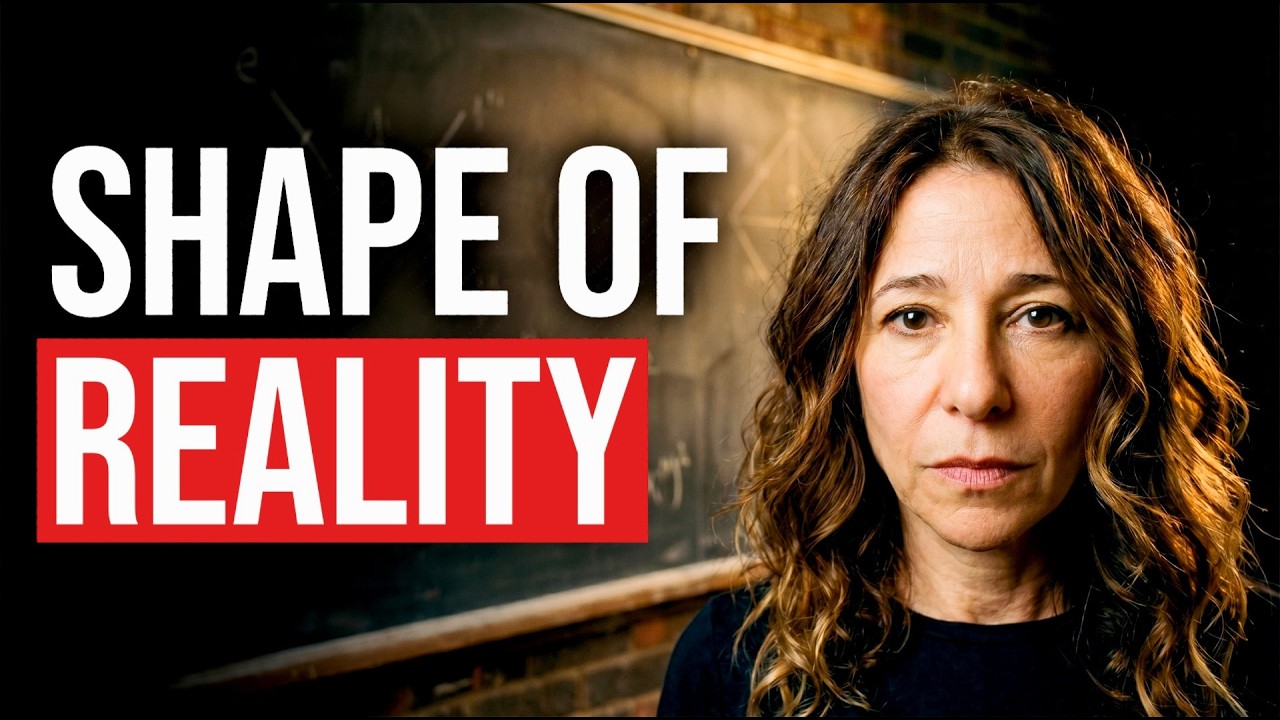
This episode of Theories of Everything features a conversation with Professor Janna Levin, discussing topics ranging from Gödel's incompleteness theorems and their implications for physics, to the nature of consciousness and the structure of the universe. Levin shares insights on her recent work involving Klein bottles and their potential to explain the matter-antimatter asymmetry, as well as her thoughts on black holes, extra dimensions, and the challenges of formulating a "theory of everything."
- Gödel's incompleteness theorems suggest that there may be limits to what we can know about the universe through physics.
- The geometry of the universe, particularly the topology of extra dimensions compactified on Klein bottles, may play a crucial role in explaining fundamental phenomena like CP violation and the origin of matter.
- Consciousness remains a profound mystery, and it is unclear whether AI will ever achieve it or if it is even necessary for advanced intelligence.
- Black holes may be fundamental particles, and their properties challenge our understanding of space-time and quantum gravity.
Gödel, Self-Reference, and the Universe
Janna Levin explores the idea of whether the universe can be described as a Gödel sentence about itself, touching on the self-referential nature of the early universe and the setting of initial data. She explains Gödel's incompleteness theorems, which state that within any consistent axiomatic system, there are true statements that cannot be proven. This leads to a discussion on whether the laws of physics and initial conditions of the universe are consistent but contain unprovable aspects. Levin considers the possibility that the Gödel sentence of the universe might be "these initial conditions cannot be predicted by the laws of physics," highlighting the separation between the laws of physics and initial conditions.
Penrose, AI, and Consciousness
Levin shares her perspective on AI and consciousness, diverging from Roger Penrose's view that AI can never be conscious. While acknowledging the impressive capabilities of current AI models like LLMs, she believes that consciousness is not substrate-dependent and that AI consciousness is possible, though likely far off. She discusses the hard problem of consciousness, questioning how electromagnetic interactions result in subjective experiences like the hallucination of color. Levin also wonders if machines with vast compute power will need consciousness or if they can simulate it sufficiently.
The Economist and Van Man Sponsors
Curt Jaimungal briefly promotes The Economist, highlighting its high-quality science and AI coverage, and mentions the exclusive discount available to listeners. He then introduces Van Man, a skincare company focused on real ingredients and ethical practices.
Averted Vision and Truth
Levin discusses the analogy of averted vision, where truth can only be glimpsed indirectly and disappears when directly confronted. She relates this to her book, "A Mad Man Dreams of Turing Machines," where she admits that the truth of certain lives cannot be reached through an axiomatic approach.
Klein Bottles and Compactified Dimensions
Levin introduces Klein bottles as non-orientable surfaces with unique properties, explaining how they differ from toruses in terms of symmetry and orientability. She describes a model where our universe has three large spatial dimensions and two additional dimensions compactified into a Klein bottle at every point in space. This leads to a discussion on how these extra dimensions might be accessed and the concept of living on a brane within a higher-dimensional space.
Spin, Pin, and Fermions
Levin explains the difference between spin and pin structures, addressing concerns about putting spin on non-orientable surfaces. She clarifies that pin structures allow for fermions to exist in these spaces, but building chiral fermions is more challenging. The conversation touches on the possibility of shooting left-handed particles into the extra dimensions to make them appear as non-interacting, "dark" matter.
Collaborative Research and Symmetry Violation
Levin describes her collaborative research process with Brian Greene, Massimo Porrati, and Dan Kabat, emphasizing the importance of pressure-testing ideas and streamlining calculations. She discusses how the geometry of Klein bottles can violate symmetries like translation symmetry and parity, potentially explaining the matter-antimatter asymmetry in the universe.
CP Violation and Cosmology
Levin clarifies that the Klein bottle model permits CP violations rather than predicting them directly. She explains how different boundary conditions and interactions with the higher-dimensional space can lead to various predictions, requiring a deeper understanding of cosmology. The model allows for the breaking of symmetry, which can then be used in model building to fit observations.
Branes and String Theory
Levin clarifies that while the concept of branes is borrowed from string theory, the approach is not string-contingent. She emphasizes that extra dimensions do not require string theory and that the CP violation is broken by geometry, not stringy effects. The brane world is used as a proof of concept to demonstrate how an asymmetry in particles can be calculated.
Dark Energy and Primordial Black Holes
Levin explains that the model does not claim that our four dimensions are a Klein bottle, but rather that our potentially five plus one dimensions, with the extra two dimensions, are a small Klein bottle. She discusses how extra dimensions can provide dark energy through the Casimir energy and potentially contribute to dark matter models. She also touches on the possibility of creating a ray gun that shoots left-handed particles into the extra dimension.
Black Hole Information Paradox
Levin addresses the black hole information paradox, explaining Hawking's provocation that black holes radiate particles due to quantum mechanics, leading to the eventual evaporation of the black hole. This raises the question of what happens to the information that falls into the black hole, as it seems to be lost, violating quantum mechanics. She discusses the firewall paradox and ER=EPR.
Firewalls and ER equals EPR
Levin dismisses firewalls as too outrageous, suggesting they would imply relativity at a non-quantum scale would have firewalls. She finds ER equals EPR interesting, the idea that entangled particles are connected by wormholes.
Black Holes as Elementary Particles
Levin argues that black holes should appear on the particle spectrum due to their simplicity and lack of features beyond mass, charge, and spin. She suggests that black holes may have been part of the original ingredients of the universe and can be formed through various processes, not just from dead stars.
Gravity and Quantum Mechanics
Levin discusses the possibility that gravity may not be fundamental, drawing on the work of Ted Jacobson and the implications of AdS/CFT. She suggests that the universe might be describable entirely in terms of quantum field theory without gravity. Levin proposes an analogy where space-time is an illusion embroidered from quantum threads of entangled wormholes.
Infinities and Gödel's Theorem
Levin expresses her discomfort with physical infinities, particularly in energy densities and observables, while acknowledging her love for infinity in mathematics. She prefers a geometrically finite universe and discusses how extra dimensions can regulate infinities in string theory. The conversation touches on the potential infinity required for Gödel's theorem to apply.
Writing and Physics
Levin reflects on how writing has enhanced her understanding of physics, even if it hasn't directly changed her calculations. She describes writing as an excruciating process but values it for providing a more holistic sense of her work. Levin shares her writing process and discusses the challenges of finding the "hook" for her essays.
Whales and the Future of Humanity
Levin discusses her essay "Whales Don't Want to Go to Mars," exploring the possibility that humanity's tragic flaw is its inability to control itself and live in balance with nature. She contrasts this with whales, a successful species content with their ecosystem. Levin speculates on the potential for a utopian future where humans overcome their self-destructive tendencies.
Insomnia and Madness
Levin shares her lifelong struggle with insomnia, describing it as a form of madness. She discusses her sleep habits, including watching TV at night and taking supplements, and acknowledges that better sleep hygiene would likely improve her condition. Levin notes that during periods of intense calculation, she finds waking up in the middle of the night to be productive.
Truth and Understanding
Levin emphasizes the importance of not lying to oneself about understanding something in physics. She shares examples of questions she poses to her students to challenge their assumptions and encourage deeper thinking. Levin acknowledges that even fundamental concepts like mass and charge remain mysterious.
Science and Culture
Levin discusses her Substack publication, "Higher Dimensions," as a venue where science equals culture. She aims to bring together various aspects of her work, from technical physics to artistic collaborations, under a unified vision. Levin emphasizes the importance of connectedness and finding meaning through scientific thinking.
Advice for Students and Learners
Levin offers advice to students and learners, encouraging them to believe in the value of diverse minds and approaches in physics. She stresses the importance of maintaining a big picture perspective and learning from others across different areas of expertise. Levin concludes by expressing her excitement for learning and the joy she finds in her work.

