
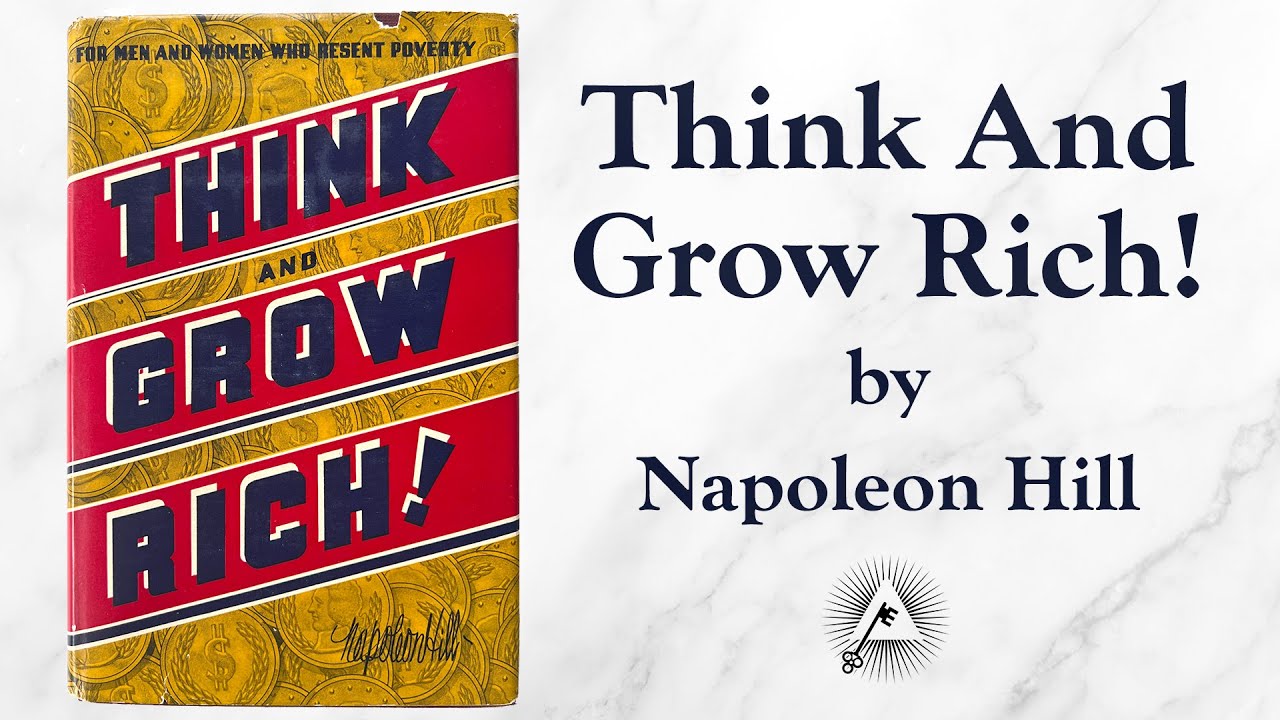
Brief Summary
This is a summary of Napoleon Hill's "Think and Grow Rich," originally published in 1937. The book outlines a 13-step philosophy for individual achievement, emphasizing the power of thought, desire, and persistence in accumulating wealth and achieving personal goals. It draws on the experiences of over 500 successful men, including Andrew Carnegie, Thomas Edison, and Henry Ford, to illustrate these principles.
- The book is a textbook for individual achievement.
- The core of the book is the 13 principles of moneymaking.
- The secret formula by which Andrew carnegi acquired his huge Fortune is revealed.
Master Key Society Introduction
Master Key Society presents a reading of Napoleon Hill's "Think and Grow Rich," emphasizing that the views expressed belong to the author and may not reflect the society's views. The recording is for research, study, and discussion purposes. The book offers a philosophy for individual achievement, providing 13 steps to riches for those seeking a definite goal in life. It is advised to study the book carefully, underlining key sentences and meditating on its contents, with no more than one chapter read per night.
Publisher’s Preface
"Think and Grow Rich" presents the money-making philosophies of over 500 wealthy men who started with nothing but ideas and plans. It provides instructions on selling personal services and self-analysis to identify obstacles to financial success. The book reveals Andrew Carnegie's formula for personal achievement, which helped him accumulate millions and create millionaires. Readers can form study clubs to discuss each chapter, share ideas, and potentially uncover the secret to Carnegie's fortune.
Author’s Preface
The author's preface reveals that the book contains a money-making secret shared by Andrew Carnegie, tested by thousands in various walks of life. Carnegie believed this formula should be taught in schools to revolutionize education. Charles M. Schwab's success with U.S. Steel, worth $600 million, exemplifies the secret's power. The secret, mentioned over a hundred times in the book, works best when discovered by the reader. The author's son found the secret in Chapter 2 and significantly increased his earning potential. The secret was used by President Woodrow Wilson during World War I to raise funds. The secret helps people achieve success with little effort and avoid failure. The secret requires a price of intentional searching and comes in two parts, one already possessed by those ready.
Chapter 1: Introduction
Edwin C. Barnes partnered with Thomas Edison through a burning desire and definiteness of purpose, traveling by freight train to meet Edison. Edison recognized Barnes' determination and gave him an opportunity. Barnes's thoughts, not appearance, secured his start, constantly intensifying his desire to become Edison's business associate. Opportunity appeared unexpectedly, with Edison's dictating machine, which Barnes successfully sold, leading to a lasting business alliance. R.U. Darby's uncle quit gold mining three feet from a gold vein, highlighting the habit of quitting when facing temporary defeat. The junkman who bought the equipment sought expert counsel and profited millions. Darby later learned the lesson of persistence in life insurance sales, never stopping despite rejections. Over 500 successful men revealed their greatest success came just beyond the point of defeat.
Chapter 2: Desire
Edwin C. Barnes achieved his dream of partnering with Edison through a burning desire and unwavering focus. He burned all bridges, committing entirely to his goal. Similarly, a warrior burned his ships to ensure victory. Marshall Field rebuilt his store after the Great Chicago Fire, demonstrating the power of a burning desire. The method to transmute desire into financial equivalent consists of six steps: fix the exact amount of money, determine what to give in return, establish a definite date, create a definite plan, write out a clear statement, and read the statement aloud twice daily, visualizing possession of the money. Only those who become money conscious accumulate great riches. Practical dreamers, who combine dreams with action, are the pattern makers of civilization.
Chapter 3: Faith
Faith, the head chemist of the mind, blends with thought to influence the subconscious mind and connect with infinite intelligence. Love and sex amplify this effect. Faith can be developed through autosuggestion, repeating instructions to the subconscious mind. This is likened to how individuals become criminals through repeated exposure to crime. Any thought repeatedly passed to the subconscious mind is accepted and acted upon. Thoughts mixed with emotion and faith translate into physical reality. Negative thoughts can also influence the subconscious mind, leading to misfortune. The key is to deceive the subconscious mind into believing one will achieve their desires. Money consciousness is achieved when the mind is saturated with the desire for money. Andrew Carnegie and Thomas Edison endorsed these steps.
Chapter 4: Auto-Suggestion
Autosuggestion, or self-suggestion, is the communication between the conscious and subconscious mind. It involves feeding the subconscious mind with desired thoughts. Repeating affirmations with emotion and feeling is crucial for success. The self-confidence formula involves knowing one's ability, realizing thoughts transform into reality, using autosuggestion, having a definite aim, and building upon truth and justice. Thoughts mixed with emotions attract similar thoughts from the ether. The ether contains both destructive and constructive vibrations. Success comes to those who are success-conscious, while failure comes to those who are failure-conscious.
Chapter 5: Specialized Knowledge
Specialized knowledge, unlike general knowledge, is essential for accumulating wealth when organized and directed through practical plans. An educated person knows where to get knowledge and how to use it. Henry Ford's success illustrates this, as he utilized a Mastermind group for specialized knowledge. R.U. Darby's story emphasizes that desire can be transmuted into gold. The six steps to turn desire into financial equivalent are: fix the exact amount of money, determine what you intend to give in return, establish a definite date, create a definite plan, write out a clear concise statement, and read your written statement aloud twice daily.
Chapter 6: Imagination
Imagination, the workshop of the mind, is crucial for shaping desires into reality. It functions in two forms: synthetic imagination, which rearranges existing ideas, and creative imagination, which connects to infinite intelligence. The current era favors imagination due to rapid changes. Practical dreamers, who act on their dreams, are the pattern makers of civilization. Tolerance and open-mindedness are essential. Pioneers like Columbus and Edison demonstrate the power of dreams. A burning desire is the starting point. The world no longer scoffs at dreamers. Disappointments temper the spirit. Success often follows a bad start.
Chapter 7: Organized Planning
Organized planning is the crystallization of desire into action. It involves allying with a Mastermind group, offering benefits to group members, meeting regularly, and maintaining perfect harmony. Every plan should be a joint creation. Persistence is key when plans fail. Failure is not permanent. It means the plans are not sound. Failure is a trickster. More than 500 successful men said their greatest success came just one step beyond the point at which defeat had overtaken them. The chapter also provides guidance on marketing personal services, emphasizing leadership qualities like courage, self-control, justice, and cooperation. It outlines common causes of failure in leadership and highlights emerging opportunities in politics, banking, industry, religion, and journalism.
Chapter 8: Decision
Decision, the mastery of procrastination, is crucial for success. Those who accumulate fortunes decide promptly and change decisions slowly, while failures do the opposite. Henry Ford's decisiveness, though sometimes seen as obstinacy, contributed to his fortune. It is important to keep one's own counsel and avoid being swayed by others' opinions. The value of decisions depends on the courage required to make them. The Declaration of Independence exemplifies this. The chapter emphasizes the importance of faith and open-mindedness.
Chapter 9: Persistence
Persistence, fueled by willpower and desire, is essential for transmuting desire into riches. Successful individuals like Ford, Carnegie, and Edison demonstrate this quality. Persistence involves a definite purpose, a plan, a closed mind against negativity, and a supportive alliance. It is a state of mind cultivated through habit. The chapter highlights the story of Fanny Hurst, whose persistence led to success on Broadway. Persistence is based on definiteness of purpose, desire, self-reliance, organized plans, accurate knowledge, cooperation, willpower, and habit.
Chapter 10: Power of the Master Mind
Power, defined as organized and intelligently directed knowledge, is essential for accumulating and retaining money. It is acquired through infinite intelligence, accumulated experience, and experimentation. The Mastermind principle, involving coordinated knowledge and effort in harmony, is key to gaining power. It has economic and psychic phases. The economic advantage comes from surrounding oneself with helpful advisors. The psychic phase involves a third, intangible mind created when two minds coordinate in harmony. Henry Ford's success was attributed to his association with great minds like Edison and Burbank. Mahatma Gandhi's power came from inducing millions to cooperate in harmony.
Chapter 11: The Mystery of Sex Transmutation
Sex transmutation involves redirecting thoughts of physical expression to other areas, unlocking imagination, courage, and willpower. Sex desire is a powerful force that, when harnessed, can lead to genius. Scientific research shows that high achievers have strong sex natures and are often motivated by a woman's influence. The 10 mind stimulants include sex expression, love, desire for fame, music, friendship, mastermind alliances, mutual suffering, autosuggestion, fear, and narcotics. Sex is the most potent. Genius is achieved by increasing thought vibrations, often through the sixth sense and creative imagination. Helen Keller, Robert Burns, and Booker T. Washington are examples of people who transmuted their desires into achievements.
Chapter 12: The Sub-conscious Mind
The subconscious mind, a field of consciousness, stores and retrieves thought impulses. It acts on dominating desires mixed with emotion, drawing power from infinite intelligence. While one cannot entirely control it, one can voluntarily influence it with desired plans. The subconscious mind is the link between the finite mind and infinite intelligence, transforming mental impulses into spiritual equivalents. It is influenced by emotionalized thoughts, both positive and negative. The subconscious mind translates orders given with belief or faith into physical equivalents.
Chapter 13: The Brain
The human brain functions as both a broadcasting and receiving station for thought vibrations. The creative imagination acts as the receiving set. Stimulating the mind through emotions increases receptivity. The Ford V8 engine story illustrates the power of determination. The poet Henley's lines emphasize the power to control thoughts. Before accumulating riches, one must magnetize their mind with intense desire and become money conscious. The principles in the book hold the secret to economic mastery.
Chapter 14: The Sixth Sense
The Sixth Sense, the apex of the philosophy, is the portion of the subconscious mind known as creative imagination. It is the medium through which infinite intelligence communicates voluntarily. It warns of dangers and notifies of opportunities. It is a mixture of the mental and the spiritual. The Sixth Sense may be induced by autosuggestion. The principles were gathered from the life experiences of more than 500 men who actually accumulated riches in huge amounts.
Chapter 15: How to Outwit the Six Ghosts of Fear
To use the philosophy, one must clear out indecision, doubt, and fear. Indecision is the seedling of fear, crystallizing into doubt, then blending into fear. The chapter analyzes the causes and cures of the six basic fears: poverty, criticism, ill health, loss of love, old age, and death. These fears are states of mind subject to control. The chapter also addresses susceptibility to negative influences, which can be combated with willpower and a closed mind. The chapter includes a self-analysis test with 28 questions to identify weaknesses. The chapter emphasizes the importance of controlling one's thoughts and choosing positive influences.

