
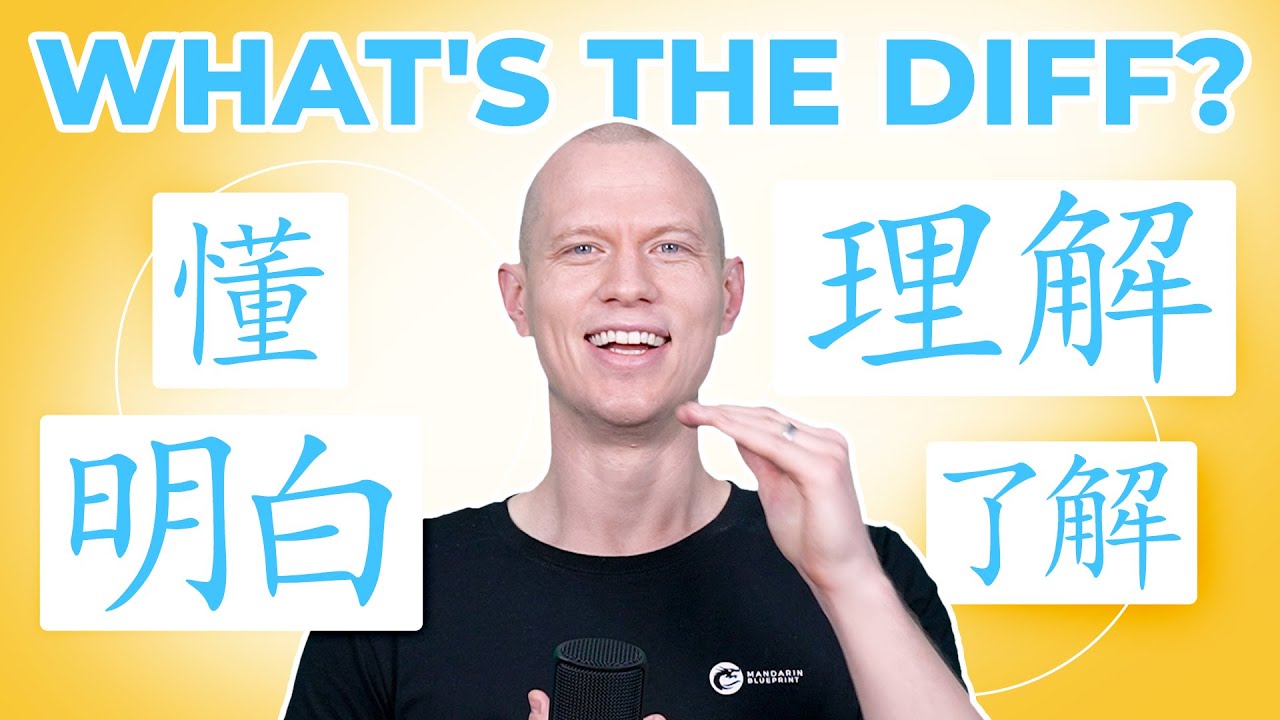
Brief Summary
This video addresses the common question of differentiating similar Chinese words, specifically focusing on nuances in understanding. It emphasizes that while conscious knowledge helps, immersion and practical application are key to mastering vocabulary. The discussion covers words like "zhidao," "mingbai," "lijie," and "dong," exploring their varying depths of understanding and contextual usage, from basic knowledge to deep comprehension and empathy.
- Understanding the nuances between similar Chinese words is crucial for effective communication.
- Immersion through listening and practical application enhances vocabulary acquisition.
- Different words represent varying depths of understanding, from basic knowledge to deep comprehension.
Intro
The presenter introduces a discussion about differentiating similar Chinese words like "dong" and "ting," acknowledging the common question of distinguishing between multiple words with seemingly identical English definitions but different usages. He suggests that while understanding the distinctions is helpful, practical application and immersion are crucial for natural acquisition. He believes that consciously grasping the concepts behind words can accelerate the learning process, even without immediate practical usage.
Importance of Listening Immersion
The presenter emphasizes the importance of listening immersion for language acquisition, noting that electronic context alone is insufficient due to its one-way nature. He shares his personal experience of learning five new words from a Chinese podcast in 45 minutes, highlighting that a solid foundation combined with engaging content facilitates effortless vocabulary acquisition. He advocates for increased listening immersion alongside speaking practice to enhance language skills.
Analysis of Understandings
The presenter shares an excerpt from an essay by Chia Lin in the Paris Review, which discusses the nuances of Chinese terms for "understand," such as "dong" and "mingbai," relating their usage to tone, context, familiarity, and abstractness. The analysis breaks down the terms, explaining the components of their characters and their connotations. For example, "mingbai" conveys a sense of clarity, while "dong" relates to feelings and thoughts, containing the "heart" radical.
Differentiating Similar Words
The presenter addresses the challenge of clearly explaining the differences between similar Chinese words like "zhidao," "mingbai," "lijie," and "dong." He notes that while these words can all translate to "understand," their usage varies. "Zhidao" represents a shallow understanding or awareness, like knowing of someone. "Mingbai" implies a slightly deeper, more abstract understanding.
In-depth Look at "Lijie"
The presenter explains that "lijie" involves deeply understanding something, often related to cognitive processes. He uses an example sentence discussing the importance of understanding concepts to their core, rather than just memorizing them. He also notes that "lijie" can be used colloquially to mean "I get it," implying empathy and a deep understanding of someone's feelings and thoughts.
Comparing "Dong" and "Liaojie"
The presenter compares "dong" and "lijie," noting their similarities, with "dong" having a "heart" component, suggesting understanding at a deep, emotional level. He explains that "dong" is more colloquial and cannot be used in all situations due to the rhythm of the Chinese language. He provides an example of someone who "gets" their job or career, indicating a deep level of expertise. "Liaojie" is described as understanding the basic points, often used to convey understanding of someone's behavior or the developments in science and technology.
Conclusion
The presenter concludes by acknowledging that his explanation may not immediately enable perfect usage of the discussed words, particularly "lijie." He encourages continuous practice with sentences, tutors, and self-generated examples to internalize the nuances. He expresses hope that the explanation contributes to the acquisition of these words.

