
Brief Summary
The video discusses the evolution and future of retirement in America, particularly focusing on the Baby Boomer generation and the challenges that lie ahead for subsequent generations. Key points include:
- Retirement as we know it is a relatively recent concept, primarily affecting the GI, Silent, and Baby Boomer generations.
- There has been a significant shift from pensions to 401(k)s, altering retirement security.
- Increased life expectancy and family dynamics have combined to create new challenges for retirement planning.
Start Here
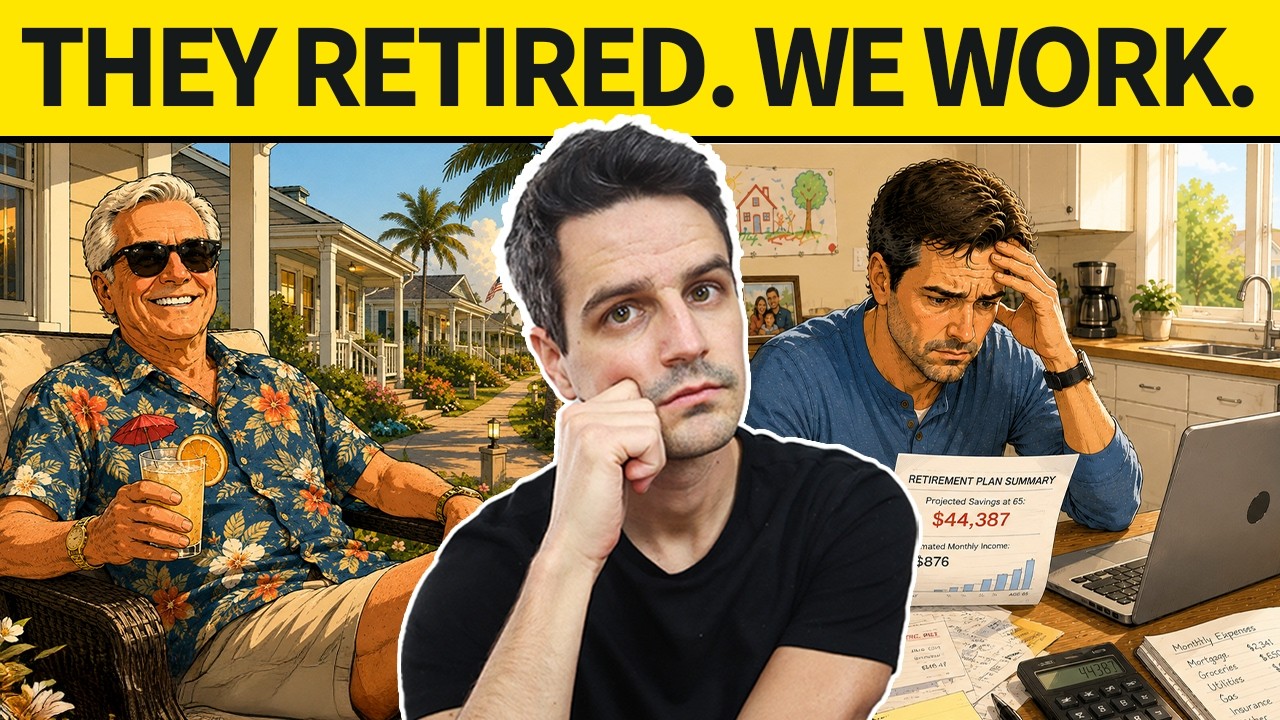
The concept of mass retirement began with the Baby Boomer generation, marking a shift in how retirement is perceived. After this generation, retirement will likely split into two distinct realities. Some will retire comfortably, while many will work longer and retire later due to economic pressures. The traditional idea of retirement, often associated with leisure and comfort, has existed for just two and a half generations, and this system is under significant strain.
Chapter 1: Retirement Before The GI Generation
Retirement as an institutionalized practice began in the 1950s. Before then, older individuals often continued working or relied on family for support. Social Security benefits weren’t introduced until the 1940s, and pensions gained popularity in the following decades, while other retirement frameworks such as Medicare and 401(k)s appeared later. Notably, life expectancy exceeded 65 only post-1949 and was skewed by high infant mortality rates. Overall, retirement, as recognized today, is a modern invention aimed at addressing the financial needs of aging individuals.
Chapter 2: The Industrial Problem
The shift from agrarian multigenerational households to urban nuclear families in the 1800s left many elderly individuals without familial support in old age. Working conditions grew tougher, with older workers displaced by younger, more physically capable employees, causing financial instability among the elderly. As many seniors found themselves unable to support themselves financially, the government introduced Social Security in 1935, which primarily aimed to prevent poverty rather than create a comfortable retirement lifestyle.
Chapter 3: The Reward of a Lifetime
Post-World War II, the notion of retirement evolved to become a reward rather than merely a means to avoid poverty, thanks largely to the implementation of pensions. Workers gained more leverage to secure guaranteed income, shifting retirement planning onto a diversified model involving Social Security, pensions, and personal savings. This period established a comfortable retirement standard for the GI and Silent generations, which the Baby Boomers expected to inherit.
Chapter 4: The 401(k) Shift
As pension schemes became unsustainable for companies due to costs, the 401(k) plan emerged in the 1970s. This system shifted the investment responsibility from employers to employees, leading to greater flexibility for workers to change jobs. However, it also meant that individuals needed to actively make their own retirement plans, introducing financial knowledge as critical for success. This transitional shift resulted in disparate retirement outcomes between the two halves of the Baby Boomer generation.
Chapter 5: The Life Expectancy Boom
Medical advancements during the 20th century lengthened retirement phases, which now last 25 to 30 years, contrasting sharply with historical retirements of 10 to 15 years. Social Security, pensions, and healthcare burdens increased significantly, placing pressure on retirees as they had to sustain these systems financially over more extended periods. Boomers experienced longer retirements while existing support structures began to fray, complicating future retirement plans.
Chapter 6: The Sandwich Generation Squeeze
Boomers often found themselves in the "sandwich generation," balancing financial support for aging parents and their children. This dual responsibility hindered their ability to prepare adequately for retirement in crucial financial years, making it difficult to invest in their future while managing these obligations. The coming generations face similar pressures while navigating an increasingly individualistic retirement landscape.
Chapter 7: The Boomers’ Saving Grace
Despite significant challenges, many Boomers managed to retire, mainly due to home equity. With a median of $250,000 in home equity, owning a home mitigated their living expenses, facilitating a basic retirement lifestyle primarily supported by Social Security. However, future generations may find it harder to replicate this due to rising home prices and delayed home ownership.
Chapter 8: The Social Security Crisis
Gen X, the next wave of retirees, will experience a different retirement landscape, heavily reliant on Social Security—without the benefits of pensions or considerable personal savings. As of now, Social Security payments are not designed to sustain a comfortable retirement, with the trust fund projected to run out in 2032. If unresolved, future retirees will see decreased payments, further complicating their financial futures.
Chapter 9: Where Do We Go From Here?
The discussion concludes with reflections on the relatively recent conception of retirement and its fragility given changing economic conditions. The author presents three main takeaways: the importance of systemic support in retirement, the benefits of shared responsibility, and the unpredictability of future retirement expectations compared to previous generations.

