
Brief Summary
This video provides a comprehensive guide to understanding wood screws, covering their anatomy, measurements, numbering systems (US gauge and metric), drive types, pre-drilling techniques, common sizes, and various non-traditional screws. It also offers downloadable charts for easy reference.
- Anatomy and measurements of wood screws
- Understanding US gauge and metric numbering systems
- Different drive types and their applications
- Pre-drilling techniques and screw depth guidelines
- Common and non-traditional screw types
Intro
The video introduces a simplified guide to wood screw sizes, types, and options. It also mentions the availability of three downloadable charts to aid in understanding the information presented.
Wood screw basics
The section covers the basic anatomy of a traditional wood screw, including the head, shank, threads, and tip. It identifies four main measurements: head diameter, shank diameter, thread diameter (also known as major diameter), and root diameter (also known as minor diameter). The head size is sometimes labeled as a max measurement on screw charts. The threads per inch (TPI) is explained as the number of threads per inch of screw length. The method of measuring screw length varies depending on the head type. Flatheads are measured from the top of the head to the tip because they sit flush with the surface. Pan heads are measured from the underside of the head, and oval heads are measured to the point where they sit flush after being countersunk.
Understanding screw numbers
This section explains how to interpret the numbers on screw packaging, starting with machine screws. For US gauge machine screws, the first number indicates the screw's diameter (e.g., a number 8 screw), the second number is the TPI, and the third number is the length. For metric machine screws, the first number is the diameter in millimeters (e.g., M6), the second is the distance between threads in millimeters, and the third is the length in millimeters. For wood screws, typically only the gauge and length are listed, with the TPI assumed to be standard for that gauge.
Types of drives
The video outlines the three most common drive types in the US: Phillips, square, and Torx (star). Phillips drives are widely used but require the correct bit size to prevent stripping. Star drives provide a more secure connection with less chance of stripping under high force. Square drives also offer a good connection. For projects requiring many screws, a driver with a secure, positive connection like the star drive is recommended.
Pre-drilling & correct screw depth
Pre-drilling removes the shank material's thickness, allowing the threads to grab the wood for a stronger connection. As a general rule, when joining two pieces of material, the screw should penetrate at least halfway through the thickness of the second piece. For example, when screwing two pieces of 3/4-inch stock together, a screw length of at least 1 1/4 inches is recommended.
Six most common wood screw sizes
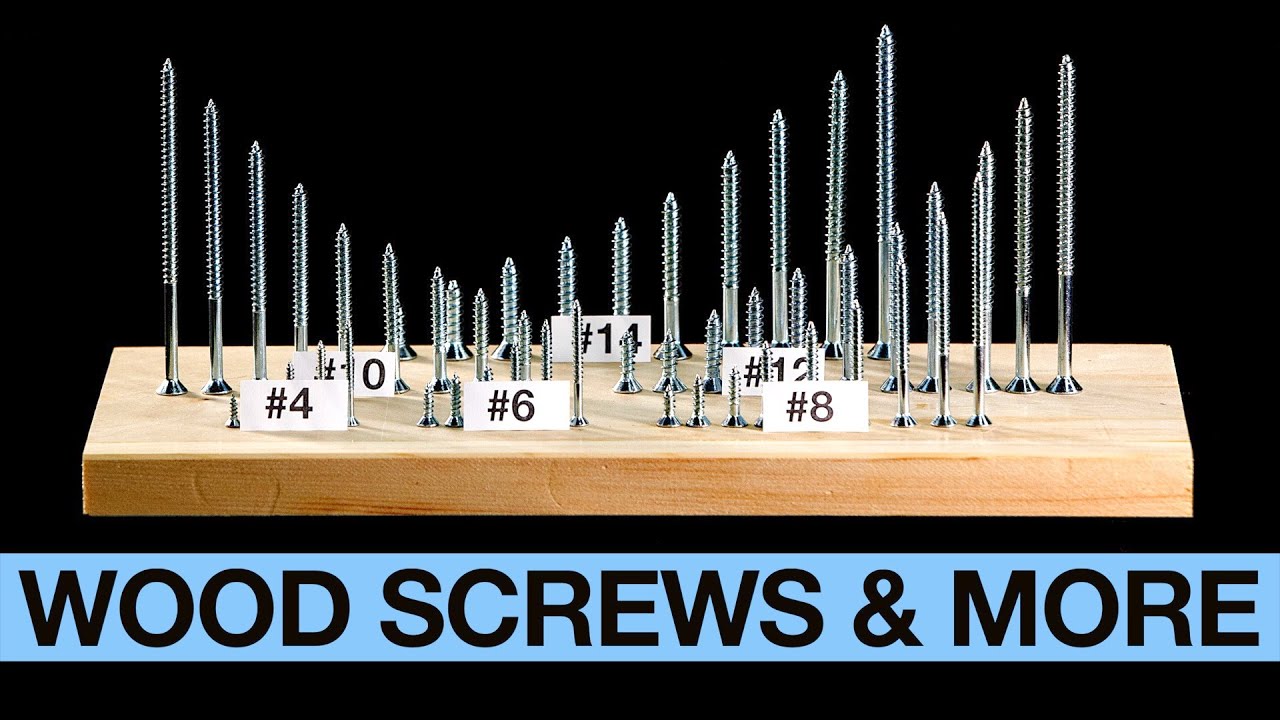
The six most common wood screw sizes are numbers 4, 6, 8, 10, 12, and 14. Number 4 screws are for light projects like small hinges and boxes, ranging from 3/8 inch to 1 1/4 inches. Number 6 screws are used for larger hinges and drawer slides, available from 1/2 inch to 1 1/2 inches. Number 8 is a common general-purpose screw, ranging from 1/2 inch to 3 inches. Number 10 screws are often used for outdoor projects like decks and porches, sized from 3/4 inch to 4 inches. Numbers 12 and 14 are for heavy-duty construction, also available from 3/4 inch to 4 inches.
Seven non-traditional screws
Seven non-traditional screws are presented. Bugle head screws, similar to flat heads but shaped like a bugle, are used for drywall and ductwork. Smaller head square drive screws are less noticeable when installed. Trim head screws have small diameter heads suitable for finished surfaces and may include a self-drilling tip. Modified truss head screws, with a flat washer attached, are useful for attaching drawer fronts due to their large, flat head. Pocket hole screws are used with Kreg jig systems. Premium exterior screws, often stainless steel with specialized threads, reduce splitting and feature star drives and nibs under the head for countersinking.
Download charts
The video mentions free downloadable charts to help understand and reference the information. The first chart details the six most common wood screw sizes, including countersink size, shank diameter, threads per inch, pilot hole sizes, and driver sizes, with a metric conversion chart. The second chart converts millimeters per thread to threads per inch. The last chart aids in conversions from fraction to decimal to metric.
Outro
The video concludes by directing viewers to the website for the free downloadable charts and thanking them for watching.

