
Brief Summary
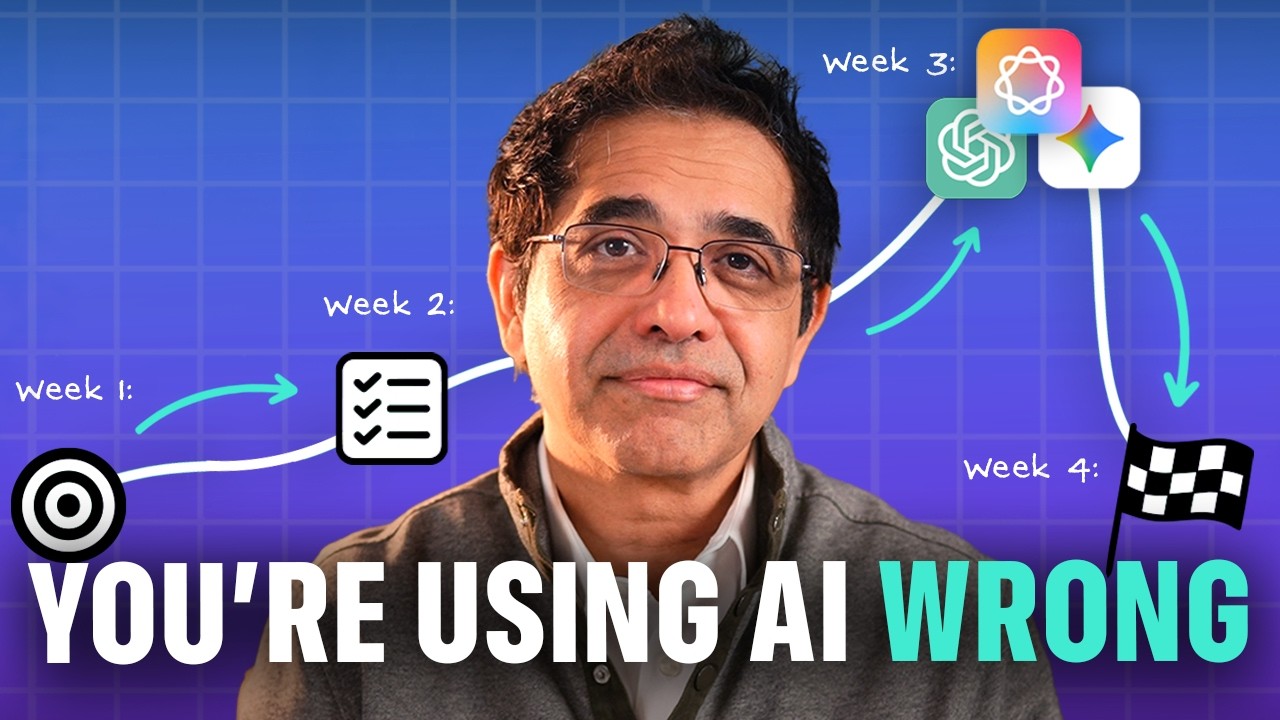
This video provides a seven-step roadmap to master AI in 30 days, even for beginners. It emphasizes understanding how AI models work, crafting effective prompts, providing context, debugging thinking, steering towards expertise, verifying outputs, and developing a personal touch. The key is to treat AI as a tool for augmenting human intelligence and creativity, rather than a replacement for it.
- Learn "Machine English" to communicate effectively with AI.
- Focus on one AI tool initially to understand its nuances.
- Provide context to AI for better results.
- Debug your thinking to improve AI outputs.
- Steer AI towards expertise for quality information.
- Verify AI outputs to avoid misinformation.
- Develop a personal touch to make AI outputs sound like you.
Introduction
The speaker introduces the idea that many people are using AI incorrectly, making it easier to get ahead by mastering it. He draws on his 20 years of experience in tech and AI to explain the widening gap between those who understand AI and those who don't. The video promises a seven-step roadmap to master AI in 30 days, even for beginners.
Week 1: Machine English
The first week focuses on learning "Machine English," which involves understanding that AI models like ChatGPT don't comprehend language but predict it. AI breaks text into tokens, converts them into multi-dimensional vectors, and places them in an embedding space where similar ideas are closer together. When prompting, AI predicts the most likely next token based on context and probability, not stored facts. To write sharper prompts, use the AIM framework: Actor (define the AI's persona), Input (provide context and data), and Mission (state the desired outcome).
Pick Your Instrument
Instead of trying multiple AI tools, the speaker recommends picking one foundational model and going deep, similar to learning a musical instrument. The deeper you understand one model, the faster you'll grasp others. Options include ChatGPT (mature), Gemini (Google ecosystem), and Claude (business-focused). Spend the first week learning the chosen model's personality, cadence, limits, and strengths, and practice using the AIM framework.
Context
Context is crucial for smart AI outputs. Without it, even the smartest AI will sound clueless. Context helps AI navigate its mathematical space and understand what matters. The MAP acronym helps build context: Memory (conversation history), Assets (files and data), Actions (tools the model can use), and Prompt (the instruction itself). Improving memory, assets, and actions enhances the context provided in the prompt, leading to better AI reasoning and responses.
Debug Your Thinking
When AI outputs are unsatisfactory, the problem often lies in the user's thinking, not the AI itself. Prompting is an iterative process. The speaker suggests questioning whether the right persona, context, and goal were provided. He also recommends asking the model to explain its logic. Three cheat codes for debugging thinking are: Chain of Thought (ask for step-by-step reasoning), Verifier Pattern (ask the AI to clarify intent with questions), and Refinement Pattern (ask the AI to propose sharper versions of the question).
Steer to Experts
To avoid generic AI outputs, steer the model towards expertise. Instead of vague prompts, direct the AI to use ideas from specific experts, frameworks, or research. If you don't know the experts, ask AI to list them. Then, feed the expert information back into the model to synthesize original frameworks.
Verify
AI can confidently present incorrect information, so verification is essential. Five ways to separate intelligence from illusion are: Assumptions (list and rank assumptions), Sources (cite independent sources), Counter Evidence (find credible disagreements), Auditing (recompute figures), and Cross-Model Verification (compare outputs from different models).
Develop Taste
The best AI outputs sound like you, so develop a personal touch. Treat AI as a sparring partner to sharpen your and its thinking. Use the OCEAN framework to add taste: Original (non-obvious ideas), Concrete (names, examples, numbers), Evident (visible reasoning), Assertive (takes a stance), and Narrative (storytelling).
Conclusion
Applying these steps over 30 days trains both the model and the user. The speaker believes AI will restore human worth by augmenting human intelligence and creativity.

