
Brief Summary
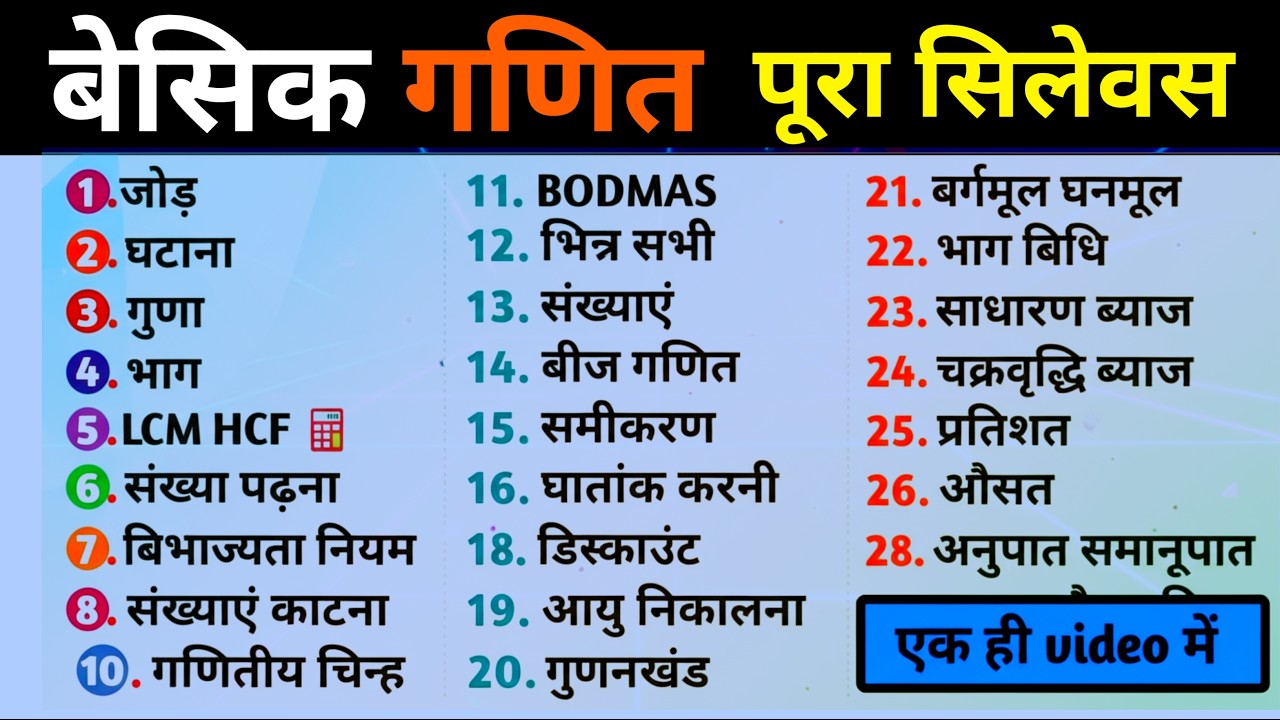
Hello doston! This video is a comprehensive guide to basic math concepts, perfect for those who struggle with the fundamentals. It covers a wide range of topics, from types of numbers to compound interest, ensuring a solid foundation for further mathematical learning.
- Types of numbers and their properties
- Basic arithmetic operations (addition, subtraction, multiplication, division)
- LCM, HCF, tables, divisibility rules, simplification
- BODMAS rule, fractions, square root, cube root, exponents, percentage, average
- Decimal operations, discount, simple and compound interest
Introduction
The video aims to address common difficulties in basic math, which often lead to mistakes in more complex problems. It emphasizes that a strong understanding of these fundamental topics is essential for success in mathematics. The presenter encourages viewers to watch the entire video without skipping any parts, even if it's a bit lengthy, to ensure a complete grasp of the concepts.
Types of Numbers
The video explains various types of numbers, starting with natural numbers (numbers starting from 1), whole numbers (numbers starting from 0), integers (including negative numbers), even numbers (divisible by 2), odd numbers (not divisible by 2), composite numbers (divisible by itself, 1 and other number), prime numbers (divisible by 1 and itself), rational numbers (expressible as p/q), irrational numbers (like √3, √5), real numbers (existing with value), and unreal numbers (non-existing numbers like -√3).
Basic Arithmetic Operations
The video provides a step-by-step explanation of addition, subtraction, multiplication, and division. It covers both simple problems and those involving carry-over and borrowing. The presenter demonstrates the traditional methods taught in schools, emphasizing their importance for a solid understanding.
LCM and HCF
The video explains LCM (Least Common Multiple) and HCF (Highest Common Factor) in detail, including their full forms, Hindi names, and definitions. It demonstrates how to find the LCM and HCF of given numbers using prime factorization. LCM is the smallest number divisible by given numbers, while HCF is the largest number that divides the given numbers.
Tables (Pahade)
The video provides tricks to learn tables from 2 to 20. It explains how to create tables by adding numbers and using patterns. For example, the table of 3 can be created by adding the tables of 1 and 2. It also provides a method to quickly calculate any multiplication like 15 * 8 by using the tables of 1 to 10.
Divisibility Rules
The video explains divisibility rules for various numbers like 2, 3, 4, 5, 6, 7, 8, 9, 10, and 11. These rules help to quickly determine whether a number is divisible by another number without performing actual division. For example, a number is divisible by 2 if its unit digit is 0, 2, 4, 6, or 8.
Simplifying Numbers (Cutting)
The video explains how to simplify fractions by canceling out common factors from the numerator and denominator. It emphasizes that the same number must be used to divide both the numerator and denominator. Several examples are provided to illustrate the process.
Rules of Signs
The video explains the rules of signs in multiplication, division, addition, and subtraction. It emphasizes that the product or quotient of two numbers with the same sign is positive, while the product or quotient of two numbers with different signs is negative. Addition and subtraction rules are also explained with examples.
BODMAS Rule
The video explains the BODMAS rule, which is an acronym for Brackets, Of, Division, Multiplication, Addition, and Subtraction. It provides the order of operations to solve mathematical expressions. Two examples are provided to illustrate the application of the BODMAS rule.
Fractions
The video explains fractions, including simple fractions and mixed fractions. It also explains the difference between proper fractions (numerator less than denominator) and improper fractions (numerator greater than denominator).
Addition and Subtraction of Fractions
The video explains how to add and subtract fractions. It covers cases where the denominators are the same and where they are different. When the denominators are the same, the numerators are simply added or subtracted. When the denominators are different, the LCM is found, and the fractions are converted to equivalent fractions with the LCM as the denominator.
Multiplication and Division of Fractions
The video explains how to multiply and divide fractions. To multiply fractions, the numerators are multiplied, and the denominators are multiplied. To divide fractions, the second fraction is inverted, and then the fractions are multiplied.
Factors
The video explains how to find the factors of a number using prime factorization. The number is divided by prime numbers until it is reduced to 1. The prime factors are then written as a product.
Square Root
The video explains how to find the square root of a number using prime factorization. The number is divided by prime numbers until it is reduced to 1. The prime factors are then grouped into pairs, and one factor from each pair is taken out. The product of these factors is the square root of the number.
Cube Root
The video explains how to find the cube root of a number using prime factorization. The number is divided by prime numbers until it is reduced to 1. The prime factors are then grouped into triplets, and one factor from each triplet is taken out. The product of these factors is the cube root of the number.
Exponents (Ghatank)
The video explains the rules of exponents, including a^0 = 1, a^-m = 1/a^m, a^m * a^n = a^(m+n), a^m / a^n = a^(m-n), (a^m)^n = a^(m*n), and a^(m/n) = nth root of a^m. These rules are essential for simplifying expressions involving exponents.
Roots
The video explains how to add, subtract, multiply, and divide numbers involving square roots. It emphasizes that only like terms (terms with the same number under the square root) can be added or subtracted. Multiplication and division of square roots are also explained with examples.
Percentage
The video explains how to calculate percentages, convert fractions to percentages, and convert percentages to fractions. It also explains how to solve problems involving percentages, such as finding a percentage of a number or finding what percentage one number is of another.
Average
The video explains how to calculate the average of a set of numbers. The average is found by adding up all the numbers and dividing by the number of numbers.
Decimals
The video explains decimals, including how to convert decimals to fractions, convert fractions to decimals, and perform arithmetic operations (addition, subtraction, multiplication, and division) with decimals.
Discount
The video explains how to calculate discounts. The discount is found by multiplying the original price by the discount percentage. The selling price is then found by subtracting the discount from the original price.
Simple Interest
The video explains how to calculate simple interest. The simple interest is found by multiplying the principal amount by the rate of interest and the time period.
Compound Interest
The video explains how to calculate compound interest. The compound interest is found using the formula CI = P(1 + R/100)^N - P, where P is the principal amount, R is the rate of interest, and N is the time period.

