
Brief Summary
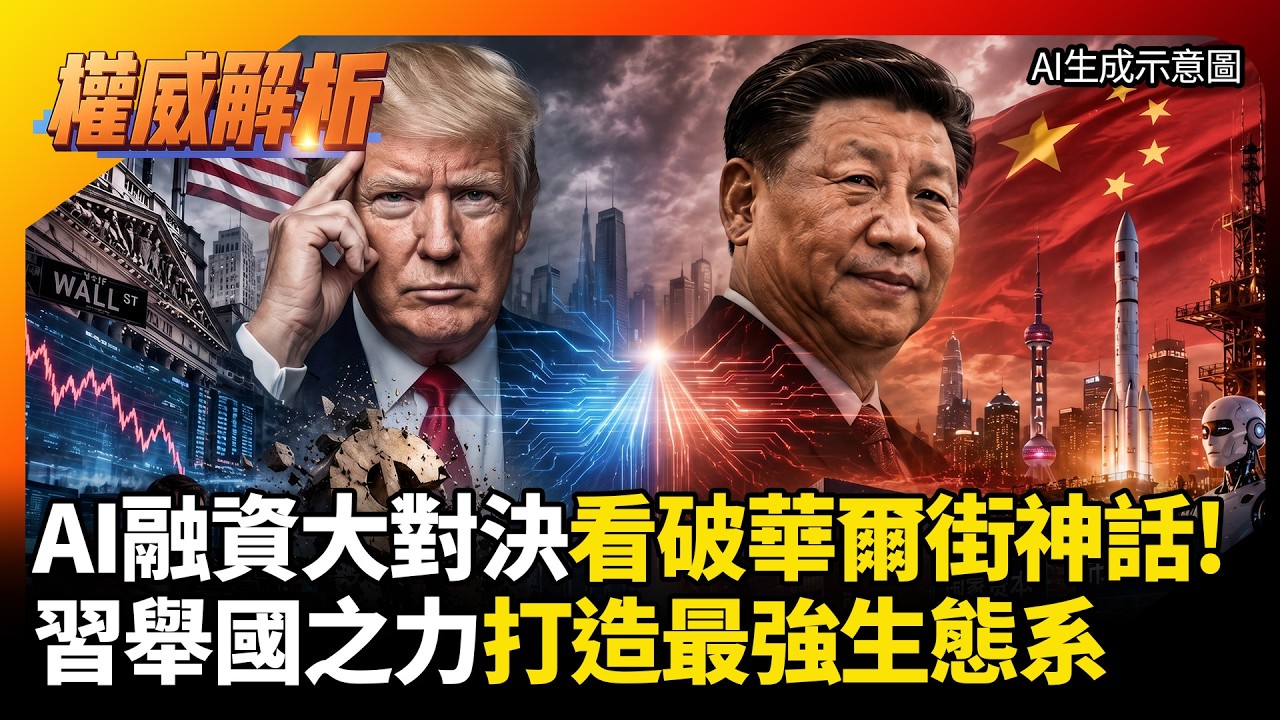
This video discusses the competition between China and the United States regarding artificial intelligence (AI) development. Key takeaways include:
- The rise of China's AI industry and its impact on global technology competition.
- The growing demand for AI data centers and hardware supply chain improvements.
- The increasing importance of semiconductors and chip manufacturing in AI capabilities.
- Predictions by Elon Musk on China's advantages in AI competition, focusing on energy supply rather than just chip technology.
重點在這
The video begins by framing the current competition between China and the US as a race for national-level infrastructure in AI. It emphasizes that both countries have unique strengths in the AI ecosystem, with China focusing on developing a comprehensive AI framework that includes ecosystem developers and application scenarios.
中國AI產業鏈日趨完整 挑戰美國科技霸權根基
China's AI industry is rapidly maturing, marked by significant fundraising efforts, such as DeepC raising over $6.7 billion. This funding illustrates the potential for a comprehensive ecosystem in China, which encompasses startups, government support, and technology development. The video notes that the global annual investment in AI has surged, indicating strong competition with the US, which faces trade restrictions affecting its ability to engage with the Chinese market.
AI資料中心建設需求持續推升 硬體供應鏈成長
The discussion shifts to the increasing demand for AI data centers that require advanced computing hardware. It highlights major suppliers like Nvidia and AMD, focusing on the critical role of GPUs, CPUs, and memory storage in enhancing AI capabilities. The evolving hardware supply chain supports both China's expansion in AI and the competitive landscape against the US.
中芯國際供應鏈崛起 中國AI半導體加速成長
The video brings attention to the emergence of China's semiconductor supply chain, particularly through companies like SMIC. It points out that as China's self-sufficiency in AI chips increases, the country will have a better position to compete internationally. This trend suggests that China is becoming less dependent on foreign technology, which is crucial for its AI ambitions.
馬斯克預言中國勝出 AI關鍵決勝點不在晶片!
Elon Musk's predictions regarding China's potential dominance in AI are discussed, emphasizing that the critical factors for success include not just chip technology but also energy supply. Musk states that by 2026, China's electricity generation capacity may surpass that of the US, highlighting energy as a necessary resource for advancing AI technology. The video concludes that to maintain its AI leadership, the US must address its infrastructure challenges, particularly in energy supply.

