
Brief Summary
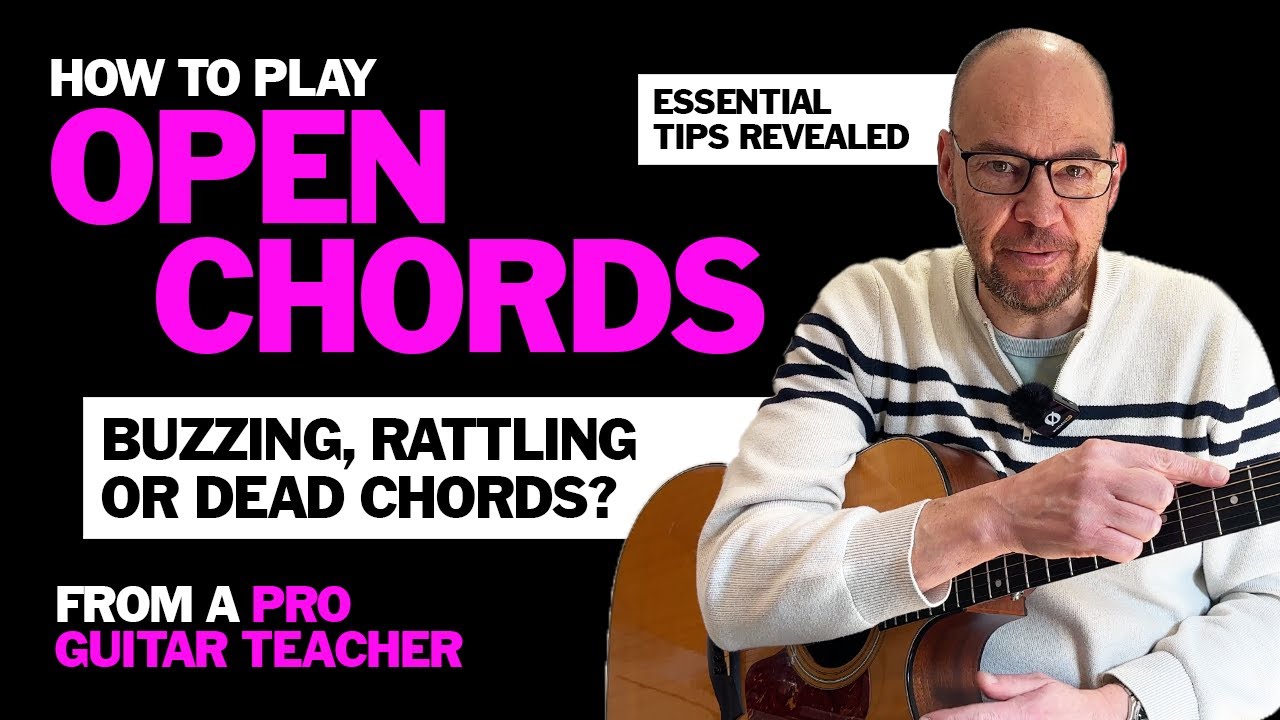
This video provides a beginner's guide to playing open chords on the guitar, covering essential techniques and principles for proper chord execution and fretting hand positioning.
- Introduction to open chords and their significance.
- Explanation of chord diagrams and how to interpret them.
- Importance of thumb position and finger placement techniques.
- Guidelines for strumming, including bass note awareness.
- Tips for practice and finger numbering.
Introduction
The video begins with an introduction aimed at beginners, focusing on how to play open chords. Open chords are basic chords that utilize unfretted strings, prompting a discussion on the most common ones, such as A minor, E minor, G, C, and D.
What are open chords?
Open chords are introduced as the fundamental starting point for guitar players. These chords contain open strings, meaning that some strings are played without being fretted, resulting in a rich sound characteristic of open chords.
How to read chord charts
Chord charts are depicted visually with 6 vertical lines representing strings and horizontal lines for frets. The video explains the significance of markings such as dots or circles for finger placement, while X's denote strings that should not be played.
Fretting hand thumb position
Proper thumb position is emphasized, recommending that beginners place their thumb behind the guitar neck, around the second fret space, making sure it’s flat and providing support for the fingers. Poor thumb positioning can lead to difficulty in fretting properly.
Posture - cross legs, use a footstool
The video advises on maintaining a good posture while playing, suggesting the use of a footstool or crossing legs to raise the neck of the guitar. This positioning aids in better access to the frets.
Imagine a ball in your fretting hand palm
It is suggested to visualize holding a ball in the fretting hand's palm, which encourages a relaxed and effective hand position on the guitar, leading to improved finger placement and comfort.
Fret finger placement
The importance of placing fingers close to the fret is discussed. Beginners should aim to position their fingers just before the fret metal without pressing on it, as this technique helps produce clear sounds when fretting.
Using fingertips is vital
Using fingertips instead of flat fingers is highlighted, as flattening can mute adjacent strings and disrupt sound quality. This position also necessitates short, well-placed fingernails for better playability.
Summary 1
A recap emphasizes thumb positioning behind the second fret, the necessity of keeping fingers close to frets, and the critical use of fingertips. The importance of strumming the correct strings is reiterated, particularly focusing on the root notes for various chords.
Bass or Root notes - play the correct number of strings
The significance of root notes is explained, differentiating between chords such as E minor, A minor, and D, which have specific strings that should or should not be played to maintain sound integrity.
Summary 2
This section reflects on earlier points, reiterating the role of the thumb, finger placement, and respecting the strings played, reinforcing the key concepts essential for mastering open chords.
Practice!
The video encourages viewers to practice various open chords, applying the techniques discussed. E minor is recommended as a good starting point and a sense of experimentation with other chords is advocated.
Finger numbers
Finger numbering is explained, with the index finger as one, the middle as two, the ring as three, and the pinky as four. While finger numbers help in transitioning between chords smoothly, the importance of comfort during play is stressed.
Final thoughts
The video concludes with an encouragement to practice open chords correctly while announcing an upcoming video focused on transitioning between chords more smoothly, encouraging viewers to subscribe for more content.

