
Brief Summary
This video provides a comprehensive guide to keyword research for SEO and AI search visibility. It covers the importance of using a keyword research template, various techniques for finding keywords, and how to prioritize them effectively. The video emphasizes the need to focus on relevant keywords, understand search intent, and consider competition in both traditional and AI search environments.
- Importance of a keyword research template for organization and prioritization.
- Techniques for finding keywords using Google Ads, Search Console, direct Google searches, Reddit, YouTube, and specialized tools like Rankability.
- Prioritizing keywords based on intent, opportunity, competition, and potential value.
- Focusing on keyword clusters and search everywhere optimization for comprehensive coverage.
Keyword Research Template
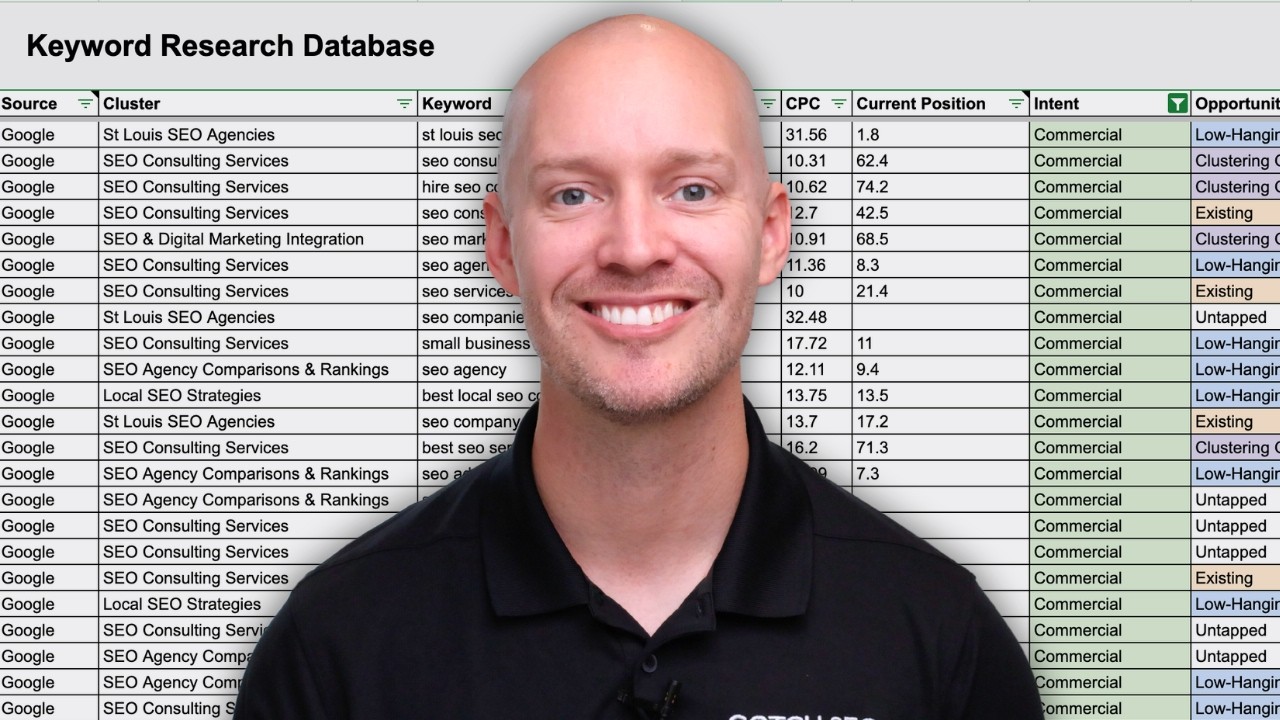
The video introduces a keyword research template designed for SEO campaigns, emphasizing its adaptability for both agencies and individual users. Key components include priority assessment, source tracking, and keyword clustering to identify areas of focus and gaps. The template also incorporates SERP features to estimate organic click-through rates and strategy, alongside standard metrics like search volume and keyword difficulty (KD). Cost per click (CPC) is used to determine keyword value, while current ranking position and URLs are tracked to identify opportunities. Search intent categorization (informational or commercial) and opportunity assessment (low-hanging fruit, existing keyword, or clustering opportunity) are automated for efficiency. The template includes an automatic scoring mechanism to prioritize keywords based on various factors, making it a critical tool for effective keyword research.
Finding Keywords Using Google Search Data
One technique for finding keywords is using Google Ads Keyword Planner to access search volume data directly from Google. By entering seed keywords, users can discover related terms and analyze their search volume and trends. While this method provides valuable demand data, it lacks comprehensive competition insights for organic SEO. The competition metric in Google Ads refers specifically to ad competition, not organic competition. Despite its limitations, Google Ads is a powerful, free tool for initial keyword exploration and high-level analysis.
Finding Keywords Using Google Search Console
Another free Google product, Google Search Console, provides query data with metrics like clicks, impressions, CTR, and position. While useful for a high-level overview, it lacks critical competition data, making it difficult to assess the full landscape of keyword competition. Despite this, Google Search Console offers valuable insights and, when combined with Google Ads, can form the basis of a keyword strategy, though it may not be fully comprehensive.
Finding Keywords Directly on Google, Reddit and YouTube
To find keywords directly on Google, start by using suggested searches and "People Also Ask" sections to uncover zero-volume keywords, which often represent untapped opportunities. These keywords may not have quantifiable demand but can still be valuable, especially as queries become more conversational due to AI. Similar techniques can be applied on Reddit by exploring subreddits for trending topics that lack search volume, providing a first-mover advantage. On YouTube, focus on analyzing the latest videos from relevant channels to identify emerging topics and avoid outdated content.
Finding Keywords Using Rankability Tool
Rankability streamlines the keyword research process by integrating various sources and offering advanced features. Users can input seed keywords and extract topic ideas from multiple sources, including Google Search Console and knowledge base artifacts. Integrating a knowledge base allows the tool to extract first-party topic ideas, providing unique content opportunities. Rankability also automates the filtering of Google Search Console data to focus on keywords directly related to the entered seeds, saving time and improving relevance. The tool offers relevance scoring, automatic clustering, and standard data metrics, enhancing the efficiency and effectiveness of keyword research.
Prioritizing Keywords
Prioritizing keywords involves categorizing them by intent and opportunity, such as low-hanging fruit or clustering opportunities. Clustering opportunities identify underperforming keywords that may require dedicated pages. Manual data collection, including target word count and lowest domain rating (DR), is necessary to refine the prioritization process. Tools like Rankability can streamline this by providing relevance scores and facilitating the identification of valuable keywords. Analyzing SERP features, such as local packs and directory listings, is crucial for understanding the competitive landscape and optimizing for both traditional and AI search.
Analyzing SERPs and Competition
Analyzing SERPs involves assessing the competitive landscape by examining SERP features and competitor profiles. A key metric is the KO score, which combines keyword value, competition, and organic CTR potential. Competition analysis should consider both the competitor's overall domain strength and the number of links needed on the page level. Rankability offers automatic AI analysis and live SERP analysis, including keyword highlighting and position history. Optimizing for search everywhere, including traditional search, local pack, YouTube, and AI mode, is essential. Performance in traditional search does not guarantee success in AI-driven results, highlighting the need for a comprehensive approach.
Focusing on Keyword Clusters and Zero Volume Keywords
Focusing on keyword clusters involves building comprehensive supporting assets around core topics rather than bouncing between unrelated keywords. This approach ensures thorough coverage and improved ranking potential. Zero-volume keywords, though lacking quantifiable demand, can offer significant opportunities, especially if they show growth trends. Identifying and targeting these keywords before competitors can provide a substantial first-mover advantage. The video concludes by emphasizing the importance of jumping on these opportunities quickly to establish rankings and leverage positive signals.

