
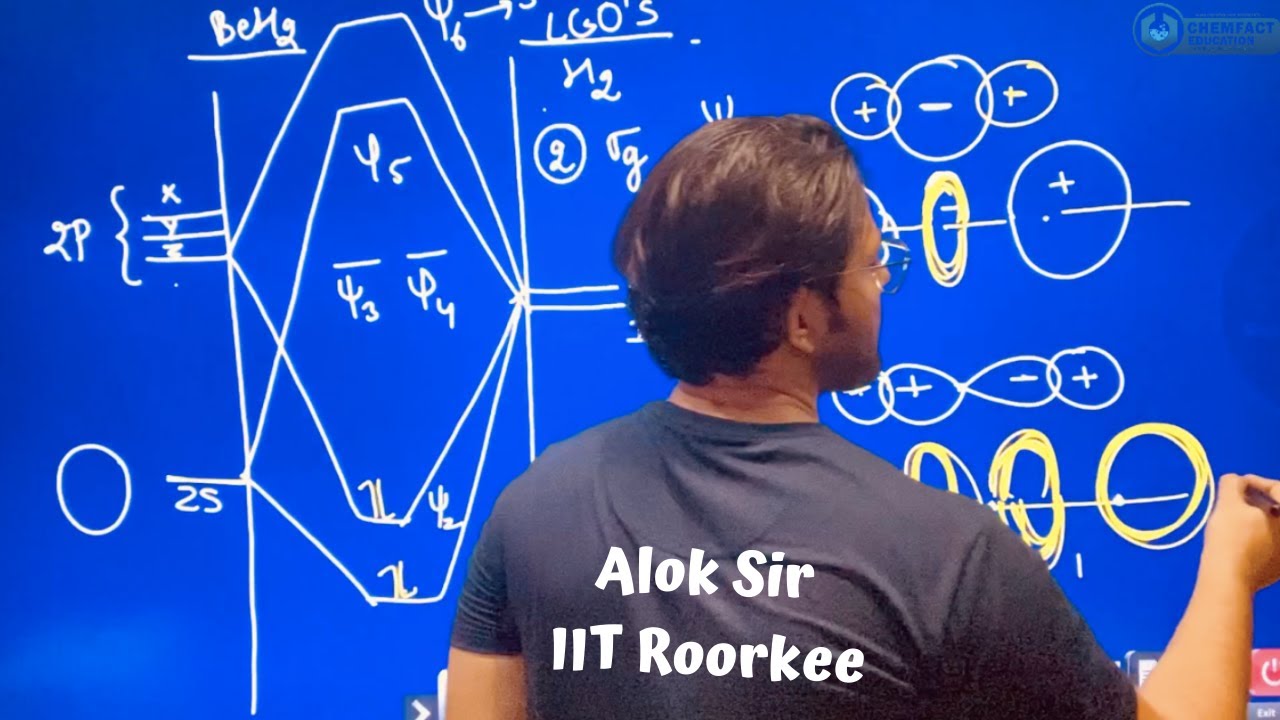
Brief Summary
This lecture focuses on creating molecular orbital (MO) diagrams for polyatomic molecules, emphasizing the importance of understanding the role of central atoms and ligands. Key takeaways include:
- The central atom's atomic orbitals are positioned on one side of the MO diagram, and the ligand group orbitals (LGOs) from side atoms are on the other side.
- The combination of atomic orbitals from the side atoms must allow compatibility for overlapping with the central atom's orbitals.
Introduction to Molecular Orbital Diagrams
The lecture begins by presenting the basics needed to create an MO diagram for polyatomic molecules, focusing on those with three or more atoms, such as BeH2 and H2O. The central atom's role is emphasized, with a reminder of the differences when transitioning from diatomic to polyatomic cases.
Central Atom and Its Orbitals
In this section, the central atom in a triatomic molecule is introduced. For compounds like BeH2, the atomic orbitals of the central atom (beryllium) are highlighted. These include the 2s and 2p orbitals, which will form the basis of the MO diagram. Each p-orbital is shown to have equal energy and how they interact with other orbitals is discussed.
Understanding Ligand Group Orbitals
The lecture proceeds to explain the role of ligands. It introduces the concept of Ligand Group Orbitals (LGOs), which are formed from the atomic orbitals of side atoms in a polyatomic molecule. The combination of LGOs must be compatible in symmetry and energy with the central atom’s orbitals for effective overlap.
Formation of Ligand Group Orbitals
Two steps are outlined for creating an MO diagram: first, side atoms combine their atomic orbitals to form LGOs and, second, these LGOs interact with the atomic orbitals of the central atom. It emphasizes that the energy of LGOs is the same as the atomic orbitals of ligands.
Example: BeH2 Molecular Orbital Diagram
Using BeH2 as an example, the lecture details how to draw the MO diagram. It characterizes the interactions between beryllium’s 2s and 2p orbitals with the LGOs of two hydrogen atoms. The bonding and antibonding interactions arise from the overlaps of these orbitals, and the energy levels of molecular orbitals are defined clearly.
Bonding and Anti-bonding Interactions
The discussion includes characteristics of bonding (for example, σ bonds in BeH2) and the role of symmetry in defining molecular orbitals. The order of energy levels for each orbital is raised, highlighting how these interactions manifest in molecular shapes.
Conclusion and Future Directions
To conclude, the lecture reinforces the concepts learned and provides insight into future lessons regarding more complex polyatomic molecules. The importance of understanding molecular orbital theory, as well as its application to more complex molecules such as H2O and SF6, is stressed. The necessity of a deep dive into symmetry properties for advanced studies in molecular chemistry is highlighted.

